
RAG Security and Privacy: A Complete Guide to Building Compliant RAG Pipelines
Learn how to secure your RAG pipeline and maintain HIPAA and GDPR compliance by protecting sensitive data across third-party embedding and LLM APIs.


What Is RAG Security and Privacy?
RAG security and privacy refers to the set of risks that arise when a Retrieval-Augmented Generation pipeline ingests, transmits, or exposes sensitive data, and the technical controls organizations use to prevent that exposure. When a RAG pipeline uses hosted embedding or LLM APIs, source documents, queries, or retrieved context may cross an external service boundary, creating multiple points where PII, PHI, and confidential data can leak outside your environment.
RAG (Retrieval-Augmented Generation) has become one of the most widely used architectural patterns for grounding enterprise LLM applications. By grounding large language models in an external knowledge base, RAG dramatically improves accuracy, reduces hallucination, and makes it possible to build domain-specific AI tools without retraining the underlying model.
But RAG's greatest strength, its ability to ingest and retrieve your organization's real internal knowledge, is also its most significant privacy liability. Every document you add to your knowledge base, and every query your users submit, creates a potential exposure point. In regulated industries like healthcare, financial services, insurance, and pharma, that exposure is not a theoretical risk. It is a compliance problem that can trigger liability under HIPAA, GDPR, CPRA, and PIPEDA.
This guide covers the full RAG security and privacy risk surface: where data gets exposed, which frameworks apply, and how to implement de-identification controls at every stage of the pipeline without degrading retrieval or generation quality.
What is Retrieval-Augmented Generation (RAG)?
Large language models like OpenAI's GPT5 and Anthropic's Claude are remarkably capable, but they are not infallible. Sometimes they answer a question with precision; other times, they confidently generate plausible-sounding but entirely false statements, a phenomenon known as hallucination. They are also constrained by the knowledge they were trained on, which means they can struggle with recent events, proprietary information, or domain-specific details that were never part of their training data.
Retrieval-Augmented Generation (RAG) is an AI framework designed to solve exactly these problems. Rather than relying solely on the model's internal knowledge, RAG grounds the model on an external knowledge base, retrieving relevant documents at query time and feeding them into the model alongside the user's question. The result is a response that is more accurate, more current, and more traceable to a specific source.
The basic workflow for a RAG pipeline follows four steps. A user submits a query. The system searches a knowledge base and retrieves the most relevant document chunks. Those chunks, along with the original query, are passed to the LLM as a prompt. The LLM then generates a response informed by the retrieved context.
This structure offers substantial benefits. Accuracy improves because the model is working from real, retrieved information rather than relying on potentially outdated training data. Hallucination is reduced for the same reason. Context awareness increases because domain-specific material can be embedded in the knowledge base and retrieved on demand. The system is also scalable, since new knowledge sources can be added without retraining the model. And because you can trace which documents informed a given response, interpretability improves as well.
RAG has become the standard architecture for enterprise AI applications built on sensitive internal data. But that's precisely where the privacy problem begins.
Where Are the Privacy Risks in a RAG Pipeline?
Building a RAG pipeline over your organization's internal documents, customer records, or operational data means moving that data through a series of third-party services. That introduces two distinct and serious privacy risks.
Risk 1: Source Data Shared with Embedding Providers
To build the knowledge base, your documents must first be chunked into smaller segments, then converted into vector embeddings using an embedding model. In most production deployments, that embedding model is provided by a third party such as OpenAI or Cohere. This means the raw text of your documents, potentially including employee names, salaries, Social Security numbers, client PII, proprietary specifications, or confidential project details, is transmitted to an external API provider.
User queries present the same risk. Because query vectors must be compared against document vectors to retrieve relevant chunks, the query itself must also be sent to the embedding provider. If a user includes a patient name, an account number, or any other sensitive identifier in their question, that information leaves your environment the moment it is embedded.
Risk 2: Prompt Data Sent to LLM Providers
The second risk occurs at the generation stage. Once relevant document chunks have been retrieved, they are combined with the user query into a prompt that is sent to the LLM. If you are using a hosted LLM API, that entire prompt, including every retrieved document chunk and the full user query, is transmitted to the LLM provider. This is not a theoretical risk. It is a structural feature of how hosted LLM APIs work, and it means that any sensitive data present in your source documents or in user queries is exposed every time the pipeline runs.
For organizations in healthcare, financial services, pharma and life sciences, insurance, or contact centers, this is not a minor compliance footnote. Depending on your jurisdiction and industry, transmitting unredacted sensitive data to third-party model providers may create liability under HIPAA, GDPR, PIPEDA, or other privacy frameworks.
RAG Privacy Risk Summary
| Risk Vector | What Gets Exposed | Applicable Framework | Mitigation |
|---|---|---|---|
| Source document embedding | Raw document text sent to embedding API | GDPR, HIPAA, CCPA | Redact documents before embedding |
| User query embedding | Query text (may contain PII) sent to embedding API | GDPR, HIPAA, CCPA | Redact queries before embedding |
| LLM prompt transmission | Retrieved chunks + query sent to LLM API | GDPR, HIPAA, CCPA, PIPEDA | Pseudonymize prompt; re-identify output |
| Vector store data leakage | Embeddings can leak sensitive values under attack | GDPR Article 32 | Redact source docs before generating embeddings |
| Internal access control gaps | Unauthorized users retrieve sensitive document chunks | HIPAA minimum necessary, GDPR | Implement role-based vector store access |
For a deeper look at how these obligations are assessed in practice, see our guides on the HIPAA minimum necessary standard and GDPR requirements for AI data processing.
Your PII detection has gaps. Here's the data to prove it.
Benchmark report, enterprise case study, and a 15-point production-readiness checklist — free for engineering teams evaluating PII detection.
Which Compliance Frameworks Apply to RAG Pipelines?
The compliance exposure in a RAG pipeline depends on the type of data your knowledge base contains and the jurisdictions your organization operates in. The following frameworks are most directly relevant to organizations building RAG applications over sensitive internal data.
| Framework | When It Applies to RAG | Key Requirement |
|---|---|---|
| HIPAA | RAG knowledge base includes clinical notes, EHR data, patient communications, or any PHI | Minimum necessary standard: only the PHI required for a given purpose may be used or transmitted. Third-party LLM/embedding providers must be HIPAA Business Associates or data must be de-identified before transmission. |
| GDPR | Knowledge base contains personal data from EU residents; LLM or embedding provider processes data outside the EU | Article 28 (data processor agreements), Article 32 (technical security measures), Article 44 (cross-border data transfers). Transmission to a US-based API provider without adequate safeguards can constitute an unlawful transfer. |
| CPRA / CCPA | Knowledge base includes personal information of California residents; organization meets CCPA applicability thresholds | CCPA purpose limitation and data minimization apply to covered processing. Certain uses of personal information to train ADMT or biometric/identity technologies can also trigger risk-assessment requirements under California's 2025 regulations. |
| PIPEDA | Knowledge base includes personal information of individuals in Canada, collected in the course of commercial activity across provincial or national borders. Alberta and BC PIPA may displace PIPEDA intra-provincially. | PIPEDA generally requires meaningful consent for collection, use and disclosure of personal information unless an exception applies, alongside appropriate-purpose, minimization and safeguard obligations. |
| Law 25 | Enterprise operates in Québec, or knowledge base holds personal information of Québec residents | Law 25 requires PIAs for certain technology projects involving personal information, including projects to acquire, develop or overhaul an information system or electronic service. |
Anonymized data: Under the GDPR, information that has been rendered anonymous so that an individual is no longer identifiable falls outside the scope of the Regulation. Pseudonymized data remains personal data. Under Québec Law 25, information that meets the statutory standard for anonymization ceases to be personal information, although the anonymization process and criteria are themselves regulated. De-identified information that could still permit indirect identification remains subject to Law 25.
For more detail on how these frameworks apply to AI systems, see our guides on HIPAA de-identification methods, the GDPR and LLM lifecycle, and Quebec Law 25 and AI.
Two Approaches to Privacy-Safe RAG
The good news is that both risk vectors have practical solutions. Limina's data de-identification platform supports both approaches, and they can be used independently or in combination depending on your pipeline architecture.
Approach 1: Prompt-Only Privacy
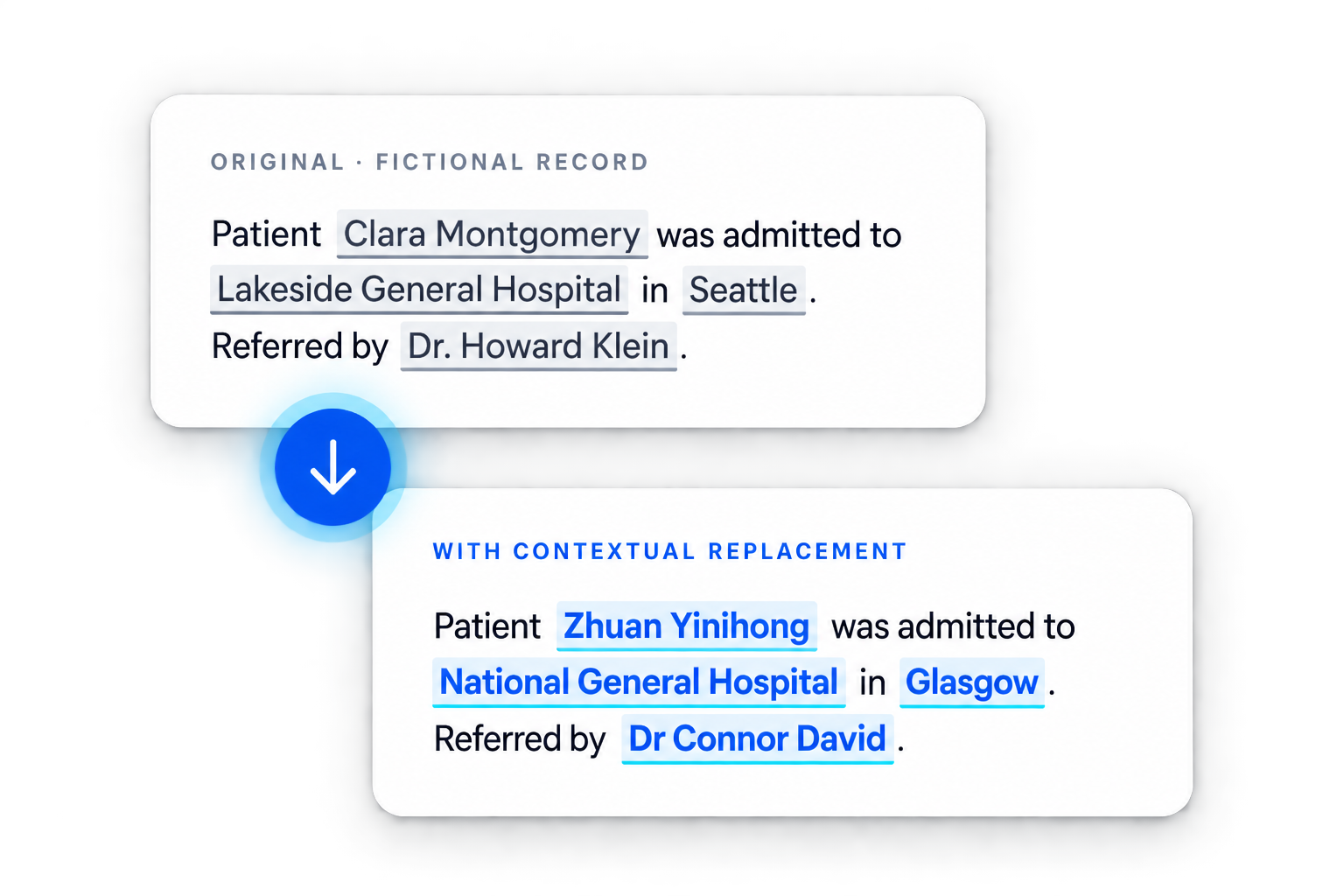
The first approach focuses on the prompt that is sent to the LLM. Before the query and retrieved document chunks are passed to the model, Limina's API is called to pseudonymize the content. Sensitive entities, names, organizations, dates, identifiers, and other PII, are detected and replaced with consistent placeholder labels. The LLM then generates a response based on the de-identified prompt, and no sensitive information is transmitted to the model provider.
This approach is performed online, in real time, because the specific content of the prompt cannot be known in advance. It is the right choice when your primary concern is protecting data at the LLM API boundary, particularly when using providers such as OpenAI or Anthropic for generation.
One consideration worth addressing: when the LLM generates a response against de-identified content, the output will contain placeholder labels rather than the original entity values. A response that references [ORGANIZATION_4] instead of a real company name is not useful to an end user. This is where re-identification comes in.
Re-Identifying the Response
Limina supports a re-identification step that takes the LLM's de-identified output and restores the original entity values in context. The result is a complete, informative answer that the user can actually act on, while the underlying model provider never saw the sensitive data at all. For more detail on this pattern, Limina provides a worked example covering confidential financial data redaction for LLMs.
Approach 2: Source Document Privacy
The second approach addresses the earlier stage of the pipeline, specifically the process of chunking and embedding your source documents. Here, Limina's API is applied to the document chunks before they are sent to the embedding provider. Sensitive entities are redacted from the source text before it leaves your environment.
If the indexed documents replace sensitive entities with pseudonyms or placeholders, applying a compatible transformation to queries can preserve entity-level matching and avoid sending raw identifiers to the embedding provider. This ensures that entity labels align between query vectors and document vectors, preserving retrieval quality without exposing the raw entity values to the embedding provider.
This approach can be executed in offline batch mode, since the source documents are often available before the pipeline is in production. It is the right choice when your primary concern is protecting data at the embedding API boundary.
Comparing the Two Approaches
The two methods are complementary. Prompt-only privacy protects data at the LLM stage and is inherently an online, real-time operation. Source document privacy protects data at the embedding stage and can be handled as a batch process before deployment. Which approach to prioritize, or whether to implement both, depends on which third-party services you are using and where your data is most exposed.
| Prompt-Only Privacy | Source Document Privacy | Combined Approach | |
|---|---|---|---|
| Protects data at | LLM API boundary | Embedding API boundary | Both boundaries |
| When it runs | Online / real-time | Offline batch + online queries | Both |
| Re-identification needed? | Yes: restores entity values in output | No: output uses redacted labels | Yes |
| Best for | Hosted LLM providers (OpenAI, Anthropic) | Hosted embedding providers (OpenAI, Cohere) | Maximum compliance coverage |
| Compliance coverage | LLM data transmission | Embedding data transmission | Full pipeline coverage |
If your organization wants to eliminate both risk vectors simultaneously, the approaches stack cleanly. Source documents are redacted before embedding. Queries are redacted before both embedding and LLM generation. Responses are re-identified before being returned to the user. The result is an end-to-end private RAG pipeline.
The same logic extends beyond text documents. Many enterprise knowledge bases include audio-derived content, and Limina applies the same entity detection to PII redaction from call transcripts and audio. At the volumes a production RAG pipeline handles, the tradeoffs between manual vs automated PII redaction effectively resolve themselves.
Understanding First-Party Data Risk in RAG
Beyond the third-party transmission risks described above, RAG pipelines also introduce a subtler but equally important category of risk: first-party data exposure. This refers to the risk that arises not from sending data outside your organization, but from how data circulates internally within your RAG system.
First-party data collected directly from customers, users, and employees can take many forms: PII such as names, addresses, phone numbers, and email addresses; behavioral data like browsing history and purchase records; device and location data; and sensitive categories like health information, financial records, or political affiliations. These unstructured data privacy risks live in emails, PDFs, chat logs, and the other formats a knowledge base typically ingests.
Two specific risks are particularly relevant in a RAG context.
The first is unintended data sharing. A RAG pipeline built over company-wide internal documents may allow an engineer to inadvertently query documents containing HR data, such as employee salaries, Social Security numbers, or performance reviews, simply because those documents were included in the knowledge base. Role-based access controls on the vector store are one mitigation strategy: by ensuring that certain document categories are only retrievable for queries made by users with the appropriate permissions, you reduce the risk that sensitive information reaches people who should not have access to it.
The second is insufficient data anonymization. If document chunks are embedded without proper de-identification, the embeddings themselves can leak sensitive information. Research has demonstrated that embeddings are not opaque: under certain conditions, sensitive values can be recovered from vector representations. Redacting the source documents before embedding is the most reliable protection against this risk.
These are not edge cases or theoretical concerns. They are systemic risks that any organization building a RAG application over internal data needs to plan for explicitly.
A practical mitigation that addresses both risks simultaneously is to de-identify source documents before they are chunked and embedded. This approach means the vector store itself contains no raw PII, so even if an unauthorized user queries the system, or an attacker probes the vector representations, the underlying sensitive values are not present to be exposed. For organizations in healthcare or financial services, this is the architecture most likely to satisfy a regulator asking how you ensured data minimization in your AI pipeline.
Building Privacy Into RAG From the Start
The organizations that end up with the most defensible AI infrastructure are the ones that treat privacy as an architectural requirement rather than a compliance checkbox. RAG is a powerful capability, but its power comes directly from the fact that it ingests and transmits your most sensitive internal knowledge. That is exactly why privacy controls need to be built into the pipeline from day one, not retrofitted after a breach or a regulatory inquiry.
Limina's data de-identification platform is purpose-built to address exactly this problem. Built by linguists, the platform understands language context and entity relationships within documents, which means it can accurately detect and pseudonymize sensitive information even in complex, unstructured text.
If your team is building or evaluating a RAG application that touches documents containing sensitive information, the question is not whether you need de-identification controls. The question is where in the pipeline to apply them, and how to do so without degrading retrieval or generation quality. Limina's data de-identification platform is purpose-built for exactly this problem: it supports both prompt-level and source-document-level redaction, maintains entity consistency for retrieval accuracy, handles re-identification so outputs remain useful to end users, and deploys entirely within your VPC so your data never leaves your environment. To see how Limina handles RAG privacy in practice, connect with the team.
Frequently Asked Questions: RAG Security and Privacy
Does HIPAA apply to RAG pipelines that process clinical data?
Yes. If a RAG pipeline processes protected health information (PHI) on behalf of a HIPAA-covered entity or business associate, HIPAA applies to that processing. Any third-party embedding or LLM provider that receives PHI will generally need to operate as a HIPAA business associate under an appropriate Business Associate Agreement, unless the data has first been de-identified in accordance with HIPAA or another exception applies. Where the HIPAA minimum necessary standard applies, organizations should also limit the PHI used or disclosed to what is reasonably necessary for the intended purpose.
Can GDPR personal data be used in a RAG knowledge base?
Personal data can be used in a RAG knowledge base, but the processing must comply with the GDPR. That includes having a lawful basis, limiting the data to what is necessary for the intended purpose, applying appropriate security measures, and meeting any applicable requirements for processors and international data transfers. If personal data is pseudonymized before being sent to an embedding or LLM provider, it generally remains personal data under the GDPR. Only data that has been rendered truly anonymous so that individuals are no longer identifiable falls outside the GDPR.
What is the difference between RAG redaction at the prompt level vs the embedding level?
Prompt-level redaction applies de-identification to the query and retrieved document chunks immediately before they are sent to the LLM API. It operates in real time and is the right control when your primary concern is what reaches your language model provider. Embedding-level redaction applies de-identification to source documents before they are chunked and converted to vector embeddings, protecting data at the embedding API boundary and ensuring the vector store itself contains no raw sensitive values. The two approaches address different risk vectors and can be combined for full pipeline coverage.
Do vector embeddings expose sensitive data?
Research has demonstrated that under certain conditions, sensitive values can be recovered from vector representations through adversarial probing. This means a vector store built on unredacted documents is not inherently private, even though the embeddings are not human-readable. For regulated data, including PHI, PII, and financial records, the safest assumption is that embeddings built on raw sensitive text carry residual exposure risk. Redacting source documents before embedding is the most reliable protection against this risk.
How does de-identification affect RAG retrieval quality?
When done correctly, de-identification has minimal impact on retrieval quality. The key is consistency: if source documents are redacted using standardized entity labels (for example, replacing all instances of a patient name with the same placeholder across every document), then query vectors built using the same redaction logic will align correctly with the document vectors at retrieval time. Limina's pseudonymization approach maintains entity consistency within and across documents, preserving the semantic relationships that retrieval depends on.
What types of data are most commonly exposed in enterprise RAG pipelines?
In healthcare RAG applications, PHI in clinical notes, discharge summaries, and provider communications is the most common exposure. In financial services, account numbers, transaction records, and customer PII in support communications are the primary risk. In any organization, internal documents such as HR records, legal contracts, board communications, and employee data can be inadvertently included in a knowledge base that was intended for a narrower purpose. Role-based access controls on the vector store, combined with source document de-identification, are the two most effective controls for limiting this exposure.
Wrap Up
RAG is one of the most effective techniques available for building LLM applications that are accurate, current, and domain-specific. But the same feature that makes it powerful, the ingestion of your organization's real knowledge into an AI pipeline, is the source of its most significant privacy risks.
In this guide, we covered what RAG is and why it has become the dominant architecture for enterprise AI applications. We identified the two primary privacy risk vectors: sending source document data to third-party embedding providers, and sending query and retrieved document data to third-party LLM providers. We described two complementary approaches to mitigating these risks through de-identification at the source document level and the prompt level, including the re-identification step that preserves the usability of the final output. And we addressed the first-party data risks that arise from how data circulates within the RAG system itself.
The goal is not to choose between useful RAG and privacy. It is to remove or transform the sensitive information the application does not need while preserving the context it does. Reach out to Limina to get started.
Related Articles


Test It on Your Own Data.
Free API key, no credit card. Enough calls to see what your current tool is missing.