AI, data privacy, and regulation, minus the noise.Get the insights that matter, straight from Limina.
Generative AI introduces failure modes traditional healthcare software never had to deal with: memorization, prompt injection, and confident hallucination. This guide covers the current BAA landscape across major AI vendors, three deployment patterns that work at enterprise scale, and what a real generative AI compliance policy needs to cover.
FDA has been issuing AI and machine learning guidance since 2021, and the regulatory framework keeps expanding every single year. This guide walks through the FDA’s guidance timeline, what the agency requires for AI-based medical devices, its data quality expectations, and exactly where FDA requirements intersect with HIPAA for training data.
Ambient AI scribes capture far more PHI than the note that eventually lands in the chart, including raw audio and every single draft before a clinician actually signs off on it. This guide covers what counts as PHI in clinical documentation, where the real risk sits, what to check in a vendor’s BAA, and best practices for a compliant rollout.
Training an AI model on clinical data without de-identifying it first creates a HIPAA problem that can outlive the model itself for years. This guide covers what HIPAA requires before using clinical data for training, Safe Harbor versus Expert Determination, and the technical details that separate a compliant training corpus from a leaky one.
Pasting patient data into a browser-based LLM bypasses every HIPAA safeguard, simply because that default path usually has no BAA behind it at all. This guide walks through three compliant architectures for using large language models in healthcare, what to check in a vendor agreement, and how de-identification sidesteps the compliance question.
HIPAA does not have a separate rulebook for artificial intelligence, but AI tools create new ways to violate it anyway. This guide covers what HIPAA actually requires of AI systems, the four points where PHI exposure happens, what to check in a vendor’s BAA, and why architecture choice matters more than most compliance teams realize today.
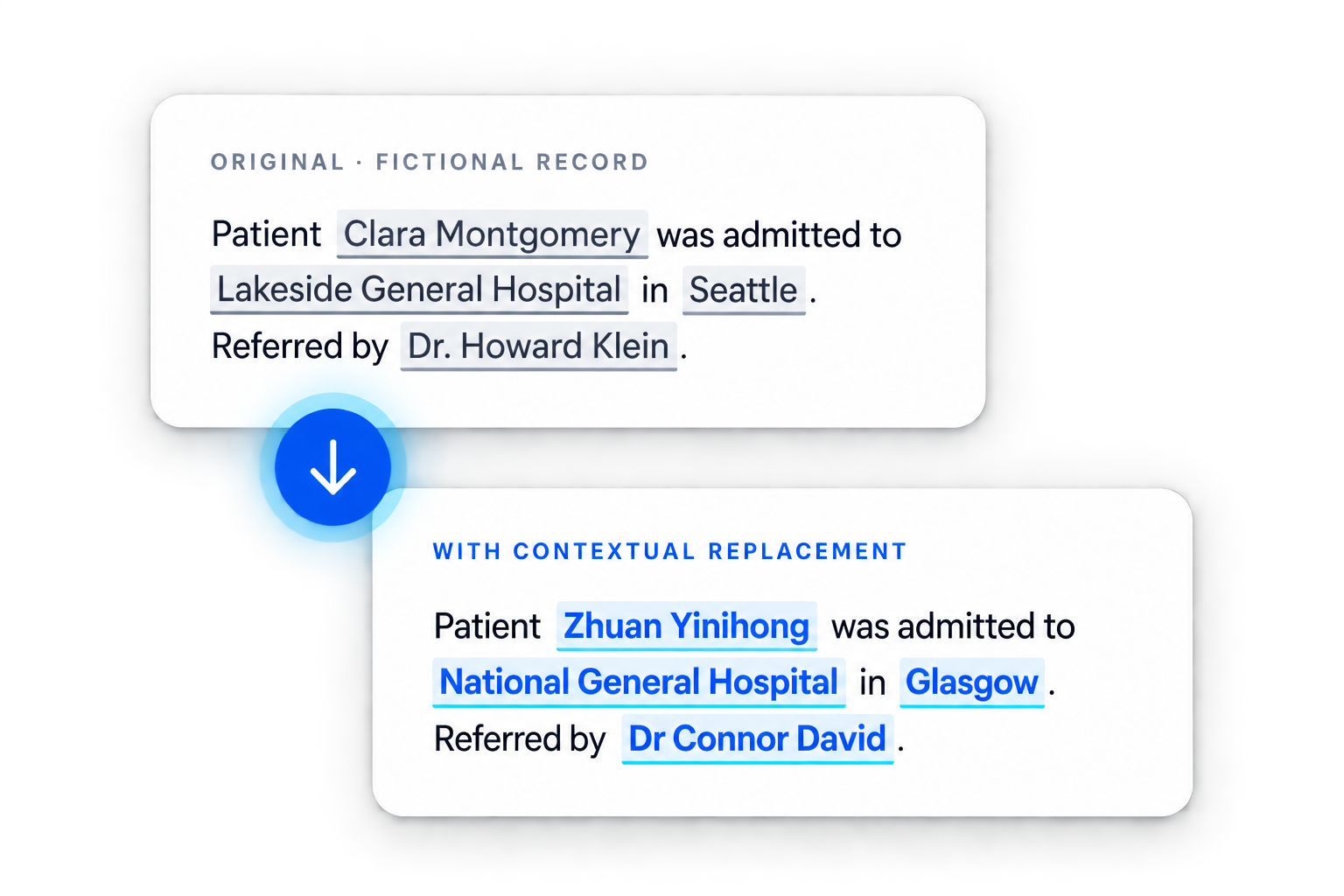
Redaction protects identity by destroying information. Limina's new Contextual Replacement capability takes a different approach, replacing sensitive identifiers with contextually accurate synthetic values so your data stays useful for research, collaboration and AI training.
New hybrid capability in release 4.5 replaces sensitive identifiers with contextually accurate synthetic values, keeping de-identified data useful for research, collaboration and AI training
Call transcripts and chat logs contain buried PII, PHI, and PCI data that rules-based tools miss. Learn how automated NLP redaction cleans conversational text, aligns audio timestamps, and ensures compliance with PCI DSS, HIPAA, and GDPR.
Training enterprise AI on raw text risks model memorization and PII extraction. Since unlearning weights is nearly impossible, pre-ingestion de-identification protects privacy, satisfies GDPR and HIPAA, and preserves key model utility.
PDFs often hide PII under black boxes, metadata, form fields, and scanned pages. Drawing boxes doesn't remove data. Learn how true automated PDF redaction strips hidden text, cleans layers, and ensures full HIPAA, GDPR, and CCPA compliance.
Emails represent the largest unstructured PII risk for enterprises, hiding data in bodies, headers, and attachments. Discover how automated NLP detection and redaction work at archive scale to ensure GDPR compliance and secure AI pipelines.
Unstructured PHI lives in clinical notes, emails, and recordings outside your EHR controls. Learn how natural language processing reliably detects and de-identifies protected health information across narrative text to ensure HIPAA compliance.
Unstructured data lacks a predefined schema, making sensitive PII and PHI hiding in emails, PDFs, and audio recordings hard to detect. Regulators treat this data like database records. Learn the key compliance risks and how to protect your files.
Training healthcare LLMs requires HIPAA-compliant de-identification of clinical narrative text to prevent data leaks. Pre-ingestion de-identification ensures compliance, satisfies FDA or IRB reviews, and prevents the model from memorizing PHI.