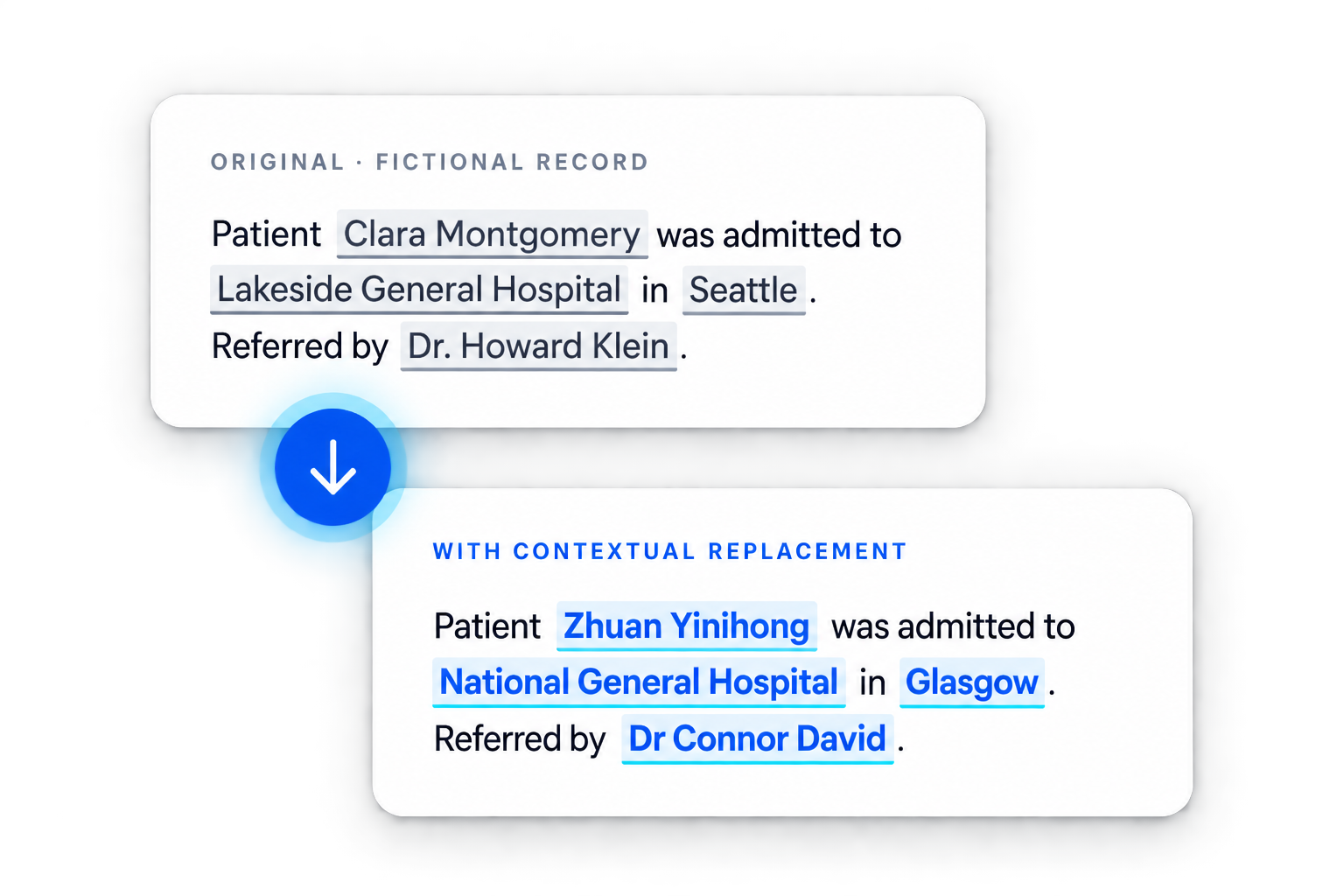
Call transcript PII redaction is the automated detection and removal of personally identifiable information (PII)—names, account numbers, government identifiers, payment card details and health information—from the text and audio records that customer conversations generate. In a contact center, every interaction produces one of these records, and almost all of them are retained.
A customer calls an insurer to open a claim. She verifies her identity with a date of birth and the last four digits of her Social Security number, describes a back injury and the medication she's taking, then reads a payment card number aloud to cover her deductible. The call is recorded, transcribed by a speech vendor, stored for seven years, sampled by an outsourced review team and exported to train an agent-assist model. One eight-minute conversation, four frameworks in scope, five systems holding a copy.
Definition: chat log and transcript privacy Chat log and transcript privacy covers the controls applied to the conversational records that contact centers, support desks and messaging channels produce—call recordings, speech-to-text transcripts, live chat sessions and messaging threads. Because customers volunteer sensitive information conversationally rather than in structured fields, identifiers can appear anywhere in the record and must be located by content analysis.
If you're someone who deals with call recordings or chat transcripts, chat log privacy is already your problem. This article covers what's in your transcripts, which rules apply and how call transcript PII redaction works.
What sensitive data lives in call transcripts and chat logs
Conversations are unstructured by nature. A customer doesn't fill in a labeled field—they say whatever's needed to get the problem solved, which usually means more than the process requires.
| Industry |
Typical conversation |
Sensitive data commonly captured |
| Insurance |
Claim intake and status calls |
Name, date of birth, policy and claim numbers, injury and diagnosis detail, payment card data |
| Banking |
Fraud, disputes and account servicing |
Account and card numbers, government identifiers, balances, security question answers |
| Healthcare |
Appointment scheduling and triage |
Patient name, date of birth, medical record number, symptoms, medications, provider names |
| Telecommunications |
Billing and technical support |
Account numbers, addresses, device identifiers, payment details |
| Retail and e-commerce |
Order and returns support |
Name, delivery address, order and payment references |
Three categories recur across all of them—personally identifiable information (PII), protected health information (PHI) and payment card industry (PCI) data—and the boundaries between them matter because each triggers a different framework.
Personal data appears in nearly every interaction: names, addresses, phone numbers, dates of birth, account references.
Payment card data appears whenever a customer pays or verifies a card during a conversation. Agents ask; customers read the number aloud or type it into a chat window.
Health information appears more often than non-healthcare organizations expect. An insurance claim call describing an injury, a leave-of-absence conversation with a benefits administrator or a pharmacy delivery query all capture health detail. Whether it constitutes PHI depends on whether the organization is a covered entity or business associate. Insurers in particular sit across several regimes at once, as this look at insurance privacy compliance shows.
Regulatory requirements for transcript and recording data
Four regimes commonly apply to the same recording, which is why contact center compliance is more complicated than it first appears.
Payment Card Industry Data Security Standard (PCI DSS). Sensitive authentication data must not be stored after authorization, even if encrypted. The PCI Security Standards Council states that this restriction applies even in environments with no primary account number present. A recording in which a customer reads out a card verification code is storage of sensitive authentication data. So is the transcript. Retaining that recording for quality assurance does not create an exception, and the primary account number itself must be rendered unreadable wherever it is stored, including in logs.
Health Insurance Portability and Accountability Act (HIPAA). The Privacy Rule protects individually identifiable health information regardless of the form or medium in which it's held (45 CFR §160.103), so a recorded call or its transcript is covered on the same terms as a chart note. De-identification follows one of the two HHS-recognized methods at 45 CFR §164.514: Safe Harbor removal of 18 identifier categories, or documented Expert Determination.
General Data Protection Regulation (GDPR) and California Consumer Privacy Act (CCPA). Recordings and transcripts are personal data, so lawful basis, data minimization, storage limitation and subject rights all apply. The right to erasure under Article 17 obliges controllers to erase personal data without undue delay where specified grounds apply, and California's right to delete at Civil Code §1798.105 creates a parallel obligation.
Biometric privacy laws. Voice adds a category most text channels don't have. Under the Illinois Biometric Information Privacy Act, a voiceprint is a biometric identifier (740 ILCS 14/10), and private entities have notice, consent, retention schedule and destruction obligations for biometric identifiers they possess (740 ILCS 14/15). Voice authentication and speaker recognition programs sit squarely in this territory, and the Illinois statute includes a private right of action (740 ILCS 14/20). Illinois is the strictest, but not the only one: Texas regulates biometric identifiers under its Capture or Use of Biometric Identifier Act and Washington under RCW 19.375, both enforced by the state attorney general.
A redacted transcript beside an unredacted recording protects nothing.
See how Limina redacts audio and transcript together in real time, so card data never reaches storage in the first place.
Request a Demo
| Framework |
What it reaches in conversational data |
Core obligation |
| PCI DSS |
Card numbers and verification codes spoken or typed during an interaction |
Sensitive authentication data is not retained after authorization; the primary account number is unreadable wherever stored |
| HIPAA |
Health information in recordings, transcripts and chat sessions held by a covered entity or business associate |
De-identify by Safe Harbor or Expert Determination before secondary use |
| GDPR and CCPA |
Recordings and transcripts as personal data |
Lawful basis, minimization, storage limitation and executable deletion |
| Biometric privacy laws |
Voiceprints created for identification or authentication |
Notice, consent, published retention schedule and destruction |
The recurring theme is that retention policy alone won't resolve these. Remove the sensitive value from the record and most of the obligations attached to it fall away with it.
The speech recognition challenge
Automatic speech recognition (ASR) output does not look like written text, and that difference defeats rule-based redaction in ways that aren't obvious until you inspect real transcripts.
Numbers are spelled out. A card number becomes "four one one one, um, four one one one" rather than a 16-digit string. A regular expression looking for card patterns matches nothing.
Punctuation and casing are unreliable. Many engines produce lowercase, sparsely punctuated text. Rules that depend on capitalization to identify proper nouns lose their primary signal.
Names are misrecognized. "Ms. Nguyen" may be transcribed as "miss when." The identifier is still present and still recognizable to a human reader, but no dictionary lookup will match it.
Disfluencies interrupt entities. Real speech contains restarts, corrections and filler: "my account is nine three—sorry, nine four seven two." The entity spans a correction, so pattern matching captures a fragment or nothing.
Turn boundaries split information. The agent asks for a date of birth in one turn; the customer answers in the next. The answer, in isolation, is just three numbers.
Transcript redaction therefore requires models that read context and handle spoken-language forms, not pattern libraries built for written text—the same argument that applies across formats in manual vs automated PII redaction, sharpened by the additional noise that speech introduces.
Limina redacts PII from call transcripts and chat logs in real time—book a demo.
Use cases that require call transcript PII redaction
As with email archives, most organizations act because a specific initiative forces the question rather than as general hygiene. Five recur.
- Quality assurance and speech analytics. Review teams, often outsourced, read and listen to customer conversations. Redaction lets the program run without widening access to identifiers, and it's usually the fastest path through a vendor risk review.
- AI training and agent assist. Fine-tuning on support conversations is one of the highest-value applications of contact center data and one of the highest-risk, since raw transcripts carry every identifier into the model.
- Long-term archiving. Retention rules often require keeping the record for years. De-identifying the retained copy satisfies that obligation while removing most of the ongoing exposure.
- Litigation holds and disputes. Producing conversation records to external parties requires protecting third-party personal data inside them.
- Vendor and platform migration. Moving transcripts between platforms, vendors or cloud regions puts identifiers in transit and into new jurisdictions.
How automated transcript redaction works
Call transcript PII redaction happens at three different points in the conversation lifecycle, and most contact centers need more than one.
| Approach |
When it runs |
What it protects |
Main limitation |
| Post-hoc transcript redaction |
After the call, on ASR output |
The transcript and any analytics corpus derived from it |
Leaves the source recording untouched |
| Post-hoc audio redaction |
After the call, using transcript timestamps |
The recording itself, muted or overwritten at detected segments |
Depends entirely on detection accuracy in the transcript |
| Real-time redaction |
On the live stream, before storage |
Sensitive values never reach storage, agent screens or downstream systems |
Requires integration at the platform layer |
Post-hoc transcript work is the workhorse for archives and analytics corpora: natural language processing detects entities in the ASR output, then redacts, replaces or tokenizes per policy. Real-time redaction is the only approach that fully addresses the PCI restriction on retaining sensitive authentication data, because prevention beats remediation when storage is prohibited outright.
A complete call transcript PII redaction pipeline covers both modalities:
- Transcribe audio, or ingest the chat transcript directly
- Detect entities in context across both agent and customer turns
- Map detections back to audio timestamps where a recording exists
- Apply the transformation policy per entity type
- Redact the audio segments and the transcript together
- Log detections, transformations and policy version for audit
Preserve conversation structure throughout. Analytics depends on turn boundaries, sentiment, timing and call reason, and redaction that flattens the dialogue destroys the value the transcripts were kept for, as the foundations of PII redaction for call transcripts and audio set out.
Contact center compliance usually comes apart at the handoffs, not inside any single platform. Test your call transcript PII redaction design against one recorded interaction end to end.
- Card data never reaches storage. Real-time redaction or pause-and-resume covers the authorization moment, and no post-call process is relied on to catch it.
- Audio and transcript are treated together. A redacted transcript beside an unredacted recording protects nothing.
- Both sides of the conversation are processed. Agents restate customer details, so agent turns carry identifiers too.
- Downstream copies are covered. Analytics platforms, quality tools, vendor exports and backups each hold a copy that inherits the obligation.
- Voice biometrics are separately assessed. If any process creates a voiceprint, biometric consent and retention rules apply on top of everything else.
- Deletion is executable. You can locate and remove one customer's data across years of audio within your regulatory deadline.
How Limina handles call transcripts and chat logs
Conversational data is the hardest input to work with, because the text is noisy before detection even starts. Spoken digits, missing punctuation, misrecognized names and corrections mid-utterance all defeat pattern matching, and the recording has to be treated alongside the transcript or the exercise is cosmetic.
Limina approaches call transcript PII redaction across six capabilities:
- Contextual entity detection on ASR output rather than pattern matching
- Timestamp mapping so the recording and the transcript are redacted together
- Real-time processing for live chat and streaming voice
- More than 50 entity types across 52 languages
- API and pipeline integration into an existing contact center as a service (CCaaS) workflow
- Detection, transformation and policy version logged for audit
Language coverage matters for multilingual operations, since translating transcripts in order to redact them just creates another copy. Reported detection accuracy on real healthcare data is 99.5 percent or higher.
Next steps
Every customer conversation your organization records is an unstructured data problem with four regulators attached to it. Chat log privacy isn't solved by shorter retention or a stricter agent script—it's call transcript PII redaction that removes the sensitive values while keeping everything the business needs.
Walk through your transcript and recording estate across real-time and batch processing—book a demo. Once transcripts are clean, the next question is what happens when that data reaches a model, which is covered in unstructured data in AI training: why raw text is a compliance liability.