
Does De-identification Hurt AI Accuracy? The Research Says No
Discover why de-identified data actually enables AI model accuracy. Explore peer-reviewed research on MIMIC, GatorTron, and clinical NLP utility.


I occasionally hear this concern from healthcare and research leaders: "If we de-identify our data, won't we lose the signal that makes them useful for AI?" It's a fair question, and one that deserves a straight answer grounded in evidence.
The short answer is no. De-identified healthcare data do not compromise AI model accuracy. They enable it.
Consider MIT's MIMIC database, which contains de-identified records from approximately 60,000 ICU admissions. This single resource has become the foundation for thousands of AI models developed by researchers worldwide (Nature Scientific Data, 2016). A landmark study evaluating de-identification across 3,503 clinical notes from 22 different note types found that the impact on subsequent information extraction was "minimal." The automated de-identification systems performed indistinguishably from human annotators while preserving medication name extraction accuracy (Journal of the American Medical Informatics Association, 2013).
So why does this myth persist? In my experience, the issue is almost never de-identification itself. It's how de-identification gets implemented. Modern approaches preserve the clinical relationships, temporal patterns, and statistical distributions that researchers extract valuable information from and AI models actually learn from. Moreover, many of the misconceptions are based on applications built on structured data, not unstructured data where so much of the value of the data lives outside of the Personally Identifiable Information (PII).
To ensure your organization is maximizing both privacy and utility, you should explore how Limina’s data de-identification technology maintains high data fidelity while meeting stringent compliance standards.
What does the peer-reviewed research actually show about de-identified data and AI?
Clinical NLP models trained on de-identified text perform at state-of-the-art levels
GatorTron is a clinical language model trained on over 82 billion words of de-identified clinical text from the University of Florida Health system. The de-identification followed HIPAA Safe Harbor guidelines. The result? State-of-the-art performance on medical question answering, clinical concept extraction, and natural language inference, outperforming previous benchmarks by 9.5% on medical question answering and 9.6% on natural language inference tasks (Yang et al., 2022). Note that previous benchmarks include the use of ClinicalBERT, which in itself is trained on the de-identified MIMIC-III dataset. ClinicalBERT achieved 85.4% accuracy on MedNLI, focused on Natural Language Inference in the clinical domain, setting a new state-of-the-art benchmark at the time of publication (Alsentzer et al., 2019). The MIMIC-III corpus contains approximately 2 million clinical notes, all de-identified per HIPAA provisions. These results demonstrate that de-identified clinical texts retain the linguistic and medical information necessary for training high-performing NLP systems. In fact, they enable them, as these models would not be trainable without privacy-preserving access to data in the first place.
This finding is further supported by a direct comparison study evaluating deep learning and traditional models on 1,113 history of present illness emergency department provider notes to detect altered mental status, with a total of 1,795 PHI tokens replaced in the de-identification process across these notes. The deep learning models achieved 95% accuracy on both the original and de-identified versions of the notes (Stubbs et al., 2019).
Is De-identified Data Effective for Clinical Prediction Tasks?
The MIMIC database has become the standard benchmark for clinical prediction tasks. Researchers have built and validated machine learning models for in-hospital mortality prediction, physiologic decompensation detection, length-of-stay forecasting, and phenotype classification using this de-identified resource (Harutyunyan et al., Scientific Data, 2019). A systematic review found that over half of studies developing machine learning models for early sepsis prediction used MIMIC data (Frontiers in Medicine, 2021).
A 2022 study on Swedish clinical BERT models confirmed that "using an automatically de-identified corpus for domain adaptation does not negatively impact downstream performance" (LREC 2022). The researchers found that pseudonymization, which replaces identifiers with realistic surrogate values, produced the best results across six different NLP tasks (ICD-10 Classification, PHI NER, Clinical Entity NER, Factuality Classification, Factuality NER, and Adverse Drug Events Classification). A subsequent study reinforced these findings: across five clinical NLP tasks “[a] large number of statistical tests are performed, revealing minimal harm to performance when using pseudonymized fine-tuning data. The results also find no deterioration from end-to-end pseudonymization of pre-training and fine-tuning data.” (Vakili et al. 2024). Together, these studies demonstrate that privacy-preserving data transformations can be applied at every stage of the model training pipeline without sacrificing utility.
For organizations in highly regulated sectors, utilizing specialized solutions for financial services or healthcare data protection ensures that these transformations are handled with the precision required for AI success.
Why do some organizations still struggle with de-identification?
The misconception that de-identification destroys data utility often stems from poorly implemented systems rather than fundamental limitations of the approach.
Dr. Ann Cavoukian, former Information and Privacy Commissioner of Ontario, co-authored research demonstrating that "de-identification of personal data may be employed in a manner that simultaneously minimizes the risk of re-identification, while maintaining a high level of data quality" (Cavoukian & El Emam, 2011). The paper argues that de-identification "enables the shift from a zero-sum paradigm to a positive-sum paradigm," rejecting the outdated assumption that privacy and data utility are necessarily in conflict.
In my work with healthcare organizations, pharma companies, and AI teams, I've seen a few factors consistently determine whether de-identification preserves utility:
Entity detection accuracy matters.
Poor detection leads to either over-redaction (removing clinically relevant information) or under-redaction (leaving identifiers exposed). Neither outcome is acceptable. High-precision entity detection is the baseline requirement for maintaining the signal in the data.
Replacement strategy affects downstream tasks.
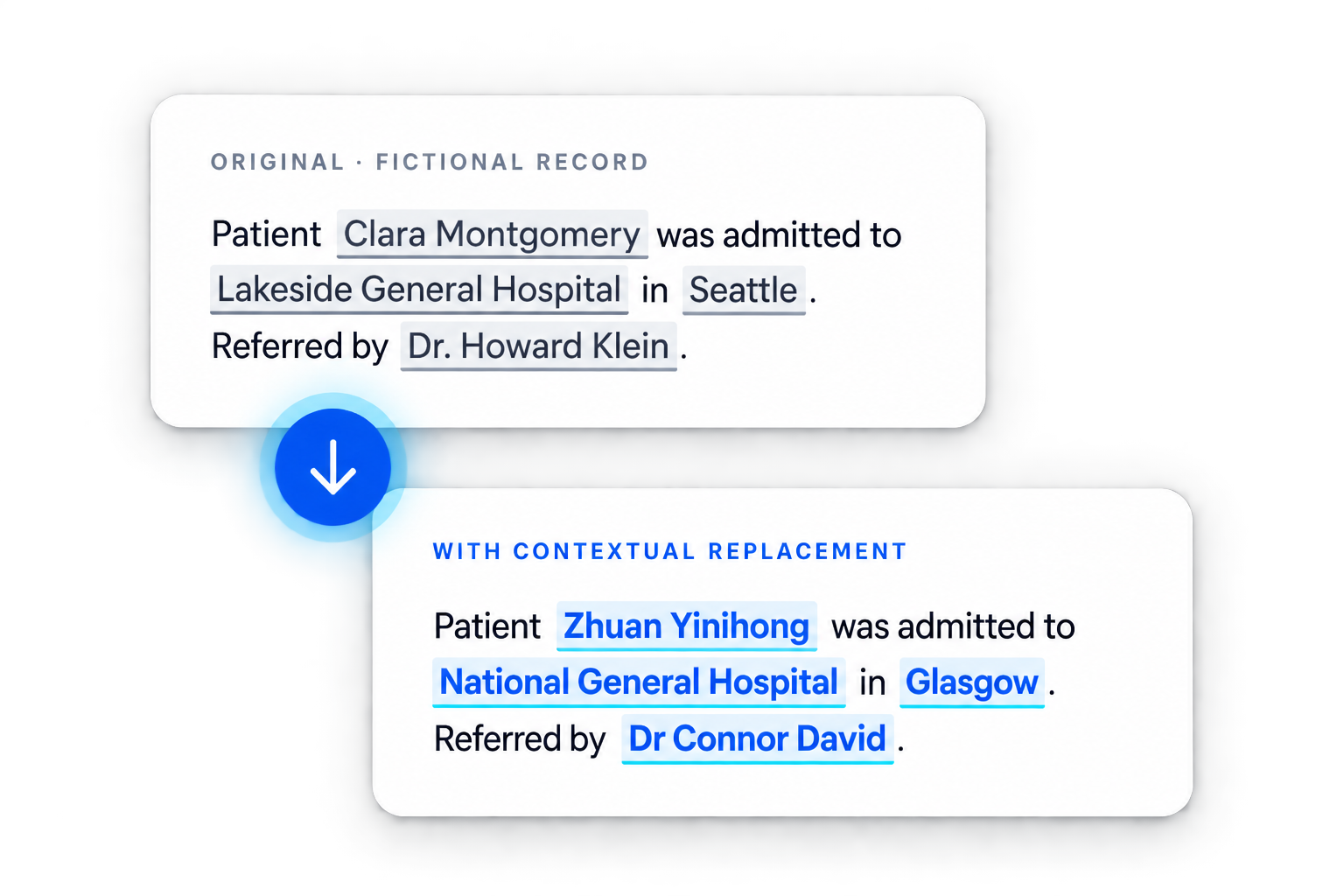
Synthetic PHI, which replaces identifiers with realistic surrogate values, preserves more utility than simple masking for many NLP applications. This "hidden-in-plain-sight" approach maintains the statistical properties and readability of the original text while enhancing privacy protection in case any identifiers were missed (Carrell et al., JAMIA, 2013).
Beyond simple replacement, effective de-identification requires sophisticated handling of temporal data:
- Date shifting that maintains relative relationships for longitudinal analyses;
- Date generalization or bucketing to reduce re-identification risk;
- Age and location generalization following HIPAA best practices.
When combined with synthetic PHI generation, these techniques provide comprehensive protection while preserving the data characteristics that downstream models depend on.
Context preservation requires specialized handling.
Clinical text contains implicit identifiers like rare diseases and unique treatment combinations that require sophisticated approaches beyond simple pattern matching. Automating this effectively requires integration with medical ontologies like SNOMED CT to identify hyperonyms (broader category terms) for rare conditions that may apply to a larger population, reducing re-identification risk to acceptable levels while maintaining clinical meaning.
Organizations that invest in high-quality de-identification infrastructure consistently report that their de-identified data support the same research and AI applications as the original records. Those using outdated or poorly configured systems often experience the data quality problems that fuel the myth.
If you are ready to update your de-identification infrastructure, contact the Limina team today to discuss your data privacy needs.
How should organizations approach de-identification for AI projects?
Based on the research evidence and what I've seen work in practice, here's how to think about de-identification for AI initiatives:
Match the de-identification method to the use case.
Different applications have different sensitivity to various types of information loss. NLP applications may be more sensitive to text alterations, while structured data analytics may tolerate more aggressive generalization. There's no one-size-fits-all approach. For example, pharma and life sciences data require a different preservation profile than contact center transcripts.
Invest in validation.
Measure the accuracy of the de-identification technology on your specific data and then the impact of de-identification on your specific downstream tasks. The research shows that well-implemented de-identification has minimal impact, but "well-implemented" requires verification for your particular context.
Consider the full data lifecycle.
De-identification is not a one-time event. As data flow through research pipelines, training processes, and model deployment, privacy protection must be maintained at each stage. This is especially true in complex sectors like insurance, where data touches multiple touchpoints.
Evaluate vendor solutions carefully.
Not all de-identification tools are equal. Look for solutions with experience handling clinical text, those which support your specific data types and languages, and those which offer deployment options that meet your security requirements.
Ready to unlock your healthcare data for AI while maintaining compliance? Let's talk about how we can support your research and AI initiatives.



Frequently Asked Questions
Does de-identification reduce the accuracy of AI models trained on healthcare data?
Peer-reviewed research consistently shows that properly implemented de-identification has minimal impact on AI model performance. A study across 3,503 clinical notes found the impact on information extraction was "minimal," with automated de-identification performing indistinguishably from human annotators. GatorTron, trained on 82 billion words of de-identified clinical text, outperformed previous models by 9-10% on multiple benchmarks. ClinicalBERT, trained on the de-identified MIMIC-III dataset, achieved state-of-the-art results on clinical natural language inference.
What is the best de-identification method for preserving data utility?
Research indicates that synthetic PHI (replacing identifiers with realistic surrogate values) preserves more utility than simple masking or removal. A Swedish clinical BERT study found pseudonymization produced the best results across six NLP tasks, though note that the definition of pseudonymization varies and what is meant is synthetic PHI. Effective de-identification also requires date shifting that maintains relative temporal relationships for longitudinal analyses, age and location generalization following HIPAA best practices, and integration with medical ontologies to handle rare conditions appropriately.
Why do some organizations report that de-identification destroys their data utility?
Poor outcomes typically result from inadequate implementation rather than fundamental limitations of de-identification. Common problems include low entity detection accuracy leading to over-redaction of clinical content, inappropriate masking strategies that remove contextual information needed for specific analyses, and failure to handle implicit identifiers like rare diseases. Organizations using high-quality de-identification with accurate detection and thoughtful replacement strategies consistently report that de-identified data support their research and AI applications.
What public evidence exists that clinical AI models can be trained on de-identified data?
The MIMIC-III database, containing de-identified records from approximately 60,000 ICU admissions, has become the foundation for thousands of AI models. A systematic review found that over half of studies developing machine learning models for early sepsis prediction used MIMIC data. Researchers have built validated models for mortality prediction, physiologic decompensation detection, length-of-stay forecasting, and phenotype classification using this de-identified resource. These results demonstrate that de-identified clinical data retain the information necessary for training high-performing AI systems.