When your organization needs to protect personally identifiable information (PII), two approaches quickly come into view: data tokenization and PII redaction. Both replace sensitive data with something else—but the something else matters enormously, and choosing the wrong method for your use case can mean either a compliance failure or a system that can no longer do its job.
This guide breaks down both approaches—how they work, where each fits, what compliance frameworks require, and how to decide which method (or combination) is right for your data environment.
What is data tokenization?
Data tokenization is the process of substituting a sensitive data value with a randomly generated, non-sensitive surrogate called a token. The token has no mathematical relationship to the original value—it cannot be reverse-engineered or decrypted. The mapping between token and original is stored in a secure, access-controlled token vault.
When a system needs the original value—for example, to process a payment or fulfill an order—it presents the token to the vault, authenticates, and retrieves the original. Every other system sees only the token.
Common tokenization use cases
- Payment card data—replacing Primary Account Numbers (PANs) with tokens for PCI DSS compliance. The token circulates through internal systems while the actual card number never leaves the payment processor's vault.
- Healthcare patient identifiers—replacing medical record numbers or patient IDs with tokens across downstream systems, while retaining the ability to re-link records when authorized.
- Database-level protection—tokenizing PII fields in production databases so analytics and application teams work only with tokens, while production systems with legitimate access retrieve real values as needed.
- Data sharing between organizations—sharing tokenized datasets across organizational boundaries, with the token vault remaining within the originating organization's control.
What is PII redaction?
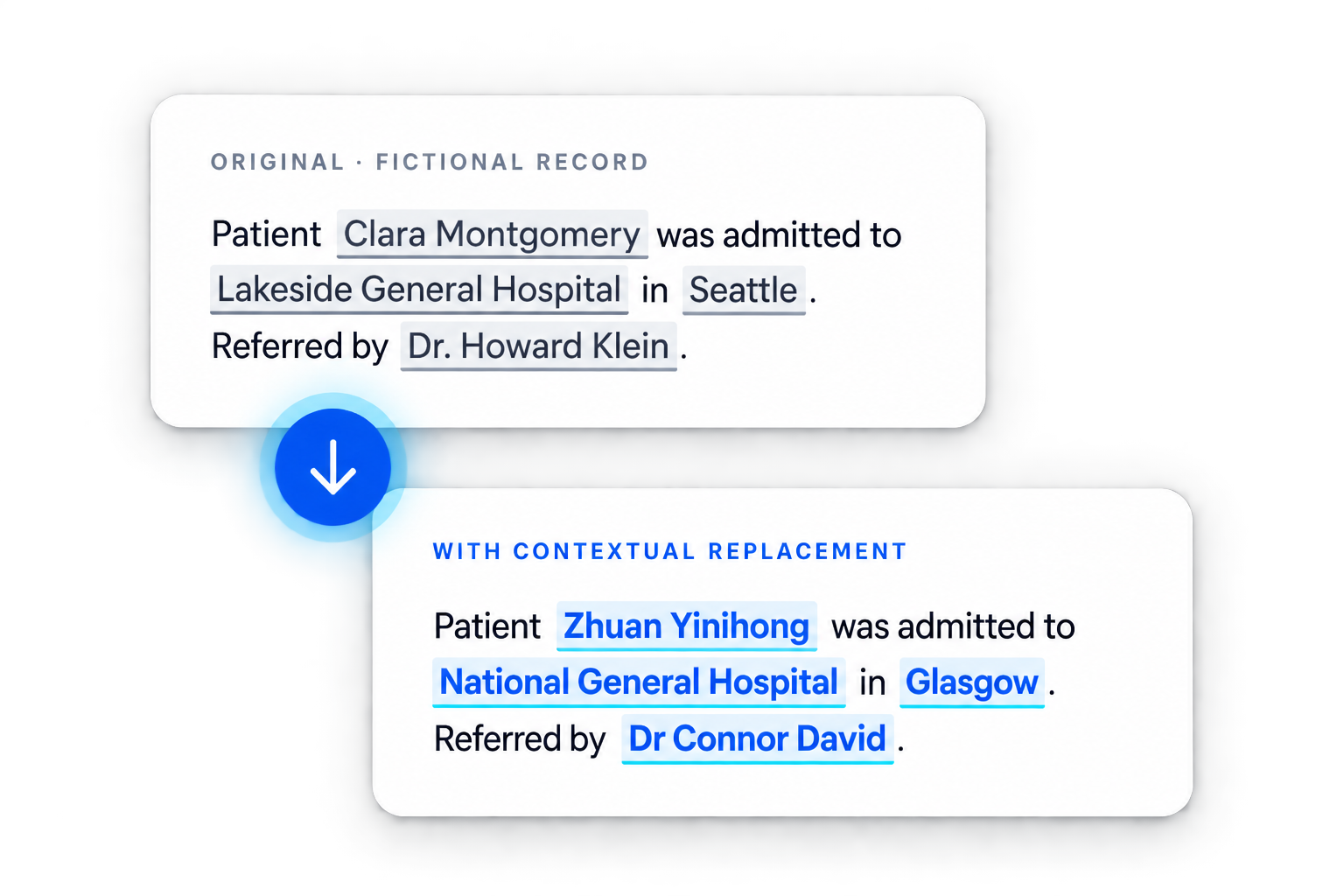
PII redaction is the process of permanently removing or replacing personally identifiable information from content—documents, transcripts, datasets, audio—so the original information cannot be recovered. Unlike tokenization, there is no vault and no reversal key. When PII is redacted, it is gone from that copy of the data.
Depending on the use case, redaction may take several forms: full removal (replacing PII with blank space or a [REDACTED] tag), pseudonymization (replacing PII with a consistent labeled placeholder such as [PATIENT_NAME] or [ACCOUNT_NUMBER]), or generalization (replacing an exact value with a broader category, such as substituting a specific age with an age range).
Common PII redaction use cases
- Document sharing and compliance exports—sharing contracts, medical records, or legal filings with PII permanently removed.
- AI and ML training data preparation—de-identifying datasets before using them to train models.
- Analytics and reporting—producing aggregate reports from data where individual-level PII is not needed.
- HIPAA de-identification—meeting the Safe Harbor or Expert Determination standard for clinical data.
- Content moderation and data lake management—removing PII from unstructured data at ingestion.
Head-to-head comparison
The table below maps the key decision dimensions side by side. Use it to narrow your approach before reading the use-case guidance that follows.
| Dimension |
Data tokenization |
PII redaction |
| Reversibility |
Reversible—original value retrievable from secure vault |
Irreversible—original value permanently removed from that copy |
| Purpose |
Protect data in transit and in use while enabling legitimate retrieval |
Eliminate PII from datasets, documents, or pipelines permanently |
| Data format |
Best for structured data: database fields, form values, fixed-format identifiers |
Designed for unstructured data: text, documents, audio, PDFs, free-form content |
| PII detection required? |
No—tokenization acts on known fields; PII location is predetermined |
Yes—redaction requires detecting PII by content analysis before removal |
| Re-identification risk |
Low if vault is secure; token alone reveals nothing |
Depends on detection quality; missed PII = re-identification risk |
| Compliance standard |
PCI DSS tokenization standard; in-scope for GDPR and HIPAA |
HIPAA Safe Harbor and Expert Determination; GDPR anonymization standard |
| Analytics utility |
High—data structure preserved; tokens can be counted, grouped, linked |
Varies—pseudonymization preserves structure; full removal reduces utility |
| Implementation complexity |
Requires secure vault infrastructure; API integration with all data consumers |
Requires NER or ML models for detection; lower infrastructure overhead than vault |
| Typical use case |
Payments, production databases, data sharing with re-linkage needs |
Training data, compliance documents, content archives, de-identification |
When to use tokenization
Tokenization is the right choice when you need to protect sensitive data but also need to retrieve the original value in authorized contexts. The defining requirement is reversibility.
Use tokenization when:
- You're processing payment data under PCI DSS—the card number must be usable for refunds, recurring payments, or disputes, but should never appear in application logs, analytics systems, or non-payment databases.
- You need to link de-identified records back to individuals in authorized workflows—for example, returning a de-identified clinical dataset to a patient's treating physician for care decisions.
- You're building a data-sharing arrangement where the receiving party works with tokens, but your organization retains the ability to re-identify when legally required.
- You're protecting structured database fields where the format and length of the original value must be preserved for downstream processing (format-preserving tokenization).
What tokenization is not suited for: unstructured content. Tokenization requires knowing where PII is before you tokenize it—it acts on labeled fields, not discovered content. If your PII lives in free-form text, call transcripts, or PDF documents, you need detection-first redaction, not tokenization.
When to use PII redaction
PII redaction is the right choice when you need to eliminate PII from content permanently and the original value does not need to be recoverable.
Use PII redaction when:
- You're preparing training data for AI or ML models—the model needs linguistic or structural patterns in the data, not actual PII values.
- You're sharing documents with external parties—legal filings, research datasets, public records—where PII must be permanently removed before release.
- You're de-identifying healthcare data under HIPAA—the Safe Harbor method requires removal of all 18 identifiers, with no reversal key retained (or if retained, under HIPAA-compliant access controls that effectively separate it from the data).
- You're processing unstructured data—emails, call transcripts, support tickets, PDFs—where PII must be discovered by natural language processing (NLP) before it can be removed.
- You're building a data archive or data lake where PII should not be retained beyond its operational life.
What redaction is not suited for: situations where you need to retrieve original values. If a downstream process legitimately needs the original PII—for fraud investigation, patient care, or account management—redaction breaks that workflow. In those cases, consider pseudonymization with a separate access-controlled mapping, or tokenization.
Can you use both approaches together?
Not sure if you need tokenization, redaction, or both?
Talk to Limina about your data environment and get a recommendation built around your compliance requirements and data formats.
Get a Demo
Yes—and in many enterprise data environments, you should. A mature data privacy architecture often applies both methods at different layers and for different purposes.
A common pattern in healthcare: incoming patient data is tokenized at the database level (patient IDs replaced with tokens for inter-system sharing), while clinical notes and unstructured content in the same record are processed through NLP-based redaction before being made available for analytics or AI training. The tokenized fields enable authorized care workflows; the redacted unstructured content enables population-level analysis without PHI exposure.
In a contact center context: payment card data captured during calls is tokenized at the IVR level using PCI DSS-compliant pause-and-resume or DTMF masking, while the call transcript is processed through PII redaction to remove broader PII—names, addresses, account details spoken in conversation—before the transcript is used for quality assurance or model training.
Compliance considerations
PCI DSS and tokenization
PCI DSS explicitly recognizes tokenization as a de-valuation method that removes card data from scope when implemented correctly. The PCI Security Standards Council has published guidance (Tokenization Product Security Guidelines) on what constitutes a compliant tokenization implementation. Tokens must be unique, non-reversible without the vault, and the vault itself must meet PCI DSS security controls.
HIPAA and redaction
HIPAA's de-identification standard—both Safe Harbor and Expert Determination—focuses on the outcome: the resulting data must present very small risk that an anticipated recipient could identify an individual. Full redaction (removing all 18 Safe Harbor identifiers) achieves this for structured PHI. For unstructured PHI in clinical notes and transcripts, NLP-based redaction is required. HIPAA does not prohibit retaining a re-identification key, but doing so means the original dataset remains PHI.
GDPR and the anonymization threshold
GDPR draws a clear line between pseudonymized data (still personal data, still in scope) and anonymized data (out of scope). Tokenization produces pseudonymized data—the token vault preserves re-identification capability, so GDPR still applies to the original data and any system with vault access. True anonymization under GDPR requires that re-identification is no longer reasonably possible. High-quality redaction—with no retained reversal key—can meet this standard for unstructured content, but requires a thorough re-identification risk assessment.
Choose the right PII protection approach for your use case
Limina supports multiple de-identification methods—redaction, pseudonymization, and tokenization—across all major data formats and unstructured content types. Whether you're preparing training data, de-identifying healthcare records, or protecting contact center transcripts, Limina's platform provides the coverage and accuracy that compliance requires.
Get a demo at getlimina.ai/en/contact-us