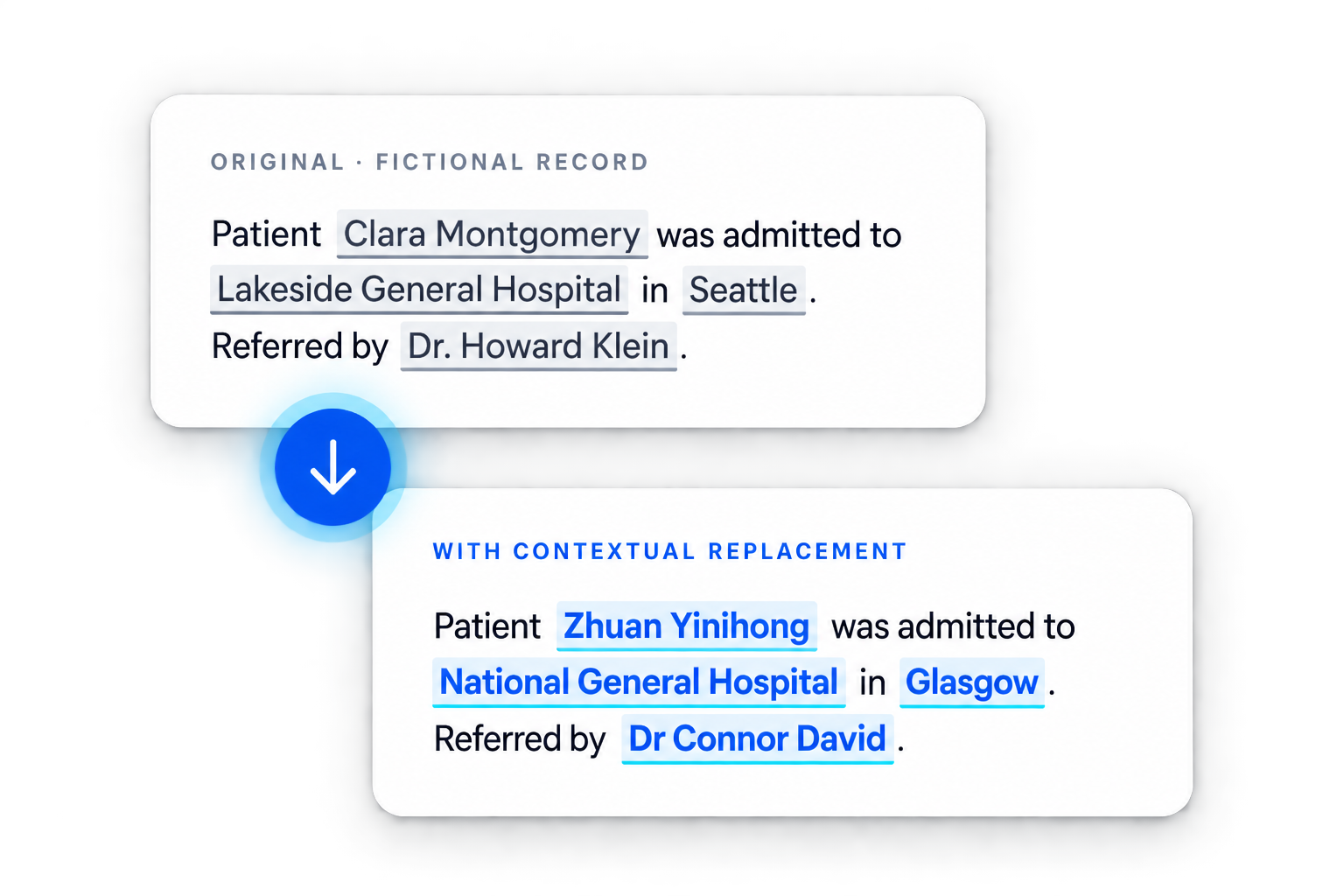
There's a moment that compliance officers and data engineers know all too well: a dataset needs to go out, a deadline is pressing, and somewhere buried inside thousands of records are names, social security numbers and medical codes that absolutely can't leave the building unredacted. The question is never really whether to redact. It's how.
Manual vs. automated PII redaction — this is one of the most consequential decisions a data or compliance team can make. A missed field in a manually reviewed document can result in a regulatory fine, a breach notification, or worse, real harm to a real person.
An automated system configured without adequate nuance can strip data to the point of uselessness or, conversely, miss context-dependent identifiers that no rule set anticipated. Neither approach is universally superior. What matters is understanding the tradeoffs clearly enough to make the right call for your specific situation. Platforms like Limina are built to handle exactly this kind of decision at enterprise scale.
What is PII redaction and why does it matter?
Personally Identifiable Information (PII) redaction is the process of detecting and removing or obscuring information that could be used to identify an individual. This includes obvious fields like names and addresses, but also extends to quasi-identifiers such as dates of birth, geographic subdivisions, and combinations of seemingly innocuous data points that, when joined, become identifying. If you're new to these categories, our guide on what PII, PCI, and PHI mean is a useful starting point.
The regulatory landscape has made redaction not just a best practice but a legal obligation across most industries.
- HIPAA governs protected health information in the United States.
- GDPR sets the standard across the European Union.
- CCPA covers California residents.
- PIPEDA applies in Canada.
Each framework carries its own definitions of what counts as identifiable, its own data minimization requirements, and its own penalty structures for non-compliance.
For organizations operating in healthcare, financial services, insurance, or pharmaceuticals, the volume of data requiring review has grown far beyond what human teams can handle sustainably. The average hospital system generates petabytes of data annually, and over 80% of that is unstructured data—the kind of unstructured data privacy risks that are hardest to catch with manual review. A mid-sized financial institution processes millions of customer interactions each month. The need for scalable, accurate, and auditable redaction has never been more urgent.
How does manual PII redaction work?
Manual redaction involves human reviewers examining documents, records, or datasets and physically removing or obscuring identifying information. In its most traditional form, this meant black marker on paper. In the modern era, it typically means a reviewer working through digital documents in a redaction-enabled tool, highlighting fields, and applying masks or deletions.
The process usually follows a defined workflow: documents are queued, assigned to reviewers with appropriate clearance, reviewed against a checklist of PII categories, redacted, and then passed to a quality control reviewer before release. In highly regulated industries, a secondary sign-off from a legal or compliance officer is often required.
Manual review is particularly common in legal discovery, government Freedom of Information Act (FOIA) responses, and clinical trial documentation, where the documents in question may be low in volume but extraordinarily high in sensitivity. In those contexts, the cost of a single missed identifier can outweigh the cost of a team of reviewers.
What are the real advantages of manual redaction?
The most significant advantage of manual redaction is contextual judgment. A trained human reviewer can recognize that a reference to a very rare condition, combined with a specific treatment date and clinical site, narrows the universe of possible individuals substantially even without a name appearing anywhere in the document. They can catch redaction requirements that no automated ruleset would anticipate, because they understand the document holistically rather than scanning it for predefined patterns. A human reviewer can also distinguish between true PII and something that merely resembles it, making them less likely to over-redact and more likely to preserve the downstream value of the data.
Manual review also offers flexibility. When dealing with novel document types, unusual data structures, or highly specialized terminology, a human can adapt without the need to retrain a model or update a configuration file. There is no cold-start problem with a well-briefed human reviewer.
For organizations with low data volumes, manual redaction can also be cost-effective when calculated on a per-document basis, particularly when the downstream risk of over-redaction or under-redaction is asymmetric. If a single released document carries regulatory or reputational risk worth millions of dollars, the economics of a careful human review team are straightforward.
What are the limitations of manual redaction?
The fundamental problem with manual redaction is that humans are inconsistent, and inconsistency at scale becomes systemic error. Human reviewers working long shifts, under pressure, or processing repetitive documents experience well-documented fatigue-related decline in accuracy. A reviewer who is thorough and careful at the start of a session will miss more as the session continues, and that performance gap does not show up anywhere in the audit trail.
Manual redaction also does not scale. Doubling throughput means doubling headcount, which means doubling cost, doubling training requirements, and doubling the number of potential points of human error. For any organization dealing with high data volumes, this creates an operational ceiling that becomes increasingly difficult to justify to leadership.
There is also a turnaround time problem. Regulatory timelines, litigation deadlines, and research data-sharing agreements increasingly demand rapid delivery of redacted datasets. Manual review pipelines built for smaller workloads become bottlenecks that hold entire projects hostage.
Finally, manual redaction creates documentation challenges that become significant under regulatory scrutiny. A typical manual audit trail can tell you that a document was assigned to a reviewer, when it was marked complete, and who signed off on it. What it can't tell you is which entity types were scanned for, which ones were found, and exactly what happened to each one. When a regulator asks not just whether redaction occurred but how you know it was done correctly and consistently, "our reviewers followed the checklist" is a much weaker position than a machine-generated log. Regulators increasingly expect the level of granularity that an automated de-identification platform produces by default — showing every detection event and redaction decision across every record processed.
Free Resource Bundle
Your PII detection has gaps.
Here's the data to prove it.
Benchmark report, enterprise case study, and a 15-point production-readiness checklist — free for engineering teams evaluating PII detection.
↓ Benchmark Whitepaper
↓ Boehringer Case Study
↓ Readiness Checklist
How does automated PII redaction work?
Automated PII redaction uses machine learning models, natural language processing (NLP), and rule-based systems to detect and redact identifying information without human intervention at the document level. Modern systems combine multiple detection approaches: pattern recognition for structured identifiers like Social Security Numbers and phone numbers, named entity recognition (NER) for names and locations, and contextual models that understand how language is being used rather than simply matching strings.
The most sophisticated automated systems, like Limina's data de-identification platform, go beyond simple pattern matching to understand entity relationships within a document, apply jurisdiction-specific redaction logic, and preserve the utility of the underlying data after redaction. This last point is critical and often underappreciated: redacted data that cannot be used for its intended purpose has no value, and an overly aggressive system can destroy the analytical utility of an entire dataset.
Automated systems also generate machine-readable audit logs that document every detection event, every redaction decision, and the confidence score associated with each. This creates an audit trail that is far more granular and reproducible than any human-review documentation system — and one that supports the level of regulatory scrutiny compliance teams increasingly face.
What are the genuine strengths of automated redaction?
Speed and scale are the most obvious advantages. Automated systems can process thousands of documents per hour without performance degradation. There is no fatigue, no inconsistency between the first document and the ten-thousandth, and no bottleneck that requires adding headcount to resolve. For organizations processing large data volumes on a regular cycle, this changes the economics of compliance entirely.
Consistency is equally important. Because automated systems apply the same logic to every document, every time, the results are reproducible. If a new PII category needs to be added, it is added once to the model or ruleset and immediately applies across all future processing. There is no need to retrain a team or update a procedure manual and hope everyone reads it.
Modern automated systems also support multi-language processing, making them essential for multinational organizations whose data spans languages and jurisdictions simultaneously. A manual review team with equivalent multilingual capability would require significant investment to build and maintain.
For organizations operating across jurisdictions, multilingual automated support is critical — and so is understanding how HIPAA and GDPR differ on health data when your compliance obligations span multiple regulatory frameworks.
For organizations pursuing HIPAA Expert Determination sign-off, exactly this kind of provable, reproducible redaction logic is what makes the process defensible.
For industries like pharma and life sciences, where clinical trial data must be de-identified to meet regulatory standards before sharing with partners or publishing in research, automated redaction enables a pace of data-sharing that would be impossible with manual teams. The same applies to contact center environments, where call transcripts, chat logs, and case notes accumulate at a rate that makes human review operationally unfeasible.
What are the limitations of automated redaction?
The primary limitation of automated systems is that they are only as good as the data and logic underlying them. A model trained primarily on English-language healthcare records may underperform on legal documents written in German. An entity recognition model that has not been exposed to industry-specific jargon may misclassify specialized terminology. In both cases, the failure mode is invisible unless there is a validation process in place.
Automated systems can also struggle with context-dependent identifiers. A name that appears in one section of a document as a patient reference and in another section as a cited author requires contextual understanding that simpler systems do not always handle correctly. The risk of false negatives, where identifying information is missed, is real if the system has not been properly configured and validated for the specific document types in use.
Automated redaction also takes real work to set up properly. Proper configuration and validation against your specific document types is essential — see Limina's product page for how the platform is configured for different environments. Organizations that rush the setup phase often find that their automated solution still requires heavy manual intervention to produce results they can trust, which defeats much of the purpose.
Manual vs. automated: a direct comparison
When comparing the two approaches across the dimensions that matter most to compliance and operations teams, the picture becomes clearer.
| Dimension |
Manual Redaction |
Automated Redaction |
| Accuracy |
High contextual precision; declines with volume and fatigue |
Consistent logic applied every time; requires proper configuration and validation |
| Speed |
Slow — linear with document count |
Fast — thousands of documents per hour |
| Scalability |
Limited by headcount and budget |
Scales on demand without adding staff |
| Cost |
Lower at small volumes; expensive at scale |
Higher setup cost; dramatically lower per-record cost at volume |
| Audit trail |
Reviewer notes and sign-off logs |
Machine-generated logs of every detection and redaction event |
| Multilingual support |
Requires bilingual reviewers |
Built-in — supports 52+ languages simultaneously |
| Regulatory readiness |
Dependent on reviewer training |
Reproducible outputs support Expert Determination and Safe Harbor documentation |
On accuracy, neither approach has an absolute advantage. Human reviewers excel at contextual judgment but decline in consistency over time and volume. Automated systems excel at consistent application of defined logic but require careful validation to ensure that logic is complete and current. The best outcomes typically come from combining both.
On cost, the comparison shifts depending on volume. At low volumes, manual review is often cheaper when total cost of ownership is considered. At high volumes, automated systems become dramatically more cost-efficient. The crossover point varies by organization, but for most enterprises processing data at scale, automation delivers a lower per-record cost within months of deployment.
Independent benchmarks show Limina achieving 99.5 percent+ accuracy on real healthcare data, compared to 60–70 percent for general-purpose cloud tools — a gap that becomes operationally significant at scale.
On scalability, automated systems win without qualification. Human teams cannot match the throughput of a well-deployed automated platform, and the economics of scaling a human team are linear in a way that automated systems are not.
On audit and compliance documentation, automated systems produce better outputs by default. Machine-generated logs of every redaction decision are more granular, more reproducible, and easier to present in a regulatory examination than reviewer notes and workflow records.
When is automated redaction the right choice?
For most enterprise use cases involving structured or semi-structured data at scale, automated redaction is not just the right choice — it's the only operationally viable one. Insurance companies processing claims data, healthcare systems de-identifying patient records for research, financial institutions anonymizing transaction data for analytics, and contact centers protecting customer information in interaction records all share a common characteristic: the data volume is too large and the processing cadence too frequent for human review to keep pace.
Automated redaction is also the right choice when real-time or near-real-time processing is required. A customer service platform that needs to redact PII from chat transcripts before they are stored in an analytics system cannot wait for a human reviewer. The processing needs to happen at the point of data creation, and that requires automation.
If you're still clarifying your organization's obligations, our foundational guide to PII, PCI, and PHI is a useful reference before you begin evaluating redaction tools.
If your organization is ready to move beyond manual processes and implement a redaction solution that can scale with your data, contact the Limina team to discuss how automated de-identification can be configured for your specific compliance requirements and data environment.
Building a redaction strategy that holds up under scrutiny
Whether your organization is just beginning to formalize its PII redaction process or looking to upgrade a manual workflow that has outgrown its capacity, the starting point is the same: a clear inventory of the data types you handle, the jurisdictions you operate in, and the regulatory frameworks that apply.
From there, the evaluation of manual versus automated approaches becomes a structured exercise in matching capabilities to requirements rather than a debate about which technology is generally better. An organization handling ten sensitive legal documents per month has very different needs than a healthcare system processing a million patient records per quarter, and the right approach for one is almost certainly wrong for the other.
Limina's data de-identification platform is built to support exactly this kind of tailored deployment. Whether your priority is meeting HIPAA Safe Harbor requirements, achieving GDPR pseudonymization standards, or building a research data pipeline that preserves analytical value while removing identifiers, the platform can be configured for your specific context rather than forcing your data into a generic workflow.
Ready to see how automated redaction would work for your data environment? Schedule a conversation with the Limina team and get a solution scoped to your actual compliance requirements.