
HIPAA Expert Determination: How It Works and How AI Can Help
The HIPAA Expert Determination method is one of two legally recognized paths to de-identifying protected health information. This article explains what the process involves, what qualifies as a low re-identification risk, and how AI-powered de-identification technology supports the expert's work without replacing it.


In the contemporary landscape of health information technology, protecting patient data is not just a regulatory obligation -- it is a foundational requirement for maintaining public trust. The Health Insurance Portability and Accountability Act (HIPAA) Privacy Rule sets the national standard for protecting individuals' medical records and other protected health information (PHI). Within that framework, covered entities and their business associates have two recognized paths to de-identifying health data before it can be used for research, analysis, or other secondary purposes: the Safe Harbor method and the Expert Determination method.
While Safe Harbor is often discussed for its relative simplicity -- it requires the removal of 18 specific categories of identifiers -- Expert Determination is the more analytically rigorous of the two approaches. It also tends to be better suited to complex, real-world datasets where PHI appears in unpredictable forms. This article focuses on the Expert Determination method: what it requires, what it means to demonstrate "very low" re-identification risk, and how AI-powered de-identification technology can support the expert's work without replacing the human judgment that HIPAA demands.
For a comprehensive treatment of the Expert Determination rule, including guidance on who qualifies as an expert and how risk thresholds are interpreted, the U.S. Department of Health and Human Services has published detailed guidance on the de-identification of protected health information.
What is the HIPAA Expert Determination method?
Under 45 CFR §164.514(b)(1), the Expert Determination method allows a covered entity to de-identify PHI when a person with appropriate knowledge of and experience with generally accepted statistical and scientific principles and methods applies those principles to determine that the risk of identifying an individual is very small. The expert must also document the methods and results of the analysis that justify the conclusion.
This is not a checklist-based exercise. Unlike Safe Harbor, which specifies exactly which data elements must be removed, Expert Determination requires the expert to assess the specific dataset in its specific context, taking into account who is likely to receive or access the data and what other information those recipients could reasonably combine with it to re-identify an individual. The standard is not that re-identification is impossible -- only that the risk is very low.
That distinction matters. It means that a dataset de-identified today may need to be reassessed in the future as new data sources become publicly available, as re-identification techniques improve, or as the intended use of the data changes. Expert Determination is, by design, a living analysis rather than a one-time certification.
What techniques does an expert use?
Expert determination within the framework of HIPAA involves a rigorous process where a qualified expert deploys a variety of techniques to ensure the de-identification of PHI. Three methods are particularly common in practice.
Suppression involves omitting specific information from the dataset entirely to prevent identification. This is appropriate when the data element is too identifying to retain in any form and cannot be generalized without destroying its analytical value.
Generalization involves broadening or abstracting certain data elements to make individual identification less likely. Age ranges are a common example -- rather than recording a patient's exact birth date, an analyst might record their age in five-year bands. Geographic data is similarly generalized, often to the level of a ZIP code prefix or county rather than a specific address.
Perturbation introduces a controlled amount of random variation into the data to obscure original values while preserving overall statistical patterns. A dataset with perturbed numeric values may no longer allow an observer to determine any individual's exact measurement, but aggregate analyses performed on that data can still yield meaningful results.
Regardless of which techniques are applied, the expert must document the entire process thoroughly. Documentation is not optional under the Expert Determination standard -- it is a compliance requirement. The written record must justify the expert's conclusion that re-identification risk is very low, and it must be sufficient for a subsequent reviewer to understand and evaluate the methods used.
Why re-identification risk changes over time
One aspect of Expert Determination that is easy to overlook is its temporal dimension. An expert may conclude that a de-identified dataset carries very low re-identification risk at the time of analysis, but that determination can become outdated. The expert must keep abreast of the latest advancements in re-identification techniques and data science to anticipate how datasets could be combined with external information to re-identify individuals.
Several factors drive this ongoing risk. Public data availability expands over time as government agencies, research institutions, and commercial data brokers release new datasets. Computational methods for linking and cross-referencing disparate datasets have improved dramatically, making previously unlikely re-identification pathways more feasible. And as the intended use of de-identified data evolves, the pool of potential recipients -- and the external data they have access to -- may change.
Given these dynamics, experts may determine that a low risk of re-identification exists only for a limited time, after which a re-assessment is necessary. Organizations that treat Expert Determination as a one-time event rather than an ongoing process are taking on compliance and reputational risk that the method was designed to surface and manage.
How does HIPAA Expert Determination apply to unstructured data?
Most discussions of PHI de-identification focus on structured data: the rows and columns in a clinical database, the fields in an electronic health record, the cells in a research spreadsheet. Structured data presents identifiers in predictable locations and formats, which makes it amenable to rule-based removal.
But a significant and growing volume of health information exists in unstructured form. Clinical notes written by physicians and nurses, discharge summaries, radiology reports, pathology findings, patient-reported outcome narratives, call center transcripts, and similar documents contain PHI that does not conform to a fixed schema. A clinician documenting a patient encounter may include a first name in one sentence, a reference to a nearby hospital by name in the next, and an implicit age indicator -- such as "three weeks after her 70th birthday" -- several paragraphs later. Identifying all of these elements requires understanding language, not just pattern-matching against a list of known identifier categories.
This is where the gap between what a human expert can manually review and what is practically feasible at scale becomes most visible. For organizations in healthcare and pharma and life sciences processing large volumes of unstructured clinical text, the challenge of preparing data for Expert Determination is substantial. If you are working through that challenge and want to understand how technology can support your compliance workflow, contact Limina's team to discuss your specific data environment.
How AI-powered de-identification supports the expert determination process
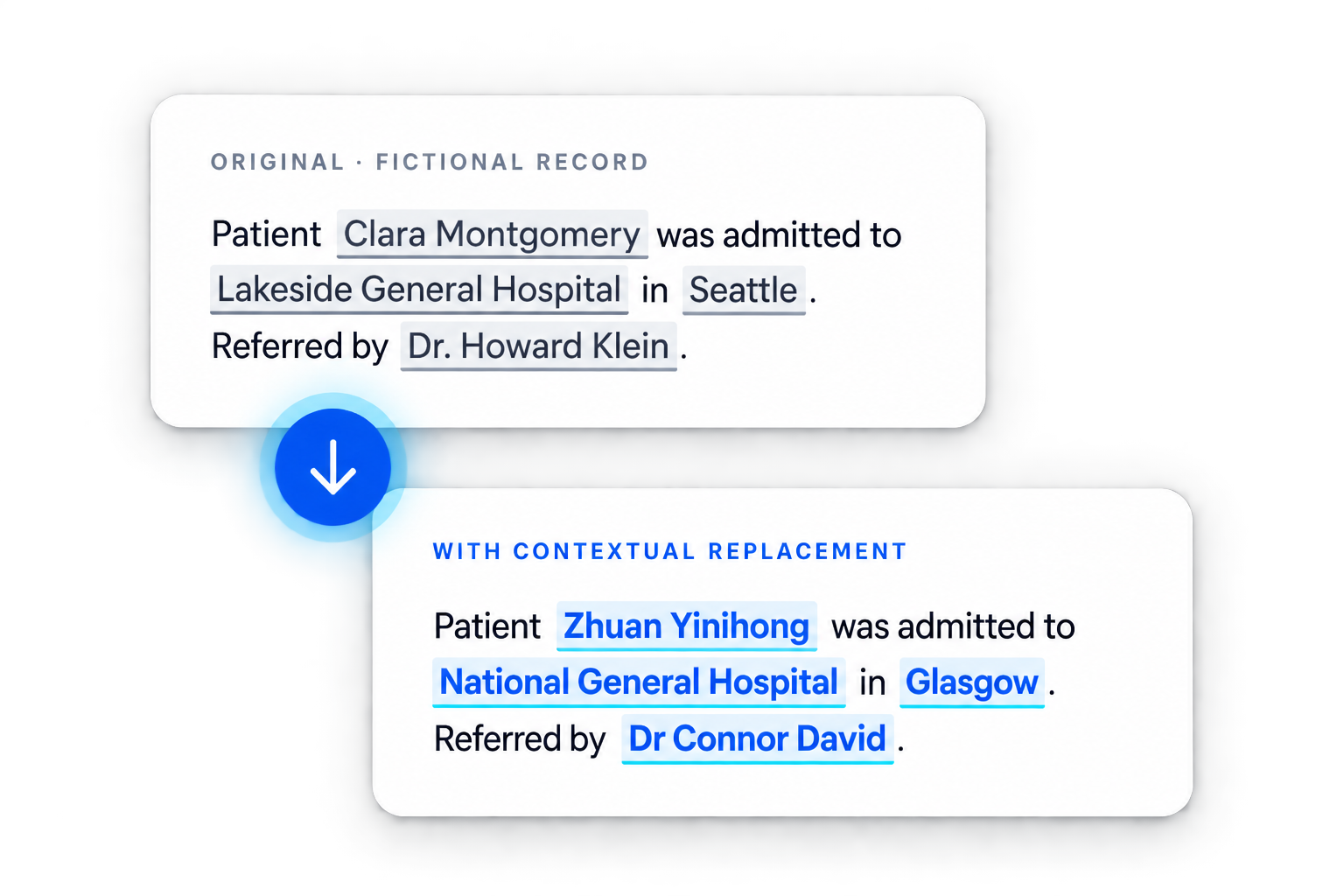
This is where Limina's technology becomes particularly advantageous. By employing sophisticated natural language processing algorithms, Limina can discern and redact PHI from unstructured text with a high degree of accuracy. Limina's de-identification solution is built by linguists, which means it is designed to understand language the way a skilled reader does -- recognizing context, resolving ambiguity, and identifying entity relationships within documents rather than simply searching for surface-level patterns.
For the Expert Determination process, this capability serves a specific and important function. Before a qualified expert applies their statistical and scientific analysis to assess re-identification risk, the dataset needs to be prepared. In the case of free text data, that preparation involves identifying and removing or redacting the PHI that is directly apparent -- names, dates, locations, provider identifiers, and other explicit elements. This pre-processing is immensely beneficial to the expert determination process, as it clears the nebulous terrain of free text data, allowing the expert to apply their statistical and scientific principles to a dataset that has been efficiently sanitized of its most apparent identifiers.
The result is a more focused, efficient expert analysis. Rather than spending time on overt data redaction -- a task that AI can perform at scale and with consistency -- the expert can concentrate on the nuanced questions of risk: What is the probability that a recipient could combine this data with other available information to identify an individual? Are there indirect or quasi-identifying variables in the dataset that require additional transformation? Does the data retain enough utility for its intended purpose after the necessary modifications are applied?
Limina's data de-identification platform is also capable of processing data across multiple languages and formats, ensuring that de-identification efforts are thorough and consistent across diverse datasets, making de-identification more accurate and scalable at the same time. For organizations operating across international markets or managing multilingual patient populations, this consistency is essential to maintaining a defensible compliance posture.
It is worth being precise about what this technology does and does not do. The integration of AI de-identification into an Expert Determination workflow is a supportive measure. It enables experts to navigate the subtleties of risk assessment with more clarity. The final determination of re-identification risk remains a human-driven process that requires a deep understanding of the data's potential use cases and the availability of other information that could lead to re-identification. No technology replaces that judgment under the current HIPAA framework -- nor should it.
Which industries rely on Expert Determination?
Expert Determination is relevant wherever organizations need to use health data for purposes beyond direct patient care while maintaining HIPAA compliance. In practice, the method sees the heaviest use in a handful of sectors.
Pharmaceutical and life sciences companies routinely work with large volumes of clinical trial data, real-world evidence, and patient-reported outcomes. De-identifying this data for secondary analysis, regulatory submission preparation, or publication requires exactly the kind of expert-driven assessment that HIPAA's Expert Determination method describes. Limina supports pharma and life sciences organizations navigating these requirements at scale.
Healthcare providers and payers dealing with claims data, clinical documentation, or population health datasets face similar demands. The unstructured content embedded in clinical notes and patient records makes AI-assisted pre-processing especially valuable in this context. Limina's work with healthcare organizations reflects the complexity of de-identifying data that spans both structured and unstructured formats.
Insurance companies and financial services organizations that handle health-adjacent data -- such as long-term care claim records or health-linked financial products -- may also find Expert Determination relevant to their compliance programs. Limina serves insurance and financial services clients with de-identification needs that cut across regulated data categories.
Contact centers in healthcare settings, which capture large volumes of voice and chat interactions containing PHI, represent another area where scalable de-identification technology and human expert analysis work in tandem. Limina's solutions for contact centers address the specific challenge of de-identifying conversational data in real time and at volume.
The relationship between technology and human expertise
As health data becomes more central to research, product development, and operational decision-making, the pressure to use that data responsibly -- and compliantly -- continues to grow. Expert Determination is one of the most rigorous frameworks available for doing so. It is also one of the most demanding, requiring sustained expert attention, detailed documentation, and periodic reassessment.
De-identification technologies like those developed by Limina are instrumental in the preliminary processing of data. They are a testament to the progress in the field of privacy-enhancing technology, yet they complement rather than replace the nuanced, expert-driven process required under the HIPAA Expert Determination method. The alliance of advanced AI tools and expert judgment forms the backbone of a robust approach to PHI de-identification and the protection of individual privacy.
If your organization is preparing for an Expert Determination process and wants to understand how AI-powered de-identification can streamline the preparation phase, reach out to the Limina team. We work with organizations across healthcare, life sciences, insurance, and financial services to make de-identification accurate, auditable, and scalable.



Frequently Asked Questions
What is the HIPAA Expert Determination method?
The HIPAA Expert Determination method is one of two legally recognized approaches to de-identifying protected health information under the HIPAA Privacy Rule. It requires a qualified expert -- someone with knowledge of and experience with statistical and scientific principles -- to analyze a dataset and determine that the risk of re-identifying any individual from that data is very small. The expert must document the methods and results of this analysis. Unlike the Safe Harbor method, which specifies a fixed list of identifiers to remove, Expert Determination is a contextual assessment that accounts for the specific dataset, its intended use, and the information that anticipated recipients could reasonably access.
Who qualifies as an expert under HIPAA's Expert Determination standard?
HIPAA does not define "expert" with a specific credential or certification. The regulation requires that the individual have appropriate knowledge of and experience with generally accepted statistical and scientific principles and methods for rendering information not individually identifiable. In practice, qualified experts often include biostatisticians, epidemiologists, data scientists, or privacy professionals with demonstrated experience in de-identification methodology. The HHS guidance document on de-identification provides additional context for evaluating who meets this threshold.
What does "very low" re-identification risk mean under HIPAA?
HIPAA does not specify a precise numerical threshold for "very low" risk. The standard requires that the expert determine the risk of identifying an individual is very small -- not that it is zero. In practice, this means the expert must assess the likelihood that an anticipated recipient could use the data, alone or in combination with other reasonably available information, to identify a specific person. The assessment is context-dependent: the same dataset may carry different levels of risk depending on who receives it and what external data they have access to.
What is the difference between HIPAA Safe Harbor and Expert Determination?
Safe Harbor requires the removal of 18 specific categories of identifiers enumerated in the HIPAA Privacy Rule. If all 18 are removed and the covered entity has no actual knowledge that the remaining data could be used to identify an individual, the data is considered de-identified. Expert Determination takes a different approach: rather than following a fixed checklist, a qualified expert applies statistical and scientific methods to assess and document that re-identification risk is very low for the specific dataset in question. Expert Determination is generally considered more flexible and more analytically rigorous than Safe Harbor.
Can AI replace a HIPAA de-identification expert?
No. Under the current HIPAA framework, the Expert Determination method requires a human expert to apply statistical and scientific principles and to document the basis for their conclusion. AI-powered de-identification technology can significantly support this process -- particularly by pre-processing unstructured text data to remove overt identifiers before the expert conducts their risk analysis -- but it does not substitute for the expert judgment the regulation requires. The determination of re-identification risk, including the assessment of indirect identifiers and contextual risk factors, remains a human-driven process.
How often does a HIPAA Expert Determination need to be reassessed?
There is no fixed schedule mandated by HIPAA, but the Expert Determination standard implies that the analysis has a temporal dimension. Experts may determine that a low risk of re-identification exists only for a limited period, after which re-assessment is necessary. Changes that may trigger a reassessment include the release of new public datasets that could be linked with the de-identified data, advances in re-identification techniques, changes in the intended use of the data, or changes in the population of anticipated recipients. Organizations should treat Expert Determination as an ongoing compliance obligation rather than a one-time certification.
How does Limina support HIPAA Expert Determination?
Limina's de-identification platform supports the Expert Determination process by automating the pre-processing of unstructured data, including clinical notes, transcripts, and other free text formats. By identifying and redacting overt PHI from these documents using context-aware natural language processing, Limina reduces the manual burden on experts and allows them to focus their analysis on the nuanced risk assessment questions that the Expert Determination standard requires. Limina's technology does not replace the human expert -- it makes the expert's work more efficient, consistent, and scalable.