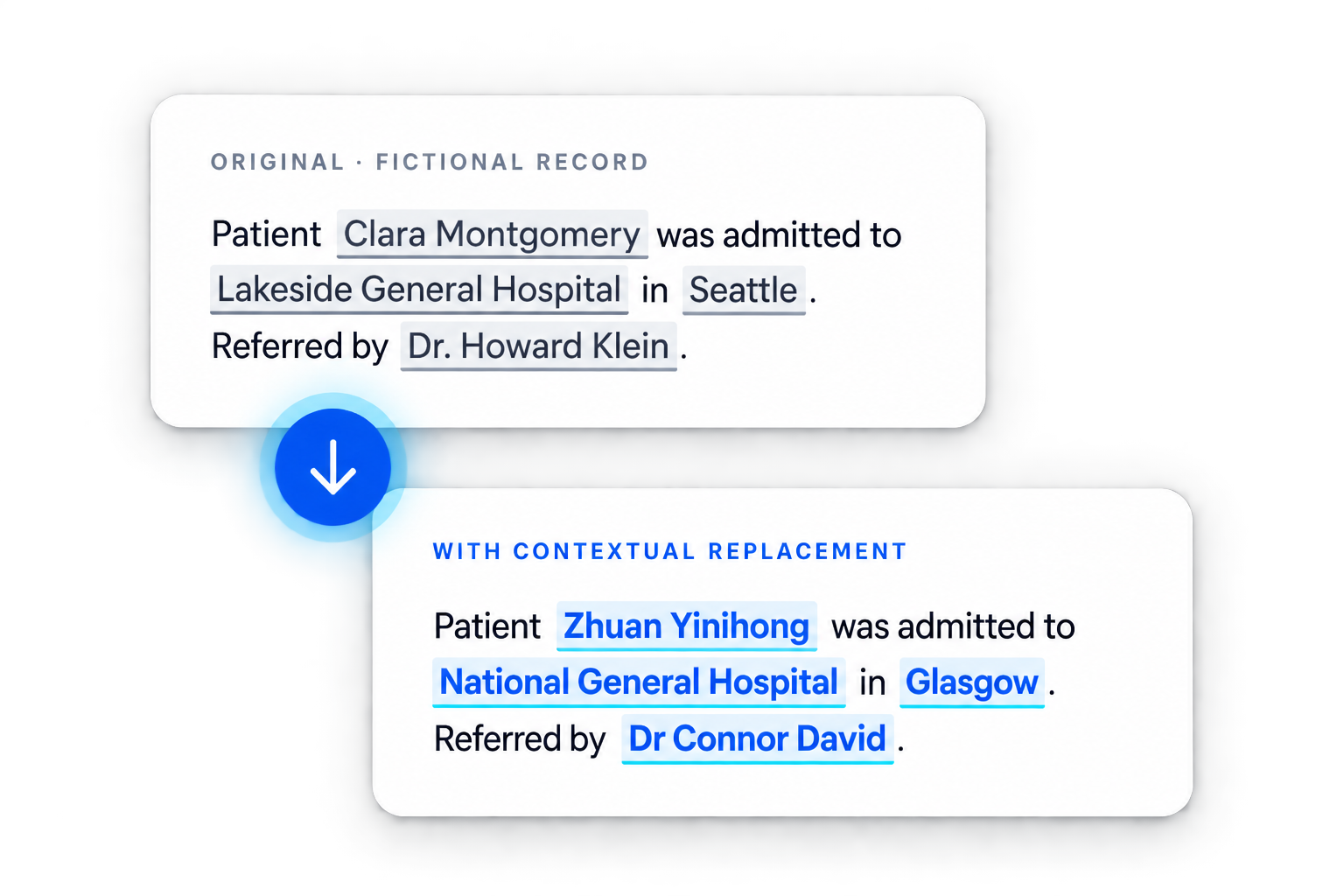
Privacy-preserving AI is not a category of model. It is a set of practices that determine whether your AI can be built, deployed and trusted with sensitive data in the first place. For enterprise buyers, data ethics boards and regulators, the term describes the techniques organizations use to extract value from AI without compromising the personal data of the people whose information made that AI possible.
Privacy-preserving AI refers to the set of technical approaches, including de-identification, differential privacy, federated learning and synthetic data, that let organizations train and deploy machine learning models on sensitive data while reducing or eliminating the risk that the model exposes, reconstructs, or relies on identifiable information about real individuals.
Each of these four techniques makes a different trade-off between privacy guarantee, implementation complexity and the resulting model's practical utility. This article compares them directly, then makes the case for why data de-identification is the most practical starting point for most regulated organizations, healthcare, pharma, financial services, insurance and contact centers among them.
The four main privacy-preserving AI techniques: comparison overview
Each technique protects privacy at a different point in the AI lifecycle, and they are not mutually exclusive.
|
De-identification |
Differential privacy |
Federated learning |
Synthetic data |
| What it does |
Detects and replaces identifiers in source data with synthetic PII (realistic surrogate values), or redacts them entirely, before training and in database queries. |
Adds calibrated statistical noise during training and to database queries so no single record meaningfully changes the model's output. Should also include tests for memorization of PII in model outputs. |
Trains across decentralized data sources without centralizing raw data. |
Generates new records that statistically resemble the original data without mapping to real individuals. |
| Implementation complexity |
Moderate. Requires accurate detection across structured and unstructured formats; integrates ahead of an existing pipeline. |
High. Requires tuning noise parameters and retraining infrastructure built for differential privacy. |
High. Requires coordinated training infrastructure across multiple, often independently governed, data sources. |
Moderate to high. Requires a generative model trained on the original distribution before use; complexity is reduced when combined with de-identification or differential privacy. |
| Data utility preserved |
High. Near-parity with raw data when identifiers are replaced rather than blank-redacted. |
Lower. Accuracy cost grows at enterprise scale, especially on smaller or imbalanced datasets. |
High for the local model; coordination overhead can affect convergence and final model quality. |
Variable. Can miss the long tail of rare or unusual real-world cases. |
| Regulatory acceptance |
Strong. Produces auditable documentation, including Expert Determination certification for the Health Insurance Portability and Accountability Act (HIPAA). |
Strong mathematically, but documentation for individual-record use cases is less established. |
Helps satisfy data-residency and data-sharing restrictions by keeping raw data local, but residual privacy risk remains; federated learning itself is not a form of de-identification. |
Reduces direct privacy exposure, though regulatory treatment is still maturing for sensitive sectors. |
| Best for |
Production model training on real operational or clinical data. |
Aggregate statistical reporting and population-level insights. |
Cross-institution collaboration where raw data cannot be centralized. |
Augmenting rare cases or sharing sample data externally. |
| Limina's role |
Performs the de-identification step: detects identifiers in a virtual private cloud (VPC) and produces audit-ready output. |
Not a fit. Limina's de-identification approach is complementary, not a noise-based technique. |
Not a fit on its own. Often paired with de-identification on each node's local data before training. |
Not a fit on its own. De-identified real data typically pairs with synthetic augmentation for rare cases. |
De-identification for AI: the most practical approach for most organizations
De-identification works by detecting and removing or transforming personal identifiers, names, dates, account numbers, medical record numbers and similar fields, in a dataset before it is used for any downstream purpose, including AI training. The same logic applies to other AI systems that retain personal data, such as the conversation logs behind AI chatbot compliance. Done well, one approach to de-identification replaces identifiers with synthetic PII (realistic surrogate values) rather than blank redactions, preserving sentence structure and contextual signal a model needs to learn from while removing the specific information that makes a record identifiable to a real person. Other approaches include full redaction or tokenization depending on the use case.
It is the only one of the four techniques compared here that both preserves data utility at near-parity with raw data and produces auditable compliance documentation, in the form of a defined de-identification methodology, accuracy validation, and, for healthcare data under HIPAA, Expert Determination certification. That combination, utility plus documentation, is why de-identified data for AI training tends to be the default starting point for organizations in regulated industries, rather than a technique reserved for unusual cases.
Differential privacy: what it is, when it is appropriate, limitations
Differential privacy adds carefully calibrated random noise during the training process itself, providing a mathematical guarantee that the presence or absence of any single individual's data in the training set does not meaningfully change the model's output. It is one of the most studied techniques in privacy preserving machine learning, and it is well suited to scenarios like aggregate statistical reporting, where the goal is population-level insight rather than individual-level prediction accuracy.
The limitation is accuracy. The noise required to provide a meaningful privacy guarantee introduces a real accuracy cost, and that cost tends to grow at enterprise scale and for smaller or imbalanced datasets. Research from Cornell Tech has found that this accuracy cost is not evenly distributed, with accuracy dropping disproportionately for underrepresented classes and subgroups within a dataset. For most enterprise AI use cases that require high prediction accuracy on individual cases, such as clinical decision support or fraud detection, differential privacy's noise requirements make it a harder fit than de-identification, even though the underlying privacy mathematics are more rigorous.
Federated learning: what it is, when it is appropriate, limitations
Federated learning trains a model across multiple decentralized data sources, such as different hospital systems or bank branches, without moving the raw data to a central location. Instead, each location trains a local update, and only the model updates, not the underlying data, are shared with a central aggregator. This is well suited to scenarios where data cannot legally or practically leave its source location, such as cross-institution research collaborations.
Federated learning does not eliminate privacy risk entirely. Research has shown that model updates themselves can, under certain conditions, be reverse-engineered to reveal information about the underlying training data, a class of attack known as gradient inversion. Federated learning also introduces meaningful infrastructure and coordination complexity, since it requires synchronized training across distributed systems rather than a single centralized pipeline, which is part of why it tends to suit specific cross-institution scenarios better than it suits a single organization's general-purpose AI training needs.
Synthetic data: what it is, when it is appropriate vs. de-identification
Synthetic data generation creates entirely new data records designed to statistically resemble an original dataset's patterns and distributions, without any single synthetic record corresponding to a real individual. This has genuine value for specific use cases: generating additional training examples for rare conditions or edge cases that are underrepresented in real data, or sharing realistic-looking sample data externally, with partners or for product demonstrations, without any privacy exposure at all.
Synthetic data has real limitations for general-purpose model training, particularly on unstructured text. Generation models can struggle to capture the full distribution of real-world variation, especially the long tail of unusual phrasing, rare conditions, or atypical cases that often carry the most learning value, and a generator trained on a limited or biased sample will reproduce and sometimes amplify that bias in its synthetic output. De-identified real data typically produces better models than fully synthetic data for most enterprise use cases, because it preserves the actual distribution and edge cases present in the organization's real operational or clinical data, which synthetic generation can only approximate.
How to choose the right privacy-preserving technique for your AI project
| Your situation |
Best-fit technique |
Why |
| Training a production model on real operational or clinical data |
De-identification |
Preserves data utility and produces auditable compliance documentation without significant accuracy trade-offs. |
| Publishing aggregate statistics or population-level insights |
Differential privacy |
The accuracy cost of added noise matters less when the output is a population-level statistic, not an individual prediction. |
| Training across institutions that cannot share raw data |
Federated learning |
Avoids moving regulated data across organizational or jurisdictional boundaries, even with its own residual privacy considerations. |
| Need more examples of rare or underrepresented cases |
Synthetic data (often combined with de-identification) |
Augments a de-identified real dataset where specific edge cases are too sparse to learn from directly. |
| Sharing sample data externally for demos or partner evaluation |
Synthetic data |
Eliminates privacy exposure entirely for use cases where no real individual's information needs to be present at all. |
In practice, the strongest privacy-preserving AI architectures often combine techniques rather than picking one exclusively, layering de-identification of the core dataset with synthetic augmentation for rare cases, for example. But for the single highest-leverage decision most organizations face, what to do with their primary training dataset before it touches a model, de-identification is the technique that fits the broadest range of enterprise use cases.
Does de-identification hurt model quality?
Don't let poor de-identification cost you model accuracy.
See how Limina hits 99.5%+ accuracy on real healthcare data while keeping your training pipeline audit-ready.
Talk to an Expert
The short answer is no, not meaningfully, provided the de-identification is accurate and context-preserving. The longer answer depends entirely on execution quality. Direct identifiers, a patient's name, an account number, a specific street address, carry very little of the linguistic or structural signal a model needs to learn its underlying task. A model learning to summarize clinical notes does not need the patient's actual name to learn the pattern of how symptoms, history and assessment are typically structured in that kind of document; it needs the structure and language itself.
Where de-identification can hurt model quality is when it is done poorly: over-redaction that strips contextual signal the model actually needs, or blank-redaction approaches that disrupt sentence structure rather than substituting realistic placeholder values. This is the gap between general-purpose de-identification tools, which tend to perform in the 60 to 70 percent accuracy range on real healthcare data, and healthcare-specific systems built for unstructured clinical narrative. Limina achieves 99.5 percent+ accuracy on real healthcare data specifically because it is built to handle the way identifiers appear in unstructured text, preserving the surrounding language so the resulting dataset remains genuinely useful for training, not just compliant on paper.
Frequently asked questions
What is privacy-preserving AI?
Privacy-preserving AI refers to a set of technical approaches, including de-identification, differential privacy, federated learning and synthetic data, that let organizations train and deploy AI models on sensitive data while reducing the risk that the model exposes or relies on identifiable information about real individuals. It is a practice, not a specific type of model.
Which privacy-preserving AI technique is best?
There is no single best technique; the right choice depends on the use case. De-identification fits most production model training on real operational or clinical data well, differential privacy suits aggregate statistical reporting, federated learning fits cross-institution collaborations that cannot share raw data, and synthetic data is useful for rare-case augmentation or external sample sharing.
Does differential privacy reduce AI model accuracy?
Yes, typically. Differential privacy works by adding calibrated statistical noise during training to guarantee that no individual's data meaningfully changes the model's output, and that noise introduces a real accuracy cost that tends to grow at enterprise scale, particularly for smaller or imbalanced datasets, making it a harder fit for use cases that need high accuracy on individual predictions.
Is federated learning fully private?
Not entirely. While federated learning avoids moving raw data to a central location, research has shown that the model updates shared during training can, under certain conditions, be reverse-engineered to reveal information about the underlying data, a class of attack known as gradient inversion. It reduces privacy risk significantly but does not eliminate it.
Can synthetic data replace de-identification?
Not generally for production model training on enterprise data. Synthetic data generation can struggle to capture the full distribution of real-world edge cases, particularly in unstructured text, and a generator trained on a biased or limited sample can reproduce that bias. De-identified real data typically produces better-performing models, with synthetic data serving better as a complement for rare-case augmentation.
Does de-identifying data before AI training hurt model performance?
Not meaningfully, when the de-identification is accurate and preserves sentence context through realistic placeholder substitution rather than blank redaction. Direct identifiers carry little of the structural signal a model needs to learn its task. Performance issues typically stem from poor-quality de-identification tools, not from the practice of de-identification itself.
How does Limina support privacy-preserving AI?
Limina de-identifies data at the point of ingestion, before it enters a training pipeline, deploying in-VPC or on-premises so data never has to leave an organization's own infrastructure. It achieves 99.5 percent+ accuracy on real healthcare data and produces expert determination-ready outputs that support HIPAA, GDPR and CPRA compliance documentation.
Where to start
Privacy-preserving AI is not a single technique you adopt once. It is an ongoing decision about which of these four approaches fits each dataset, each model, and each regulatory obligation as your AI program grows. For most production model training on real operational or clinical data, de-identification remains the most practical place to start, since it preserves the utility of the data while building the audit trail regulators expect to see.
Limina helps healthcare, financial services, insurance and contact center organizations de-identify training data in-VPC, producing expert determination-ready outputs for HIPAA, GDPR and CPRA compliance.
Talk to an Expert to see how it fits your training pipeline.
Explore Limina's data de-identification platform to see the full platform, or read more on AI training data privacy.