
Strip the Identifiers.
Not the Meaning.
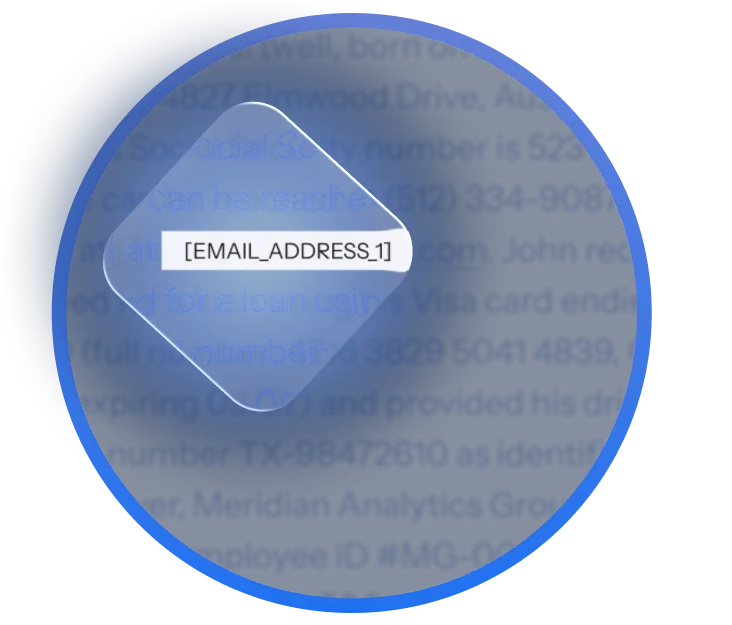
Turn your most restricted data into fuel for AI, analytics, and research with data de-identification that works inside your own environment.
Trusted for
.png)

.webp)



.png)
.avif)
From Restricted to Ready
Three steps to compliant, usable data, whether you're building AI models, sharing with partners, or satisfying an auditor. Works on text, documents, images, and audio across 52+ languages.
.png)
Detect What Matters
.png)
Transform for Your Use Case
.png)
Deploy in Your Environment
Built for
Real-World Data
Japanese call transcripts. French clinical trial documents. Scanned German PDFs. Millions of audio files. Code-switching in customer chats. Whatever shows up in production, we handle it.

Most Tools Match Patterns. We Read Context.

Your Data Never Leaves Your Environment

Months of Compliance Work in Minutes

Any Data. Any Format. Any Language.

Audit-Ready by Default
Providence Health
99.5%+
0
Shipped
The AI was ready. The data wasn't.
Years of valuable clinical data sat unused because it contained too much PHI to safely feed into AI models. Providence wanted to build a smart assistant for physicians using EHR data and conversation transcripts, but privacy requirements had the project stuck in limbo.
Limina unlocked it.
Limina automated PHI removal from physician conversations and EHR records entirely within Providence's own environment. Providence evaluated major cloud providers but rejected them over data usage concerns. Container deployment meant sensitive data never left their infrastructure.


Limina's integration was seamless and exactly what we needed to scrub all the PII out of our datasets.
Development Manager,
Providence

Frequently Asked Questions
What entity types does Limina detect?
Over 50 entity types covering PII, PHI, and PCI across 52 languages. Standard entities include names, addresses, phone numbers, emails, dates of birth, and government IDs. Healthcare-specific detection covers medical record numbers, prescription identifiers, and clinical codes. Financial entities include credit cards, bank accounts, and transaction IDs. We also catch region-specific identifiers like Canadian SINs, Japanese My Number IDs, UK NHS numbers, and EU tax identifiers. For the complete entity list and detection capabilities by language, visit our documentation.
How does data linking work?
Co-reference resolution connects entities that refer to the same person, place, or thing across your text. When a document mentions "Dr. Sarah Chen" and later references "the physician," we link those mentions together.
Relation extraction goes further by identifying how entities connect. For example, we surface which date of birth, origin, or kinship relationships belong to which patient.
Can I customize detection for our specific use case?
Yes. You can adjust detection in several ways depending on what you need. Start by choosing which of our 50+ entity types to scan for. If you only care about health data, enable PHI entities and skip everything else. If you need GDPR compliance, use our preset entity group that covers all GDPR-defined personal data. You can also add regex patterns to catch domain-specific identifiers like internal employee IDs, claim numbers, or product codes that follow a predictable format. For example, if your employee IDs always look like "EMP-12345," add a block filter with that pattern and we'll detect them as sensitive data. For entities that need context to identify (not just a pattern), we can adjust our models with de-identified examples that resemble your data. This works well for things like custom medical terminology, regional identifiers, or industry jargon that our base models might miss. Custom entity training is available on select plans.
How does Limina compare to general-purpose NER tools?
We tested approximately 45,000 words across multiple real-world domains, comparing Limina against major cloud providers' general-purpose PII detection products. The results show why specialization matters.
General-purpose solutions miss between 13.8% and 46.5% of PII entities in real-world data. Limina misses between 0.2% and 7% across the same datasets. That difference is everything when missed PII can lead to data breaches, regulatory fines, and lost customer trust.
Six years of focused development on PII detection challenges produces fundamentally different results than general-purpose products built for broader use cases.
We've gone head to head against other products in POCs for the last 6 years, and the pattern holds: customers consistently choose Limina when they test accuracy on their own data.
When a multinational insurance company tested other products for Japanese data, they failed completely. Limina delivered the accuracy they were looking for.
Download our whitepaper for detailed methodology, results, and head-to-head comparisons.
What formats and data sources does Limina work with?
Limina integrates with your existing data infrastructure through REST APIs and containerized deployment. You can process data from databases, data warehouses like Snowflake, cloud storage (S3, Azure Blob, GCS), streaming pipelines, or any system that can make API calls.
Text and Documents: We process plain text, PDFs (both native and scanned), Word documents (DOC/DOCX), PowerPoint (PPT/PPTX), and Excel (XLS/XLSX) files. We also support CSV, JSON, and XML.
Images: Image processing handles both visual and textual PII. We detect faces and license plates automatically, plus run OCR to find any text in the image. Supported formats include JPEG, PNG, TIFF, BMP, and GIF.
Audio: For audio files like WAV, MP3, and M4A, we first generate a transcript using automatic speech recognition, then we scan that transcript for PII.
Structured data: When processing tabular data from databases, CSV files, or JSON, Limina uses the column headers as context. So if you have a column called "PatientNotes" next to "DateOfBirth," the system understands what each field contains and catches PII that might otherwise look like random numbers.
Deploy our container in your cloud environment or on-premises to keep data in your infrastructure.
We're always adding new formats and deployment options. If you need something not listed here, reach out and we can share our timeline.