PII in email is personally identifiable information—names, addresses, government identifiers, account numbers, health details and employee records—that sits inside message bodies, subject lines and attachments rather than in a governed database field. For most enterprises, email is the single highest-volume source of unstructured PII they hold, which makes email data privacy the hardest gap to close.
The reason is behavioral. Employees paste customer records into messages to resolve issues. Vendors attach spreadsheets. Every one of those messages is retained, indexed, backed up and, increasingly, fed into analytics or AI pipelines.
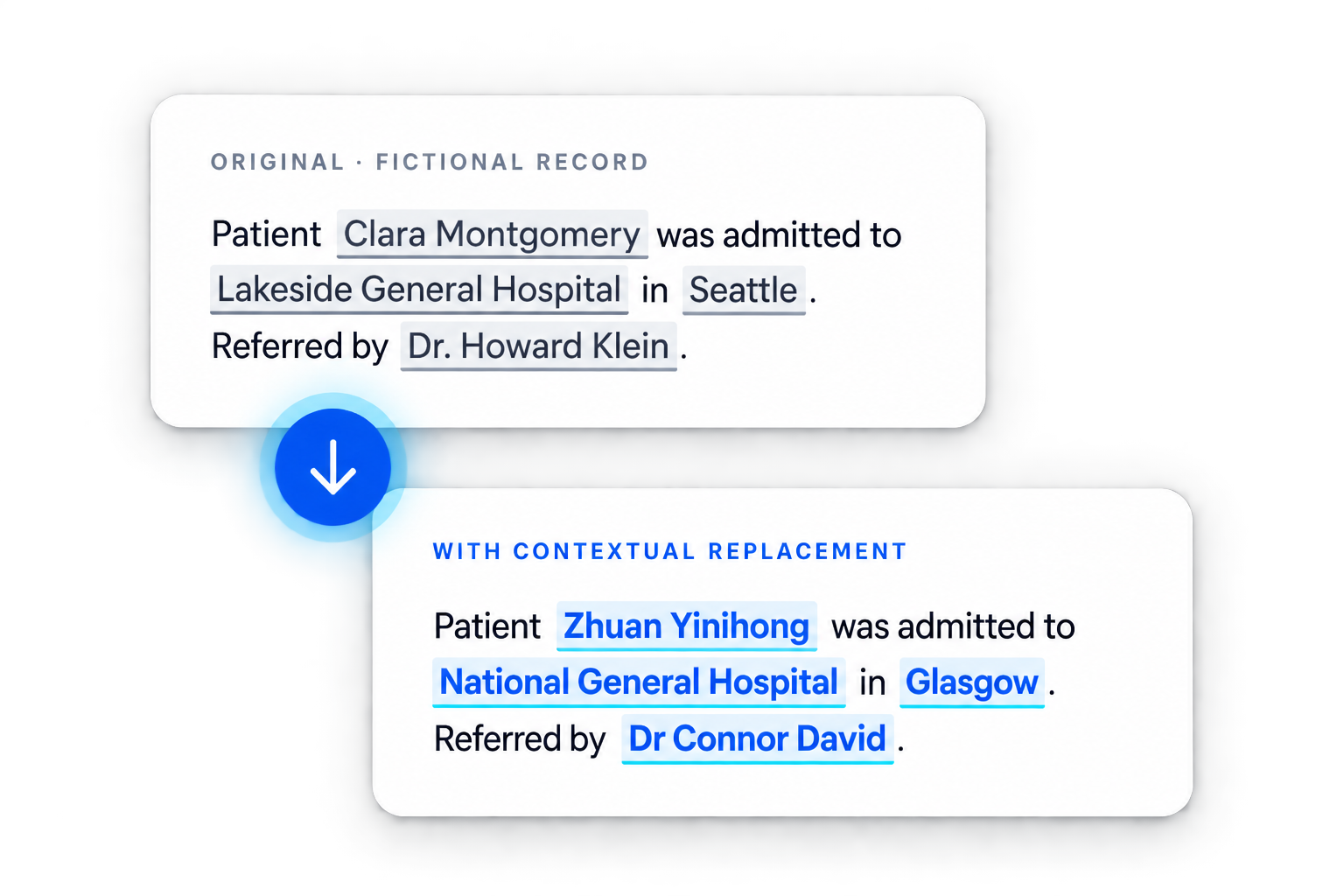
Definition: email redaction Email redaction is the automated detection and removal or replacement of personally identifiable information across message bodies, headers, subject lines and attachments. Unlike keyword filtering, it uses natural language processing to classify entities in context, so an account number is treated differently from an order number and a person's name is distinguished from a company name.
If you're someone who deals with email archives, the question isn't whether your archive holds PII in email. It's how you find and remove it at a volume where manual review is impossible—which makes email the sharpest instance of the broader unstructured data privacy problem.
Types of PII in email: what actually accumulates
Email collects every category of regulated data because it's the default channel for exceptions—the cases that don't fit a form or a workflow.
| Category |
What appears |
Where it usually enters the thread |
| Direct identifiers |
Names, home and work addresses, phone numbers, dates of birth |
Customer correspondence, internal coordination |
| Government identifiers |
Social Security, passport, driver's license and tax numbers |
Onboarding, identity verification, human resources |
| Financial and payment card industry (PCI) data |
Bank and routing numbers, card numbers, invoice and loan references |
Finance, collections, claims and billing threads |
| Health information |
Conditions, accommodations, treatment and insurance detail |
Benefits enrollment, leave requests, carrier correspondence |
| Employee data |
Reviews, disciplinary records, compensation, background checks |
Manager and human resources threads |
| Attachment payloads |
Everything above, plus signatures and identity documents |
PDFs, spreadsheets and scans attached to any of the above |
Health information is the row most often misjudged: whether it qualifies as protected health information depends on sender and context rather than content alone, and the boundaries are set out in this guide to PII, PHI and PCI. Employee data is the row most often ungoverned. In financial services, the identifier rows carry supervisory obligations beyond privacy law.
A single 40-message service thread routinely holds a customer name, address, partial card number, order history and a screenshot of an identity document. None of it is labeled—the same unlabeled-by-default condition that makes PDFs and chat logs equally hard to govern.
The scale problem: why manual email redaction doesn't work
Manual review breaks on four dimensions at once, and the failure is arithmetic rather than reviewer diligence.
Volume. A mail archive is years of retained correspondence across every mailbox, and each message is a separate object with its own body, headers and attachments. Review effort scales with that object count. Compliance headcount does not.
The clock. Privacy rights come with fixed statutory deadlines. Under the General Data Protection Regulation (GDPR), a controller must respond to a data subject request within one month, extendable by two further months for complex cases. Under the California Consumer Privacy Act (CCPA), a business has 45 calendar days, extendable once to 90 in total. Manual search across an unindexed archive does not reliably fit inside either window.
Consistency. Two reviewers judge the same ambiguous string differently—one redacts a reference number, the other leaves it. Inconsistent output supports no defensible claim about the corpus.
Exposure. Manual redaction requires humans to read content in order to remove it, so for an archive holding health or employee data the review itself widens access to material that should be narrowly held.
Manual review also handles the body and stops. Headers, quoted replies, attachments and metadata all carry PII, which is why the manual versus automated redaction tradeoff resolves in one direction at enterprise scale.
Use cases that require redaction at archive scale
Most organizations act because a specific initiative forces the question.
| Use case |
What triggers it |
What redaction has to preserve |
| AI training and fine-tuning |
Building models on internal correspondence |
Linguistic structure and intent, so the model still learns |
| Vendor and partner data sharing |
Analytics, quality review or offshore support |
Analytical fields such as dates, categories and sentiment |
| Litigation holds and eDiscovery |
Producing responsive documents to opposing counsel |
Evidentiary content while protecting third-party PII |
| Subject access and deletion requests |
GDPR and California consumer requests |
The ability to locate every mention of one individual |
| Data lake and warehouse ingestion |
Consolidating mail into an analytics platform |
Thread structure and metadata for downstream joins |
| Long-term archive retention |
Regulatory retention with minimized risk |
Enough content to satisfy the retention obligation |
Manual redaction can't keep up with your inbox.
Automate detection across message bodies, headers, quoted replies and attachments, with an audit trail for every redaction.
Request a Demo
The AI case is growing fastest. Enterprise correspondence is attractive training data—domain-specific, conversational and abundant—and saturated with PII that a model trained on it can reproduce, which puts email squarely inside GDPR obligations across the model lifecycle.
Process your archive, not a sample. Limina processes email archives in bulk through pipeline or API integration, so redaction runs where your data already lives. See how it works with your data stack.
How automated email redaction works
Automated redaction is a detection problem before it's a removal problem, in four stages.
- Parse the full message. Extract the body, subject, headers, quoted reply chains and attachments, which need format-specific handling: text extraction for documents, optical character recognition for scans.
- Detect entities in context. A trained model classifies each candidate span by reading the surrounding language. This is what separates it from pattern matching—the same 10-digit number is an order number in "your order 4483920117 shipped" and an account number in "the balance on account 4483920117". A regular expression cannot tell them apart. A context-aware model can.
- Apply a transformation policy per entity type. Redact values, replace them with realistic surrogates that preserve linguistic structure or tokenize them where authorized re-identification is required.
- Log the result. Record every detection, its type and confidence, the transformation applied and the policy version, producing the audit trail regulators ask for.
Context matters just as much for names. "April" is a month in one sentence and a person in the next; "Ford" is a surname, a manufacturer and a place. Handling these consistently separates a usable redacted corpus from one that either leaks identifiers or is over-redacted into uselessness.
Where email redaction belongs in your pipeline
Placement determines whether this works: two defensible positions and one common mistake.
- At ingestion, as a processing step between the mail export and the destination store. Messages are parsed, redacted and only then written to the data lake, warehouse or training corpus. This is the correct default, because the destination never holds raw identifiers.
- As a service call inside an existing extract, transform and load job, where a redaction application programming interface (API) is invoked per message or per batch and the response is what gets persisted. Use this when rewriting the pipeline is impractical.
- The mistake is redacting the destination store after loading. The raw archive has already been copied into a second governed system, both copies are in scope, and you have doubled the surface area rather than reduced it.
GDPR Article 17 and CCPA deletion obligations for email archives
Deletion rights are where email archives create acute exposure, because honoring them requires finding every mention of one person across an unindexed corpus.
Under Article 17 of the GDPR, a data subject has the right to obtain erasure of personal data without undue delay where specified grounds apply, and the controller has a corresponding obligation to erase. It applies wherever the data is held: message bodies, attachments, backups and the quoted copy sitting in every recipient's mailbox. California's regime runs parallel, giving consumers a right to request deletion subject to statutory exceptions, with the business required to direct its service providers to do the same.
Three difficulties follow:
- Copies multiply. One message exists in sent items, every recipient inbox, the archive, the backup and any analytics copy.
- Search misses. Keyword search skips messages that reference someone by nickname, role or context, and skips attachments entirely without content extraction.
- Deletion conflicts with retention. Legal holds may require keeping the message, in which case removing the personal data from the retained copy is the workable path.
That last case is why de-identification and deletion are related strategies rather than alternatives. Be precise about what redaction achieves, though: under GDPR, pseudonymized data remains personal data and stays in scope, and only genuine anonymization—where re-identification is no longer reasonably possible—removes content from scope. Stripping identifiers materially reduces risk and can satisfy a deletion request against a retained copy, but it does not automatically end your obligations.
How Limina handles PII in email at scale
Email breaks most redaction tooling in a specific way: the message is not the unit of work.
| Message layer |
Typical contents |
Why body-only tools miss it |
| Body |
Names, identifiers, health and financial detail |
Usually covered |
| Subject line and headers |
Names, case and account references, routing detail |
Treated as metadata, not content |
| Quoted reply chain |
Every identifier from earlier in the thread |
Skipped as duplicate text |
| Attachments |
Statements, forms, scans, identity documents |
Needs format-specific extraction and OCR |
Limina processes those layers together across more than 50 entity types and 52 languages, so an archive is redacted as a batch job rather than a manual project. Multilingual coverage matters more here than in most formats: correspondence arrives in whatever language the customer wrote in, and translating it to redact it just creates another copy. Deployment is in-VPC or on-premises, which is usually non-negotiable once the archive holds employee records alongside customer ones. Reported accuracy is 99.5 percent or higher on real healthcare data, and email sits closer to conversational text than to structured records, so the same context resolution carries over.
Next steps
Email is where your unstructured PII concentrates, and it's the corpus most likely to be pulled into an AI project, shared with a vendor or targeted by a deletion request. Handling it upstream is cheaper than remediating afterward.
Book a 30-minute call with a Limina engineer to walk through your archive and integration path.
Documents present a different set of problems—embedded metadata, form fields and scanned pages. Continue with PDF privacy risks: how personal data hides in documents.