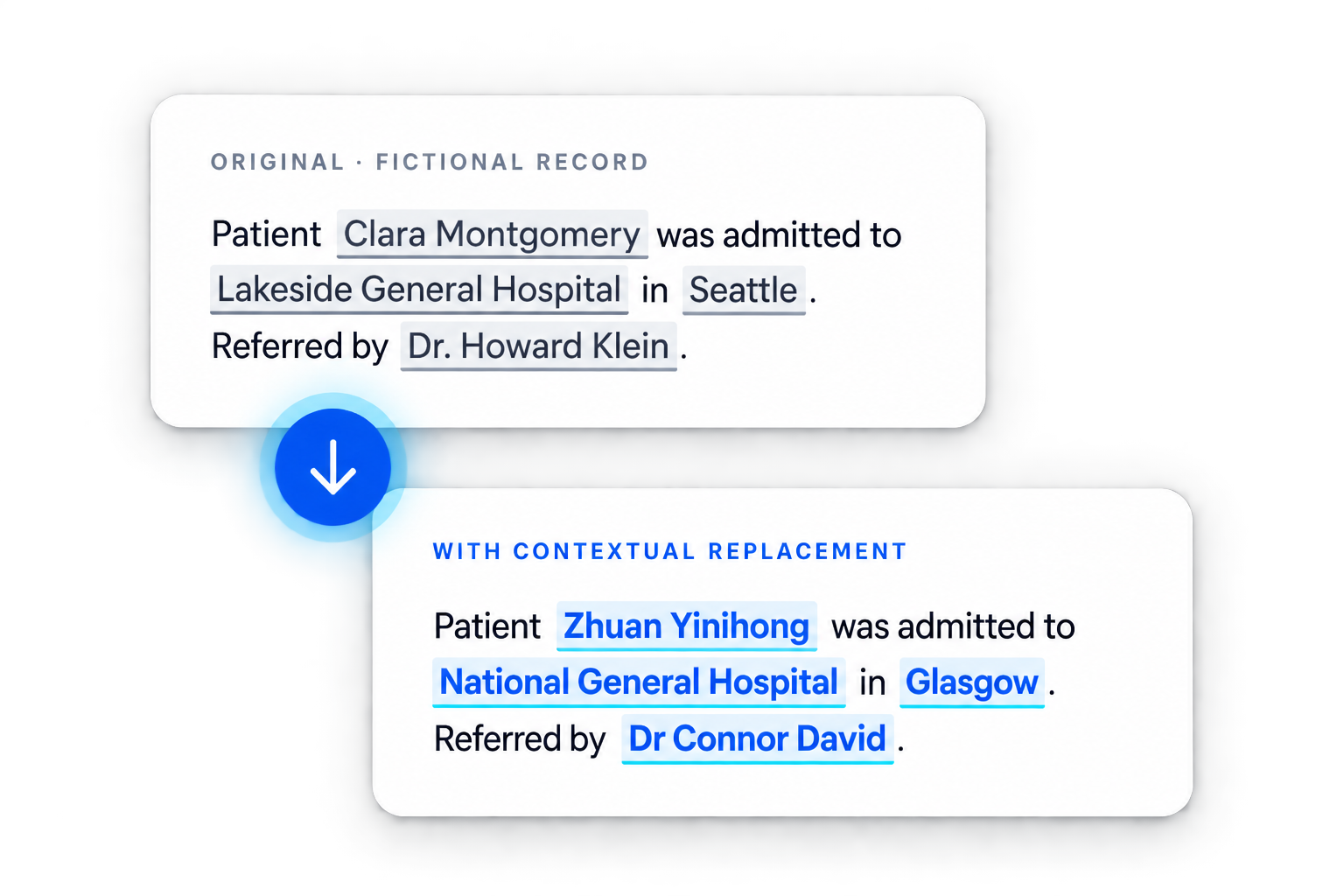
AI training data privacy is the practice of removing personal data from a training corpus before it reaches a model, rather than trying to control the model's behavior afterward. It matters because a model trained on raw enterprise text absorbs every identifier in that text—and can reproduce it in output.
Picture the concrete version. A health system fine-tunes a language model on five years of clinical notes to draft discharge instructions. A clinician later prompts it about a rare presentation, and the model completes the passage with a real patient's name and admission date, because that combination appeared in the training data and the model memorized it. Nothing was hacked. The model did exactly what it was trained to do.
Definition: AI training data privacy AI training data privacy covers the controls applied to personal data inside a training or fine-tuning corpus—identifying personally identifiable information (PII), protected health information (PHI) and payment card industry (PCI) data in unstructured text, then removing or replacing it before ingestion. Because you cannot reliably remove specific records from a trained model afterward, the control point sits upstream, in the data pipeline.
If you're someone who deals with AI training data, you've probably found this problem partway through a project. This article covers what enterprise AI trains on, why raw corpora create exposure, what memorization means in practice, what regulators expect and how the main de-identification methods trade off against model performance.
What unstructured data trains enterprise AI
Enterprise AI projects rarely train on public data alone. The value comes from proprietary content, and proprietary content is overwhelmingly unstructured—the same unstructured data privacy risks that apply to your archives apply to your training corpus, only with less ability to correct them later.
- Email and internal correspondence for tone, domain vocabulary and process knowledge
- Support tickets and chat logs for customer service assistants and triage models
- Call transcripts for quality analytics, summarization and agent-assist tools
- Clinical notes, radiology reports and discharge summaries for healthcare AI, and trial documentation for pharma and life sciences models
- Contracts and policy documents for legal and procurement assistants
- Knowledge base articles and internal wikis for retrieval systems
Retrieval-augmented generation (RAG) deserves separate mention, because teams often assume it sidesteps the problem. It doesn't. RAG doesn't train on the documents, but it does index them, embed them and surface their contents in responses—which means personal data flows to the user at inference time instead of being memorized at training time. The specific controls that apply are covered in the RAG privacy guide.
The same logic applies to employees pasting customer data into commercial chat assistants, an adjacent exposure examined in protecting confidential corporate information.
AI training data privacy: why raw text is a compliance liability
Three frameworks bear on training data, and it's worth being precise about what each one actually requires.
Health Insurance Portability and Accountability Act (HIPAA). The Privacy Rule requires covered entities to make reasonable efforts to limit protected health information to the minimum necessary to accomplish the intended purpose. Training a model on complete clinical notes—patient names, addresses, record numbers and all—is difficult to justify under that standard when the clinical language alone serves the purpose. Data that meets the HHS de-identification standard falls outside the Privacy Rule entirely, which is the cleaner path.
General Data Protection Regulation (GDPR). Personal data used for training requires a lawful basis under Article 6, and the principles of purpose limitation, data minimization and storage limitation apply to the corpus. Article 22 is also relevant, though often cited imprecisely: it grants data subjects the right not to be subject to decisions based solely on automated processing that produce legal or similarly significant effects. That governs how you deploy a model rather than what you train it on, but it drives documentation and explainability obligations that are far easier to meet when your training data provenance is clean.
California Consumer Privacy Act (CCPA) and California Privacy Rights Act (CPRA). California's regime requires that collection, use and retention of personal information be reasonably necessary and proportionate to the disclosed purpose, and gives consumers a right to request deletion. Both obligations are awkward to satisfy when personal data has been absorbed into model weights.
The structural problem underneath all three is that a trained model is not a database. You can delete a row. You cannot reliably delete a person from a set of weights without retraining, and retraining a large model to honor a single deletion request is not a viable operational answer. That asymmetry is what makes AI training data privacy a pipeline decision rather than a governance policy.
What happens when a model memorizes PII
Memorization is not a theoretical risk. Security researchers have demonstrated repeatedly that training data can be recovered from deployed models.
Carlini and colleagues showed in their USENIX Security work that training data can be extracted from language models by querying them, recovering verbatim sequences including personal information that appeared in the training corpus. Later work by Nasr and colleagues demonstrated scalable extraction against production models, showing that alignment techniques reduce but do not eliminate the exposure.
Three practical consequences follow for enterprise deployments.
Adversarial extraction. An attacker who can query your model can attempt to elicit memorized sequences. If your fine-tuning corpus contained account numbers or patient identifiers, those are candidates for recovery.
Incidental leakage. More common: the model completes a plausible-sounding passage using a real name, address or reference number because that string was statistically available. No attacker is required.
Unanswerable subject requests. When a customer asks whether their data was used to train your model and requests removal, "we removed it from the source dataset" is not the same answer as "it is not in the model." If the raw data was ingested, the honest answer is uncomfortable.
Risk concentrates where data repeats. The same extraction research found that sequences appearing many times in a corpus are markedly easier to recover than sequences appearing once, which matters more than teams expect: forwarded email chains, template documents and repeated case notes duplicate the same identifiers across a corpus without anyone intending it. Clinical text carries the highest concentration of this problem, and the detection requirements it imposes are covered in de-identifying unstructured PHI.
De-identify before ingestion. Limina integrates with your training pipeline to remove PII, PHI and payment card data before it reaches the model. See how pipeline de-identification works.
Stop letting PII slow down your AI innovation.
Learn how automated de-identification removes PII, PHI and payment card data from your training pipeline without sacrificing model accuracy.
Get the Guide
What regulators expect before you train on personal data
No regulator has published an AI training data privacy rulebook, but existing positions map onto training corpora clearly enough to plan against. Two expectations do most of the work.
The first is that de-identification is a defined standard, not a best effort. Under HIPAA, data is de-identified when it meets Safe Harbor or Expert Determination—and the HHS guidance is explicit that for Expert Determination, the methods and results justifying the determination must be documented and made available to the Office for Civil Rights on request. Under GDPR, the accountability principle puts you in the same position: you have to be able to demonstrate compliance, not assert it.
The second is that the demonstration has to describe the data you actually trained on. That means a record of what was detected, what was transformed, under which policy version, at which point in the pipeline. Broader background on preparing corpora to this standard is in de-identification for AI training data.
Both expectations point the same way operationally: de-identification is a pipeline stage, not a review step. A workable sequence looks like this.
- Inventory the dataset. Catalog every source feeding the pipeline, including the ones added informally—an exported ticket dump, a shared drive of PDFs, a transcript archive.
- Normalize formats. Extract text from documents, apply optical character recognition (OCR) to scans and images, and transcribe audio with automatic speech recognition (ASR). Anything you can't read, you can't clean.
- Detect entities in context. Classify names, identifiers, dates, locations and financial values by meaning rather than pattern.
- Transform per policy. Redact, pseudonymize or tokenize according to what the downstream model actually needs.
- Log and version. Record detections, transformations, policy version and corpus hash, so you can demonstrate what the model was trained on.
- Validate a sample. Human-review a statistically meaningful sample before the corpus is committed to training.
Positioning matters. Consider where the de-identification stage sits in a typical pipeline:
raw sources (email, tickets, notes, transcripts, PDFs)
│
▼
extraction and normalization (OCR, ASR, text extraction)
│
▼
de-identification stage ← detection + transformation + audit log
│
▼
training corpus store (contains no direct identifiers)
│
▼
training, fine-tuning and embedding
Teams commonly place de-identification after the dataset store, as a cleanup pass. That's the wrong position, because the raw data has already been copied into a governed system and every copy is in scope.
Methods and their tradeoffs for model performance
Three approaches dominate, and they are not interchangeable.
| Method |
What it does |
Effect on model utility |
Best fit |
| Full redaction |
Removes identifiers entirely, often leaving a placeholder token |
Can disrupt sentence structure if applied bluntly; safe and simple |
Archives, vendor sharing, datasets where identity context is irrelevant |
| Pseudonymization |
Replaces identifiers with consistent, realistic surrogates |
Preserves grammatical structure and co-reference, so models learn normal language |
Most training and fine-tuning work on conversational or clinical text |
| Synthetic data generation |
Produces artificial records modeled on the original distribution |
No real identifiers, but distribution fidelity and rare-case coverage suffer |
Augmenting scarce data, testing, cases where real text can't be used at all |
Pseudonymization is usually the strongest fit for training. Replacing "Maria Alvarez" with a consistent surrogate name keeps the sentence grammatical and keeps co-reference intact across a document, so the model learns how clinical or customer language behaves rather than learning to parse a string of redaction placeholders. Blunt redaction that turns every name into [REDACTED] teaches the model a pattern that does not exist in the text it will see at inference time.
Two implementation details deserve care. Surrogate consistency should hold within a document but not necessarily across the corpus, or you risk creating a stable pseudo-identifier that supports re-identification. And date shifting should preserve intervals within a patient or case record, since the clinical or behavioral signal usually lives in the interval rather than the absolute date.
How Limina de-identifies training corpora
Training corpora impose one requirement that other de-identification work does not: the output has to remain good training data. A tool that reduces every name to an identical placeholder has protected the corpus and damaged it, because you have taught the model a token that will never appear at inference time.
Limina handles this through consistent surrogate replacement rather than blunt removal, preserving co-reference within a document so the language stays natural, across more than 50 entity types and 52 languages. Deployment is in-VPC or on-premises, so raw training data is never shipped elsewhere to be cleaned—which would reproduce the exposure you are trying to remove. Detection and transformation logs give you the record of what the model was trained on that regulators and customers ask for. Reported accuracy on real healthcare data is 99.5 percent or higher, with entity coverage extending to the account numbers, card data and transaction references that dominate financial text.
Integration is an API or pipeline call, which lets the de-identification stage sit at the position shown in the diagram above rather than run as a separate manual pass:
# Pseudocode: de-identification stage inside a training pipeline
# [VERIFY] Confirm client name, parameters and response fields against
# current API documentation before publishing.
for document in raw_corpus:
text = extract_text(document) # PDF, DOCX, transcript, email body
result = client.process_text(
text=text,
entity_types=["NAME", "DATE", "MRN", "ACCOUNT_NUMBER"],
transformation="synthetic", # consistent surrogates, not placeholders
)
training_store.write(result.processed_text)
audit_log.write(document.id, result.entities_detected, policy_version)
Next steps
The compliance decision in AI is made in the data pipeline, not in the model. Once raw personal data has been ingested, your options narrow to controls that are expensive, partial or both. Getting AI training data privacy right upstream is cheaper than every alternative downstream.
Book a demo to see de-identification run against your own training corpus inside your own environment, or review the data de-identification platform for pipeline integration and entity coverage details.