Unstructured PHI is protected health information (PHI) that exists outside structured electronic health record (EHR) systems, likein clinical notes, radiology reports, discharge summaries, emails and call recordings,and is not covered by standard database access controls.
It's also where most of the health information in your organization actually sits. Your EHR governs the coded, structured layer: problem lists, medication orders, lab values. The narrative layer around it: what the physician dictated, what the nurse typed overnight, what the patient said on a recorded call,carries the same regulatory weight and almost none of the same controls.
Definition: unstructured PHI Unstructured PHI is individually identifiable health information contained in free-form content rather than in defined database fields. It includes dictated and typed clinical notes, imaging reports, referral letters, patient emails, faxes, scanned records and audio consultations. Because identifiers appear inside narrative text rather than labeled fields, unstructured PHI requires content analysis to locate before it can be de-identified.
If you handle unstructured PHI at a healthcare organization, this creates a specific operational problem. Research teams, analytics groups and artificial intelligence (AI) projects all want the narrative data, because that's where the clinical signal is. Legal and compliance can't release it, because nobody can demonstrate that the PHI has been removed. This article covers where unstructured PHI lives, why EHR controls don't reach it, what the Health Insurance Portability and Accountability Act (HIPAA) actually requires for free text and how natural language processing (NLP) makes PHI de-identification reliable enough to close the gap.
Where unstructured PHI lives
Start with an inventory, because the sources are more numerous than most organizations expect. Each of the following is routinely stored outside EHR access controls, often in systems owned by different departments.
| Source |
Typical identifiers it carries |
System that usually owns it |
| Free-text clinical notes |
Patient and provider names, facility names, service dates, relatives' names |
EHR export, data warehouse, research extract |
| Radiology and pathology reports |
Ordering physician, prior study dates, identifying circumstances |
Imaging or lab information system |
| Lab reports and result narratives |
Accession numbers, collection dates, ordering clinician |
Laboratory information system |
| Discharge summaries and referral letters |
Names, dates, locations, dense contextual detail |
Document management, outbound fax queue |
| Provider and patient email |
Names, appointment details, attached records, patient questions |
Mail server and archive |
| Audio consultations and voicemails |
Everything spoken aloud, plus caller metadata |
Telehealth platform, dictation vendor |
| Scanned and faxed records |
Handwritten intake, consent forms, outside records |
Imaging archive, shared drive |
| Claims and prior authorization files |
Conditions, treatments, patient circumstances |
Payer platform, clearinghouse |
Three of these deserve specific attention. Email archives are rarely scoped into PHI governance programs and are almost never de-identified, even though care coordination threads carry names alongside conditions. Audio becomes searchable text the moment it is transcribed, usually in a second system owned by a speech vendor. Scanned and faxed records arrive as images and require optical character recognition (OCR) before any detection is possible at all.
A useful test: if a document was written for a person to read rather than for a system to query, assume it contains unstructured PHI until proven otherwise. The same inventory problem shows up across healthcare providers, payers and their vendors, because each holds a different slice of the same patient narrative.
Why EHR controls don't cover unstructured PHI
Your EHR does its job well. The problem is scope. EHR access controls govern who can open a chart inside the EHR. They do not reach content after it has been exported, transcribed, attached to an email or copied into a research extract.
Four gaps recur across health systems:
- Export breaks the boundary. The moment a note is pulled into a data warehouse, a research file or a vendor platform, role-based EHR permissions no longer apply.
- Attachments travel. A referral letter attached to an email is governed by mail retention policy, not chart access policy.
- Transcription creates copies. Dictation and telehealth audio typically pass through a speech vendor, producing text files in a second system.
- Departmental systems hold parallel records. Radiology, pathology, billing, patient relations and contact center platforms each store narrative content that never entered the EHR at all.
The compliance consequence is straightforward. HIPAA obligations attach to the information, not the application, which is why unstructured data privacy risk has to be governed at the content layer rather than the system layer, and why the boundary between PHI, personally identifiable information (PII) and payment card data (PCI) matters operationally when a single support email carries a diagnosis, a home address and a partial card number in the same paragraph.
HIPAA requirements for unstructured PHI: Safe Harbor vs Expert Determination
The U.S. Department of Health and Human Services (HHS) recognizes two methods for de-identifying protected health information. Both are available for free text, but they behave very differently when applied to narrative content.
Safe Harbor requires removing 18 specified categories of identifiers, including names, geographic subdivisions smaller than a state, all date elements other than year that relate to an individual, telephone numbers, email addresses, medical record numbers (MRNs), account numbers, biometric identifiers and full-face photographs. The covered entity must also have no actual knowledge that the remaining information could identify the individual. The method is deterministic and easy to explain to auditors, provided you can account for every one of the 18 identifier categories wherever they appear in narrative text.
Expert Determination relies on a person with appropriate knowledge of statistical and scientific principles documenting that the risk of re-identification is very small. It permits retaining elements that Safe Harbor would strip—admission dates, for example—when the expert can justify the residual risk. The expert determination process is documented and repeatable, but it requires expert involvement and ongoing governance.
| Consideration |
Safe Harbor |
Expert Determination |
| Basis |
Remove 18 identifier categories |
Documented statistical risk assessment |
| Date granularity retained |
Year only |
Can retain fuller dates with justification |
| Utility for longitudinal research |
Limited |
Higher |
| Expert involvement |
Not required |
Required |
| Fit for free-text clinical notes |
Workable, but demands exhaustive detection |
Common where date and geography detail matters |
| Evidence needed |
Documented removal process |
Written determination and methodology |
Safe Harbor and Expert Determination both need proof, not assurances.
See how Limina logs every detection and transformation so your reviewer has evidence, not a claim.
Talk to an Expert
The complication with free text is the same under both methods: you cannot remove what you haven't found. Safe Harbor's 18 categories are easy to enumerate in a structured table and genuinely hard to guarantee across 40 million narrative documents. This is why detection accuracy, not method selection, is usually the binding constraint.
If you also handle European patient data, the same clinical note falls under two regimes at once. The General Data Protection Regulation (GDPR) and HIPAA diverge on both counts, and the HIPAA and GDPR differences for health data change what counts as identifiable and what documentation you owe.
Why detecting PHI in free text is hard
Rule-based tools work on formats, not meaning. That's sufficient for a medical record number with a fixed pattern and insufficient for essentially everything else in a clinical note.
Consider four failure modes that appear constantly in real clinical text:
- Ambiguous proper nouns. "The patient was seen by Dr. Parkinson for suspected Parkinson disease at Parkinson Memorial." One instance is a provider name, one is a condition and one is a facility. A dictionary lookup flags all three or none.
- Context-dependent numbers. A four-digit number could be a year, a room number, a partial account or a dosage. Pattern matching cannot distinguish them, so tools either over-redact—destroying clinical meaning—or under-redact and leave identifiers in place.
- Indirect identifiers. "The patient is the mayor of a small town in Vermont who was injured in the July fire." No listed identifier appears, yet the individual is trivially identifiable. Safe Harbor's actual-knowledge provision is directly implicated here.
- Transcription and dictation noise. Speech recognition output contains misrecognitions, missing punctuation and inconsistent spellings of names. A rule expecting "MRN: 4482910" won't match the same identifier spelled out as "M R N four four eight two nine one zero" in a transcript.
The consequence compounds with volume, and the arithmetic is unforgiving. On a corpus of one million notes, a detection process that misses even five percent of identifiers leaves tens of thousands of residual PHI instances scattered through the dataset. You cannot review your way out of that, and you cannot make a defensible de-identification claim over it. This is why detection performance on your own content—not on a vendor's sample—is the number that determines whether the project is viable.
See detection accuracy on clinical free text. Limina detects 50+ PHI entity types in clinical free text with 99.5 percent accuracy. See a live demo.
How NLP-based PHI de-identification works for clinical text
Model-based de-identification treats a clinical note as language rather than as a string to pattern-match. The pipeline runs in five stages.
- Normalize the input. Convert scanned documents and faxes with OCR. Transcribe audio consultations. Extract text from PDFs, DOCX files and message bodies while preserving document structure and page position.
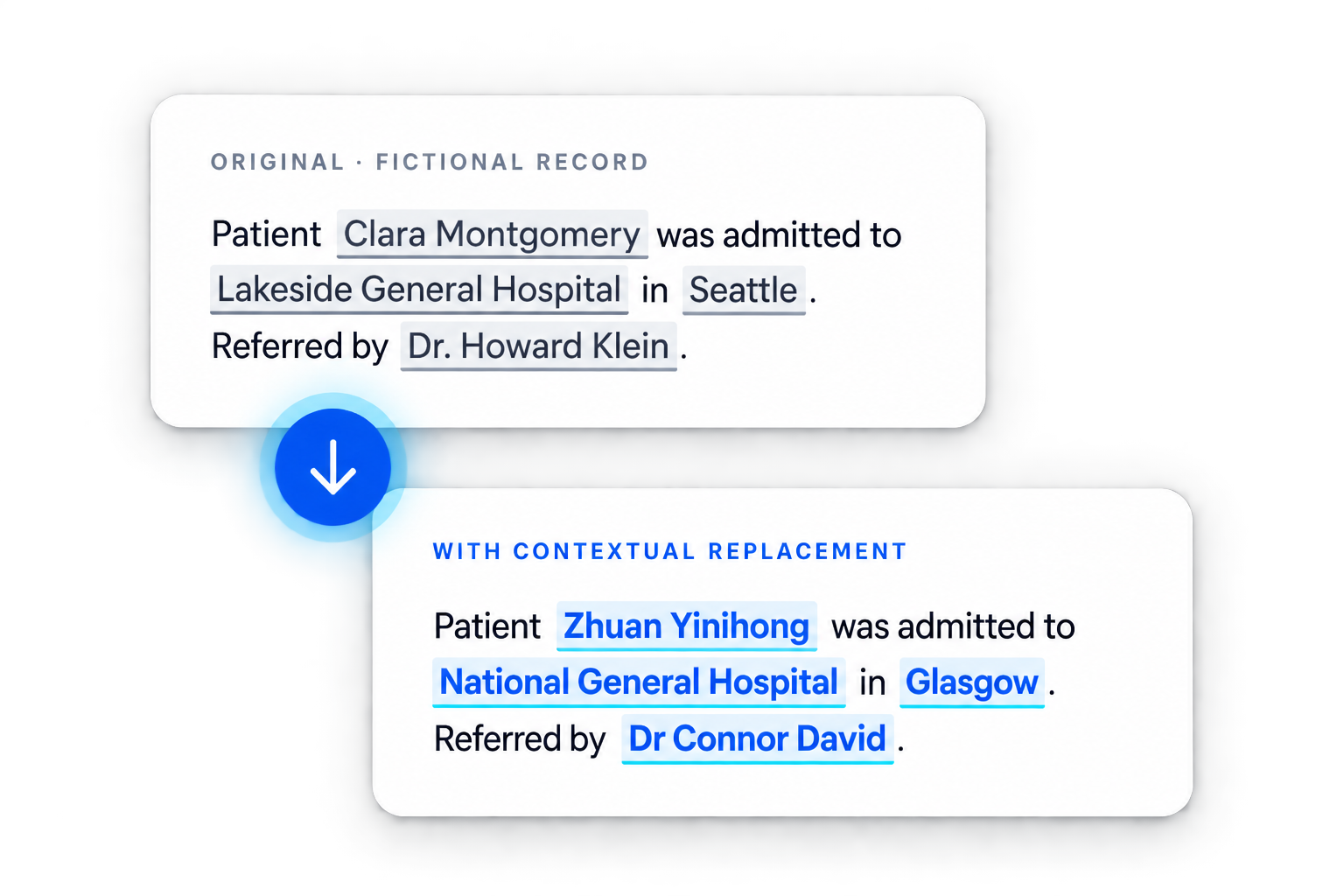
- Detect entities in context. A trained model reads the surrounding sentence to classify each candidate span—patient name, provider name, facility, date, medical record number, address, age over 89. The same string receives different labels in different contexts, which is the entire point.
- Resolve references across the document. Co-reference resolution links "she", "the patient" and "Ms. Alvarez" to one entity, so pseudonyms stay consistent and pronoun-carried identification is caught.
- Apply the transformation policy. Redact, replace with a synthetic surrogate or tokenize per entity type. Clinical research typically keeps date offsets consistent within a patient so intervals remain analyzable while absolute dates are shifted.
- Log everything. Record each detection, its confidence, the transformation applied and the policy version, so an expert determination reviewer or auditor can evaluate the process rather than take it on trust.
How to read an accuracy benchmark. A single headline number tells you very little. Ask for recall per entity type, because a tool that catches 99 percent of names and 70 percent of dates fails Safe Harbor regardless of its average. Ask what corpus produced the figure, because performance on news text or generic business documents does not transfer to dictated clinical narrative. The gap is wide in practice: de-identification accuracy research has measured general-purpose cloud detection services at roughly 60 to 70 percent on real healthcare data, against 99.5 percent or better for clinically trained models. Then run the benchmark again on a held-out sample of your own notes, because that is the only result an expert determination reviewer can rely on.
Language coverage matters more than most health systems anticipate. Patient-facing correspondence, interpreter-mediated telehealth transcripts and multinational pharma trial documentation routinely arrive in languages the primary detection model must handle natively rather than through translation, which itself creates a copy of the PHI.
Limina's approach to unstructured PHI
Clinical text imposes three requirements on PHI de-identification that general document tooling does not, and they map directly to the failure modes above.
- Detection has to be trained on clinical language. The Parkinson problem—provider name, condition and facility sharing a string—is not solvable by dictionary lookup. Limina's models classify by surrounding context rather than by pattern or dictionary match.
- PHI cannot leave the building to be cleaned. Deployment runs inside your own virtual private cloud (VPC) or on-premises, so clinical notes are processed within your own infrastructure rather than transiting to a third-party service for detection, which removes a business associate and data residency question rather than answering it.
- The determination needs evidence, not assurances. Detection logs, transformation records and policy versioning are produced during processing, which is what a qualified expert reviews when documenting residual risk.
What that buys operationally: research teams get usable narrative datasets, AI teams get corpora that don't carry PHI into a model, and compliance gets a record it can defend.
Next steps
Unstructured PHI isn't a niche category—it's the majority of the health information your organization holds, sitting in systems your EHR controls never reach. Closing that gap starts with detection you can measure and evidence you can produce.
Talk to an expert about de-identifying your clinical free text, and see how detection performs across notes, transcripts and scanned records.
If you're weighing which method to pursue, start with the HIPAA expert determination guide, then download the expert determination whitepaper for the full documentation requirements.