Unstructured data is any data that does not follow a predefined schema or format—including emails, PDFs, images, audio files, chat logs and clinical notes. It's the majority of what your organization creates every day, and it's where most of your regulated personal information actually lives.
That's the core problem with unstructured data privacy. Your database has columns, access controls and a data dictionary. Your shared drive has 40,000 PDFs that nobody has opened in three years, and at least some of them contain Social Security numbers.
Definition: unstructured data privacy. Unstructured data privacy is the practice of identifying, protecting and governing personal information that exists inside free-form content—text, documents, audio and images—rather than inside structured database fields. Because this data has no schema, privacy controls must interpret meaning and context to locate sensitive information before it can be redacted, replaced or restricted.
If you deal with unstructured data at a regulated organization, this matters for one practical reason: regulators don't care what format your data is in. The Health Insurance Portability and Accountability Act (HIPAA) applies to Protected Health Information (PHI) in a voicemail exactly as it applies to PHI in an electronic health record. This guide covers what unstructured data is, what sensitive information hides inside it, which frameworks apply and what actually works to protect it at scale.
What counts as unstructured data? Common examples by format
Unstructured data is content created for humans to read, hear or look at—not for a database to query. It has no fixed fields, so the same document can contain a name, a diagnosis, an account number and a home address with nothing marking any of them as sensitive.
Semi-structured formats sit in between. A JSON payload or an email has structured metadata (sender, timestamp, headers) wrapped around a free-text body. The metadata is easy to govern. The body is not.
The most common unstructured data examples in a regulated enterprise break down by format, each carrying its own concentration of privacy risk across emails, PDFs and chat logs.
| Format |
Common sensitive data found |
Industries most affected |
| Email and attachments |
Names, addresses, Social Security numbers, account numbers, employee records, health details |
All industries, especially financial services and HR functions |
| PDFs and scanned documents |
Full identity sets, signatures, medical record numbers, financial statements, document metadata |
Healthcare, legal, insurance, banking |
| Call recordings and transcripts |
Payment card numbers, dates of birth, verification answers, health complaints |
Contact centers, insurance, telecommunications |
| Chat logs and support tickets |
Customer identifiers, order and account numbers, complaint details, health information |
Retail, software, healthcare, financial services |
| Clinical notes and dictation |
Patient names, provider names, dates of service, facility names, diagnoses |
Healthcare, pharma, life sciences |
| Images and screenshots |
Faces, identity documents, whiteboard content, embedded text |
Insurance claims, onboarding, human resources |
| Collaboration content |
Meeting transcripts, shared files, pasted customer data |
All industries |
Why unstructured data is harder to protect than structured data
Structured data privacy is a governance problem. Unstructured data privacy is a comprehension problem. That difference explains why organizations with mature database controls still fail privacy audits on their document stores.
Four properties make unstructured data resistant to conventional controls.
There is no schema to point at. In a database, you protect the ssn column. In a 12-page contract, the Social Security number is a nine-digit string somewhere in paragraph four. No column definition tells you it's there, so no policy can automatically apply to it.
Volume compounds daily. Every email thread, recorded call, uploaded claim photo and support ticket adds new records. Unlike a database schema, which changes rarely, the unstructured estate grows continuously and nobody owns it centrally.
Format diversity breaks tooling. A tool that reads plain text won't read a scanned PDF. A tool that reads scanned PDFs won't read an audio file. Coverage gaps are where compliance failures live.
Meaning depends on context. The string "Wells" could be a surname, a hospital name or a village. A four-digit number could be a year of birth, a room number or part of an account. Rule-based tools that match patterns cannot resolve this, which is why they produce both false negatives and unusable over-redaction—the central technical argument for automated, model-based redaction over manual review.
| Dimension |
Structured data |
Unstructured data |
| Location of sensitive fields |
Known and mapped |
Unknown until content is analyzed |
| Discovery method |
Schema inspection |
Natural language processing and optical character recognition |
| Access control granularity |
Row, column, table |
File or repository only |
| Deletion request handling |
Targeted query |
Full-corpus search across formats |
| Typical audit readiness |
High |
Low without dedicated tooling |
You can't govern what you haven't found.
See how Limina detects PII, PHI and cardholder data across emails, PDFs, images and audio in one pipeline, in-VPC or on-premises.
Request a Demo
What types of sensitive data hide in unstructured sources
Three categories of regulated data show up in free-form content, and each carries a different compliance consequence: Personally Identifiable Information (PII), Protected Health Information (PHI) and cardholder data covered by the Payment Card Industry Data Security Standard (PCI DSS). The distinctions matter because they determine which framework applies, and this explainer on PII, PHI and PCI covers the boundaries in detail.
| Category |
Where it shows up in unstructured content |
Governing framework |
| PII |
Names, mailing addresses, phone numbers, order and account numbers in support threads and tickets |
General Data Protection Regulation (GDPR), California Consumer Privacy Act (CCPA) as amended by the California Privacy Rights Act (CPRA), and other applicable privacy laws depending on where the data originates and is processed. |
| PHI |
Diagnoses described in voicemails, referral letters attached to email, adjuster notes scanned into PDFs |
HIPAA (health data is also covered under GDPR, PIPEDA and LGPD, though HIPAA is the only framework that specifically defines PHI) |
| Cardholder data |
Card numbers read aloud on recorded calls or pasted into chat sessions |
PCI DSS |
PII appears everywhere. A single customer service email can contain a full name, a mailing address, a phone number, an order number and a partial payment card. None of it is flagged. All of it is regulated under the GDPR and California law.
Unstructured PHI extends well past the medical record, which is why healthcare organizations find it in places their chart controls never reach. HIPAA's identifier list includes names, geographic subdivisions, dates, contact details, account numbers and biometric identifiers, among others—and it applies wherever those identifiers appear alongside health information, regardless of the file it sits in.
Cardholder data is the most common surprise. Customers read card numbers aloud on recorded support calls. Agents paste them into chat sessions to resolve billing issues. The recording is retained for quality assurance and the transcript is stored for analytics, and now cardholder data sits in two systems that were never scoped for it.
Consider one realistic scenario. A regional insurer runs a quality assurance program on claim calls. A claimant explains a back injury, gives a date of birth to verify identity, then reads a card number to pay a deductible. That single seven-minute recording now contains PII, PHI and cardholder data at once, and it sits in a vendor platform, transcribed by a speech engine and sampled by an offshore review team. Nothing about that workflow is unusual. Everything about it is in scope, which is why contact centers and insurance carriers carry outsized exposure relative to the data they think they hold.
Unstructured data privacy under HIPAA, GDPR and CPRA
Regulators treat unstructured data the same as structured data. There is no format exemption in any major framework, which means the obligations below apply to your call recordings and shared drives as fully as to your data warehouse.
| Framework |
Core obligation |
What it means for unstructured data |
| HIPAA Privacy Rule |
Protects individually identifiable health information in any form or medium |
A voicemail, a scanned chart and a provider email carry the same duties as the electronic health record |
| HIPAA de-identification standard |
Safe Harbor removal of 18 identifier types, or Expert Determination by a qualified expert |
Identifiers are embedded in narrative rather than listed in fields, so removal requires content analysis |
| GDPR Article 17 |
Erase personal data without undue delay when specified grounds apply |
You must locate every mention of one data subject across mail archives, tickets, recordings and document stores |
| GDPR Articles 5(1)(c) and 5(1)(e) |
Data minimization and storage limitation |
Free-text notes and recordings accumulate long past the purpose that justified collecting them |
| CCPA, as amended by the CPRA |
Rights to delete, know and correct personal information, subject to exceptions |
The obligation attaches to the personal information itself, not to the system that happens to hold it |
Two of these deserve a closer look. The U.S. Department of Health and Human Services (HHS) recognizes two methods for de-identifying PHI, and once data is properly de-identified under either one, it falls outside the Privacy Rule entirely. Separately, the right to erasure under Article 17 of the GDPR has a close California analogue in the right to delete personal information, so a single deletion request can trigger obligations under both.
The practical takeaway is that de-identification changes which obligations apply—but the three frameworks set the bar in different places. Under HIPAA, data de-identified by Safe Harbor or Expert Determination falls outside the Privacy Rule. Under California law, personal information excludes deidentified information, subject to conditions on preventing reidentification. GDPR sets the highest bar: only genuinely anonymous data escapes the regulation, while pseudonymized data remains personal data with its obligations intact. That gap makes the treatment you choose a compliance decision rather than a technical one.
See it on your own data. Limina detects PII across 50+ entity types in emails, PDFs and audio, in-VPC or on-premises. Request a demo.
How organizations protect unstructured data
Effective programs run four steps in order, the sequence automated data de-identification platforms are built around. Skipping discovery is the most common failure, because you cannot govern what you haven't inventoried.
- Discover. Inventory where unstructured content lives: mail servers, file shares, ticketing systems, recording platforms, data lakes and backups. Note format, volume, retention and access.
- Detect. Run content through natural language processing that identifies entities in context rather than matching patterns. Scanned documents and images need optical character recognition first. Audio needs transcription with entity detection applied to the output.
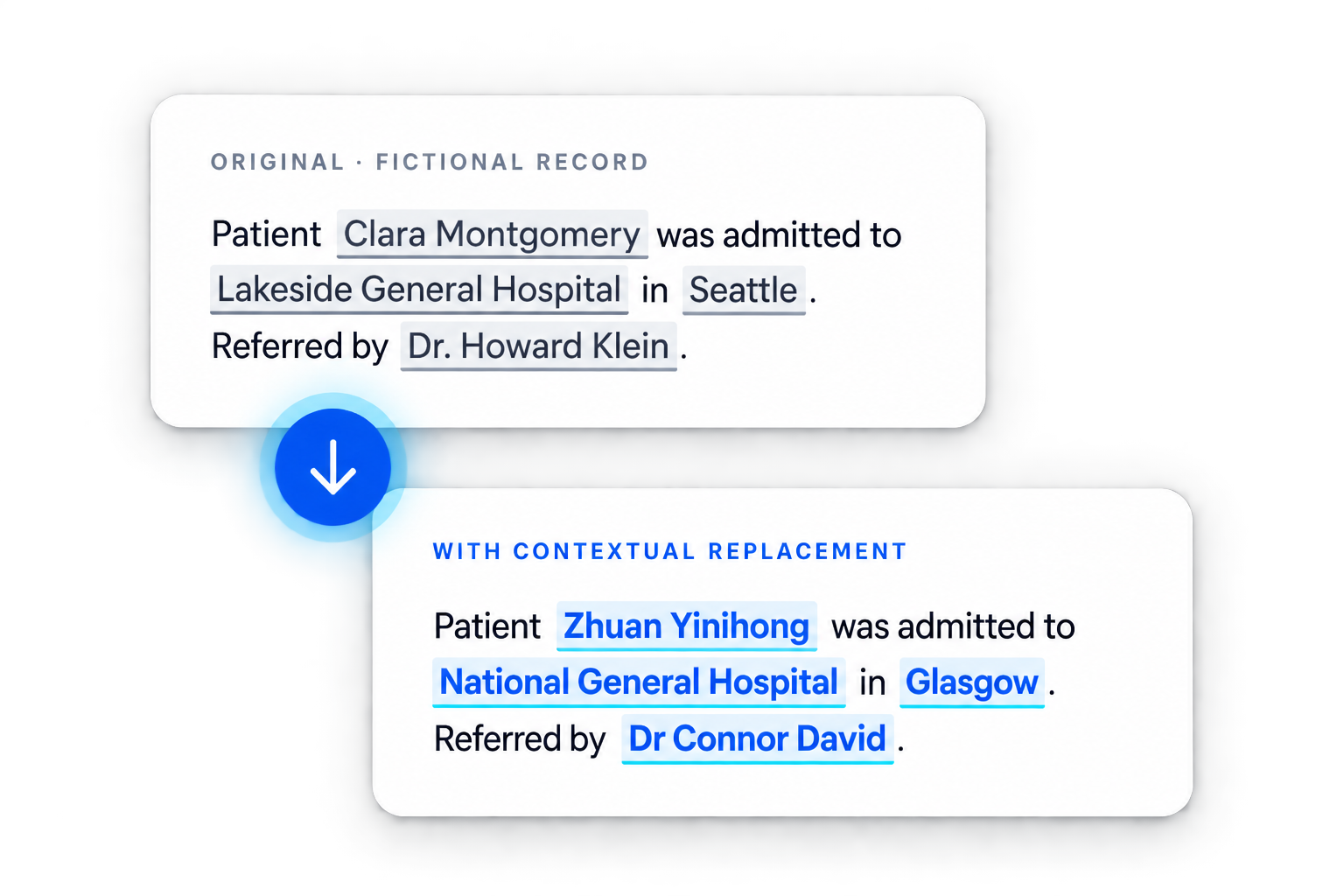
- Transform. Choose a treatment per use case. Redaction removes the identifier entirely and suits archives and vendor sharing. Pseudonymization replaces identifiers with consistent surrogates and preserves analytical utility, which matters for model training and longitudinal analysis. Tokenization swaps values for reversible tokens where authorized re-identification is required.
- Prove. Log what was detected, what was changed and under which policy version. Auditors and expert determination reviewers all ask for this evidence, and reconstructing it afterward is rarely possible.
Step three is where most programs go wrong. Redaction is safer but destroys utility, while pseudonymization keeps data analytically useful at the cost of re-identification risk when surrogate mappings are poorly governed. Match the method to the downstream purpose rather than applying one approach everywhere.
How Limina approaches unstructured data
The problem this article describes is a coverage problem before it's an accuracy problem. Most organizations end up with a redaction tool for documents, a separate one for audio and nothing at all for images, which leaves the gaps exactly where the formats meet—an attachment inside an email, a scanned insert in a PDF, a screenshot pasted into a ticket.
Limina runs detection across text, documents, images and audio in one pipeline, so a mixed-format record is processed completely rather than in the parts each point tool happens to read:
- Formats: plain text, documents, images and audio in a single pipeline
- Coverage: 50+ entity types across 52 languages, including code-switching within a single sentence
- Deployment: in-VPC or on-premises, so content never leaves your control boundary
- Evidence: detection and transformation logs produced during processing, not reconstructed afterward
Detection quality on this content depends on resolving context—separating a patient name from a drug name from a hospital name in the same sentence—which is where pattern-based matching breaks down. In-house benchmarking on real healthcare data puts accuracy at 99.5 percent or higher, against 60 to 70 percent for general-purpose cloud tools. The full methodology and head-to-head results are in the benchmark whitepaper.
Next steps
Unstructured data privacy is solvable, but not by policy alone. It requires knowing where your content is, what's inside it and what evidence you can produce when someone asks. Most organizations can answer the first question and not the other two.
Talk to an expert about your unstructured data estate and how de-identification fits your formats, regulations and deployment model.
Healthcare and life sciences teams should start with the deeper treatment of unstructured PHI outside the EHR, where Safe Harbor and Expert Determination apply differently to free text than they do to structured records.