July 9, 2026
.

AI Training Data Privacy: What Every Data Team Needs to Know

AI models can permanently memorize and leak sensitive training data. This guide outlines critical data privacy risks—from inference attacks to compliance traps—and explains how early de-identification protects pipelines without ruining model utility.

Limina
Company
AI Training Data Privacy

Every organization that trains or fine-tunes an AI model on internal data has a privacy problem they may not have fully addressed yet. It is not only a healthcare problem. Financial services firms have transaction histories and account details in their training sets. Pharma companies have clinical trial records. Insurance carriers have claims data full of medical and financial detail. Even retail and SaaS companies have customer support transcripts and behavioral data sitting in the same data lake that feeds their next fine-tuning run.

AI training data privacy is the discipline of identifying, minimizing, and protecting personal information inside the datasets used to train, fine-tune, or evaluate machine learning models—so the resulting model does not carry forward privacy risk from the data it learned on, and so the organization training it does not carry forward unnecessary regulatory exposure. It is one of the core practices behind privacy-preserving AI: building and training models in a way that does not compromise the personal data they learn from.

This matters because training data privacy behaves differently from operational data privacy. Once personal data is used to train a model, it can influence that model's behavior indefinitely, in ways that are harder to audit, harder to delete, and in some documented cases harder to fully separate from the model's outputs than a database record ever would be.

Why training data creates unique privacy risks

Operational data—the kind that flows through a CRM or a transaction processing system—has a privacy risk profile that is mostly bounded: it sits in a known system, with known access controls, and can be deleted on request in a predictable way. Training data behaves differently because of what happens to it during the training process itself.

Once a model has been trained on a dataset, that data's influence is distributed across millions or billions of model parameters rather than sitting in a single retrievable record. This creates two problems operational data does not have. First, erasure becomes technically difficult: deleting the original training record does not remove its influence from a model that has already learned from it, and full retraining is often the only fully reliable way to honor a deletion request. Second, memorization is a documented, measurable phenomenon: peer-reviewed research has shown that an adversary can extract individual training examples by querying a language model, and that larger models are more vulnerable to this kind of extraction than smaller ones.

What regulations apply to AI training data privacy

Several overlapping frameworks govern training data depending on what it contains and where the organization—and its data subjects—are located.

Framework What it requires of training data Where it bites hardest
HIPAA Training data containing PHI must be de-identified (Safe Harbor or Expert Determination) or handled under a Business Associate Agreement throughout the pipeline. Healthcare and life sciences organizations training models on clinical or claims data.
GDPR Requires a lawful basis for using personal data in training, data minimization, and grappling with the right to erasure once data has shaped a model's weights. Any organization training on data belonging to individuals in the EU or EEA, regardless of company location.
CPRA / CCPA Risk assessments are required when personal information is used to train automated decision-making technology (ADMT) for significant decisions. Financial services, insurance, employment, and healthcare use cases involving California consumers.
Emerging AI-specific laws Generative AI training data transparency requirements and similar disclosure obligations are beginning to appear at the state level. Organizations operating or training publicly accessible generative AI systems.

The four privacy risks in AI training data

These four risk categories cover most of what can go wrong when personal data enters a training pipeline unaddressed.

Risk How it happens Illustrative scenario How de-identification mitigates it
Memorization The model retains specific training examples in its weights, particularly examples that appear multiple times or are otherwise distinctive in the training set. For example, a model fine-tuned on customer support transcripts could reproduce a verbatim snippet of a real customer's account details when prompted in a way that triggers the memorized sequence. Removing direct identifiers before training means memorized fragments, if they surface, no longer contain PII, PHI, or PCI in the first place.
Inference attacks An attacker queries the model in ways designed to determine whether a specific individual's data was part of the training set (membership inference), or to reconstruct attributes about training subjects. For example, a researcher could query a model in a structured way to determine whether a particular patient record was used in training a clinical model. De-identified training data reduces what an inference attack can actually recover, since the underlying identifiers were never present to begin with.
Data leakage PII or other sensitive content surfaces unprompted or semi-prompted in model outputs, distinct from deliberate extraction attempts. For example, a customer-facing chatbot fine-tuned on internal data could occasionally output a fragment resembling another customer's information in response to an unrelated query. If the training data never contained identifiable PII, there is nothing identifiable for the model to leak in its outputs.
Compliance scope Retaining identifiable PHI, PII, or PCI in a training dataset keeps the entire pipeline within the scope of HIPAA, GDPR, CPRA, or other frameworks for as long as that data exists. For example, a health system's AI training environment could be subject to full HIPAA Security Rule audit requirements because the training data was never de-identified, even though the resulting model is used only for non-clinical operational tasks. Properly de-identified data exits the scope of these frameworks, reducing the audit and documentation burden across the entire pipeline.

De-identification vs synthetic data for AI training

De-identification and synthetic data solve a similar problem from different directions. De-identification starts with real data and removes or transforms the parts that identify individuals, preserving the underlying structure, language patterns, and statistical relationships in the rest of the data. Synthetic data generates entirely new records designed to statistically resemble the original dataset without any single record corresponding to a real individual.

Dimension De-identification Synthetic data
Starting point Real data with identifiers removed or replaced Entirely generated records—no direct link to real individuals
Data utility High—preserves real-world distribution, edge cases, and domain-specific language Variable—can struggle with rare conditions and long-tail unstructured text
Compliance acceptance Widely accepted under HIPAA (Safe Harbor, Expert Determination), GDPR, CPRA Accepted in some contexts; validation requirements vary by regulator
Best for Production model training on operational or clinical data Rare-case augmentation, external sharing, or scenarios requiring zero data linkage
Implementation complexity Moderate—depends on accuracy of the de-identification tool Higher—generation quality must be validated against real distribution

In practice, de-identified real data tends to produce better-performing models for most enterprise use cases, because synthetic data generation can struggle to capture the full distribution and edge cases present in real-world data—particularly for unstructured text like clinical notes or customer conversations, where value is often in the long tail of unusual phrasing and rare conditions a synthetic generator may smooth over or fail to represent. Synthetic data remains useful for specific scenarios, such as generating training examples for rare edge cases or sharing realistic-looking sample data externally without any privacy exposure. For most organizations training production models on their own operational or clinical data, de-identification of the real dataset is the more practical default for privacy-preserving AI.

Privacy-preserving AI techniques: a brief overview

De-identification is one of several techniques organizations use to build privacy-preserving AI. The table below compares the main approaches.

Technique What it does Key trade-off Best fit
De-identification Removes or replaces identifiers in the dataset before training begins Depends on tool accuracy; high-accuracy tools preserve utility Most enterprise AI training use cases with real operational or clinical data
Differential privacy Adds calibrated statistical noise during training so no single individual's data meaningfully changes model output Accuracy degrades at enterprise scale; privacy budget management is complex Research or federated settings where a formal mathematical privacy guarantee is required
Federated learning Trains models across decentralized data sources without moving raw data to a central location Model updates themselves can sometimes be reverse-engineered to reveal training data information Settings where data cannot legally leave its origin (e.g., cross-hospital research)
Synthetic data Generates statistically similar records with no direct link to real individuals Quality varies; edge cases and rare conditions are often underrepresented Rare-case augmentation or external sharing where zero data linkage is required

Each technique trades off differently between privacy guarantee, implementation complexity, and practical model accuracy. We cover this comparison in full in our article on privacy-preserving AI techniques.

How to audit your training dataset for PII

  1. Inventory data sources. List every data source feeding the training pipeline, including any source added informally after the original data governance review—such as a support ticket export or a chat log dump.
  2. Classify by sensitivity. Identify which sources are likely to contain PII, PHI, or PCI based on their origin, rather than assuming structured fields are the only risk—unstructured text frequently carries the most identifiers.
  3. Sample and scan. Run a representative sample of the dataset through a PII detection tool to measure how much identifiable information is actually present, rather than relying on assumptions about what the data "should" contain.
  4. Measure detection accuracy. Validate the tool's accuracy on your specific data type—general-purpose tools often underperform significantly on domain-specific unstructured text compared to clean, structured data.
  5. De-identify before ingestion, not after. Apply de-identification to the full dataset before it enters the training pipeline—not as a remediation step after a model has already been trained on the raw data.
  6. Document the process. Record the de-identification method, accuracy results, and any retained fields, creating the documentation trail regulators, auditors, or enterprise customers may eventually request.

What de-identified training data looks like, and how it affects model quality

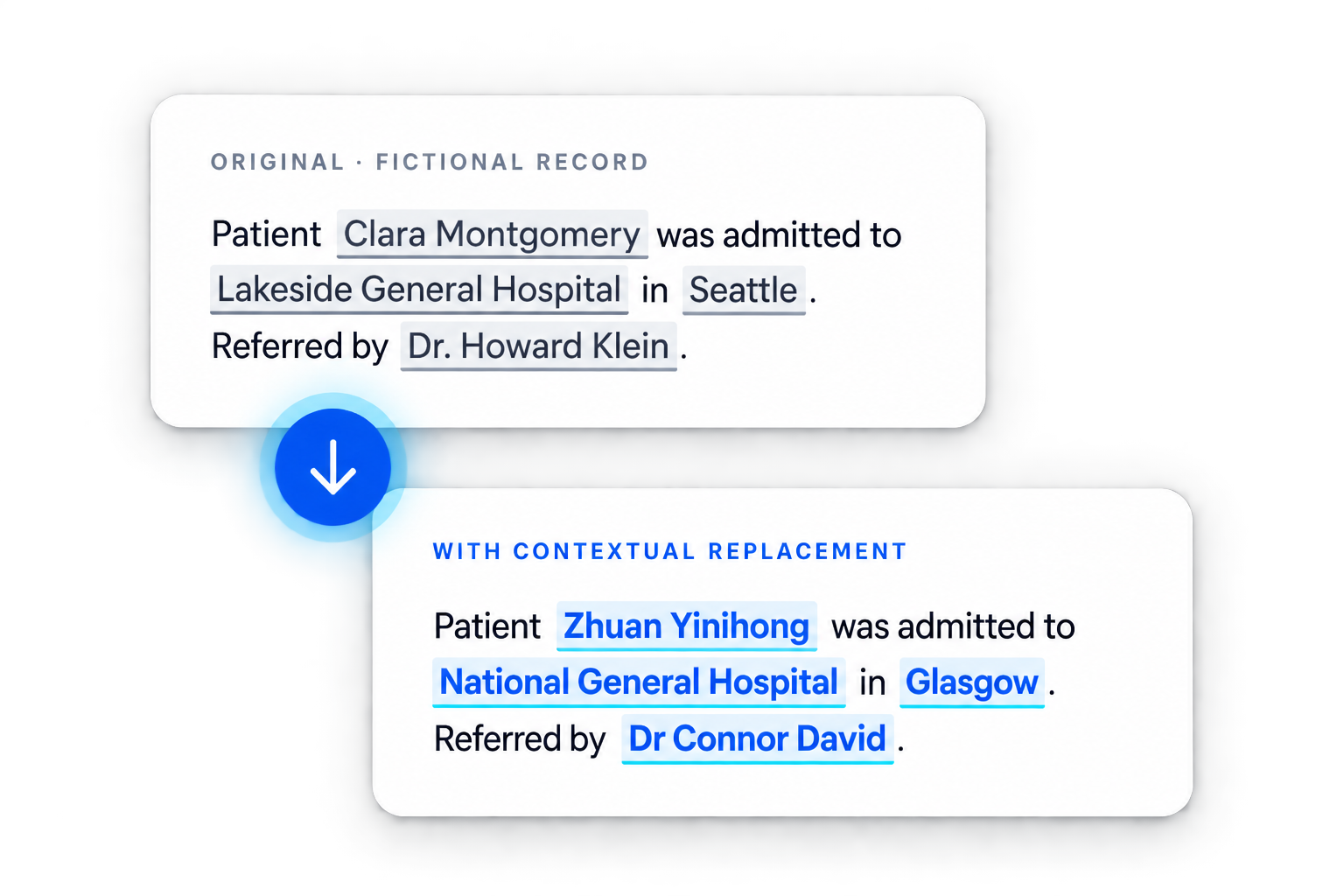
A common assumption among data teams is that removing identifiers necessarily degrades model quality. In practice, the relationship is more nuanced. Direct identifiers—names, account numbers, exact addresses—carry little of the linguistic or structural signal a model needs to learn the underlying task. A customer support model does not need a customer's actual name to learn how to resolve a billing dispute; it needs the pattern of the conversation. De-identification, done well, replaces identifiers with realistic placeholders or consistent surrogate values rather than blank redactions, which preserves sentence structure and context for the model to learn from.

De-identified training data, when the de-identification is accurate and context-preserving, produces models of comparable quality to training on raw identifiable data for most enterprise use cases—while removing the compliance and reputational exposure of training on raw PII, PHI, or PCI. The accuracy of the de-identification step itself is what determines whether this holds: a tool that misses identifiers leaves residual risk, and a tool that over-redacts non-identifying content can degrade the linguistic signal the model needs. Limina is built to close exactly this gap—de-identifying training data at the point of ingestion with 99.5 percent accuracy on real healthcare data, well above the 60 to 70 percent typical of general-purpose cloud tools, while preserving the surrounding context that gives a model something useful to learn from.

Where training data privacy goes from here

Every organization fine-tuning a model on internal data is—whether or not it has been framed this way yet—making a decision about AI training data privacy. The choice is between addressing it deliberately, with de-identification applied early and documented thoroughly, or addressing it reactively, after a regulator, auditor, or enterprise customer asks a question the team is not yet prepared to answer. Organizations working through this decision often start with Limina's data de-identification platform, which de-identifies training data in-VPC at the point of ingestion—before it ever reaches a training pipeline—helping teams across healthcare, pharma, financial services, and insurance reduce privacy risk without starting from scratch on model quality. For teams building on clinical data specifically, the requirements and pipeline architecture are covered in depth in our guide to building a HIPAA-compliant AI pipeline.

Ready to de-identify your training data?

Limina de-identifies training datasets in-VPC, at the point of ingestion, before data ever reaches a training pipeline—with 99.5 percent accuracy on real healthcare data and expert determination-ready documentation for HIPAA, GDPR, and CPRA compliance. If your team is evaluating how to bring internal data into a model safely, our team can walk through your specific data types and your data de-identification platform options.

Talk to an expert to get started

Read our companion comparison of privacy-preserving AI techniques for a deeper look at how de-identification stacks up against differential privacy and federated learning.

Related Articles