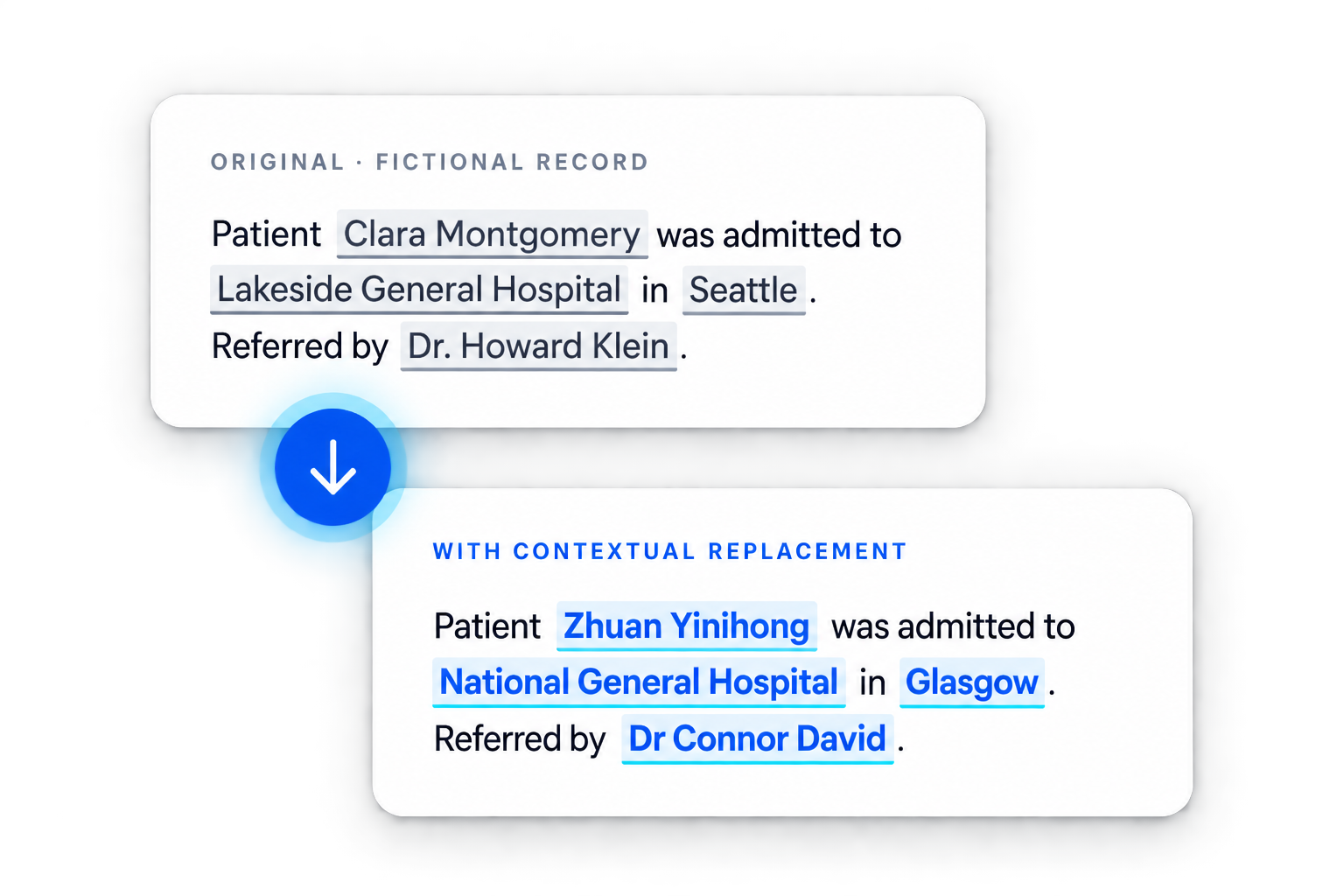
When your AI chatbot processes a patient’s medical question, a customer’s account details or an employee’s personal information, what regulations apply? In a growing number of cases, the honest answer is all of them.
When a conversational AI system collects, stores or transmits personal information, protected health information or payment data on behalf of a regulated organization, there is a set of compliance standards they must oblige. For most companies deploying chatbots in healthcare, financial services, insurance or contact centers, that means navigating HIPAA, GDPR, California’s CPRA and an expanding list of state laws, including the new SB 243 companion chatbot statute, often simultaneously.
Most organizations discover their compliance obligations only after the chatbot is already live. A chatbot built to answer scheduling questions quietly starts collecting symptom descriptions. A customer service bot starts retaining full account numbers in plaintext conversation logs. Nobody intended that outcome, and yet the regulatory exposure is the same as if they had.
This article covers the frameworks that apply to AI chatbots, where the highest-risk gaps tend to form and how de-identifying chatbot data changes the compliance picture.
The compliance frameworks that apply to AI chatbots
Depending on where your chatbot operates and who it talks to, several overlapping frameworks can apply at once.
| Framework |
Triggers when |
Core obligation |
| HIPAA |
The chatbot creates, receives, maintains or transmits PHI on behalf of a covered entity or business associate. |
Business Associate Agreement, Security Rule safeguards, minimum necessary use, breach notification. |
| GDPR |
The chatbot processes personal data of individuals in the EU or EEA, regardless of where the company is based. |
Lawful basis for processing, data minimization, transparency, honoring data subject rights including erasure. |
| CPRA, CCPA |
The chatbot processes personal information of California consumers, especially if used for automated decision-making. |
Privacy notices, consumer rights (access, deletion, opt-out), and, for qualifying ADMT use, pre-use notices and opt-outs. |
| California SB 243 |
The chatbot meets the statutory definition of a “companion chatbot” (adaptive, human-like, relationship-sustaining). |
AI disclosure, crisis-response protocols, minor-specific break reminders, annual reporting starting 2027. |
These frameworks are not mutually exclusive, and a single chatbot conversation can trigger more than one at the same time. A healthcare contact center chatbot that talks to a California resident about a billing question tied to a medical visit can implicate HIPAA, CPRA and potentially GDPR if the parent organization also serves EU patients, all from one interaction.
HIPAA and AI chatbots: when does a chatbot become a business associate?
HIPAA applies to AI chatbots the same way it applies to any vendor or tool: based on what the system does with protected health information, not what kind of technology it is. An AI chatbot becomes a business associate under HIPAA when it creates, receives, maintains or transmits PHI on behalf of a covered entity or another business associate.
In practice, this covers a wide range of chatbot use cases across healthcare organizations: patient-facing bots that collect symptoms or appointment details, AI-assisted transcription tools that convert patient-clinician conversations into notes, chatbots that respond to medical questions or generate patient letters and any conversational AI embedded inside an EHR or patient portal. If the chatbot touches PHI as part of its core function, a signed Business Associate Agreement (BAA) is required before that data flows to the vendor.
A BAA, however, only covers the surfaces it explicitly lists. Many widely used consumer-grade AI tiers are explicitly excluded from BAA coverage by their own vendors, meaning PHI entered into those surfaces is a HIPAA violation regardless of how careful the user is. Healthcare organizations deploying chatbots should confirm not just that a BAA exists, but that it covers the exact product tier and feature set the chatbot actually uses, since AI vendors frequently exclude specific features even within a covered tier.
Many healthcare chatbots handle PHI without their operators fully realizing it. A scheduling bot that asks “what are you being seen for” is collecting PHI the moment a patient answers. The safest architectural posture, and the one HIPAA compliance teams are increasingly standardizing on, keeps PHI from leaving the covered entity’s own infrastructure in the first place, whether through in-VPC deployment of the AI tool itself or through de-identification of conversation data before it is stored or analyzed downstream.
HIPAA enforcement carries real financial weight. As of the most recent inflation adjustment effective January 28, 2026, HIPAA civil monetary penalties range from $145 per violation for the lowest culpability tier up to $73,011 per violation for willful neglect that is corrected, with willful neglect that is not corrected carrying a per-violation penalty up to the full annual cap of $2,190,294 for all violations of an identical requirement in a calendar year.
GDPR and AI chatbots: lawful basis, minimization and erasure
GDPR applies to any AI chatbot processing the personal data of individuals located in the EU or EEA, regardless of where the operating company is headquartered. Three principles create the most friction for chatbot deployments specifically.
Lawful basis
Every chatbot interaction that processes personal data needs a valid legal basis under GDPR Article 6: consent, legitimate interest, contractual necessity or legal obligation are the most common for conversational AI. Consent must be freely given, specific, informed and unambiguous, which is a higher bar than a buried terms-of-service checkbox.
Data minimization
A chatbot should collect only what it needs for its stated purpose. A customer service bot resolving an order issue needs an order number and basic verification, not a full account history. In practice, this means conversation logs should not retain identifiable personal data beyond what is strictly necessary, and any logs kept for quality assurance or model improvement should be minimized or de-identified rather than stored in raw form.
Right to erasure
Users can request deletion of their personal data from chatbot systems under GDPR’s right to erasure. This becomes technically difficult once conversation data has been used to fine-tune or train a model: deleting the original record does not remove its influence on a model that has already learned from it, and full retraining is often the only fully reliable remedy. Regulatory guidance has acknowledged this gap, which is part of why minimizing and de-identifying chatbot data before it ever reaches a training pipeline is a more durable compliance strategy than trying to engineer erasure after the fact.
State laws: California SB 243, CPRA and what's coming
California has moved further and faster than any other state on AI chatbot regulation, through two distinct frameworks that often apply to the same chatbot at once.
California SB 243, effective January 1, 2026, targets “companion chatbots” specifically: AI systems built to sustain adaptive, human-like relationships with users. It requires AI disclosure, suitability warnings, crisis-response protocols for self-harm and suicide content, minor-specific break reminders every three hours and annual reporting to the state beginning July 1, 2027. It excludes chatbots used solely for customer service or business operations, so a narrowly functional support bot is less likely to be covered than a chatbot designed to feel like a companion. For the full breakdown, see our dedicated guide to SB 243.
Separately, California's CPRA finalized new regulations on automated decision-making technology (ADMT), effective January 1, 2026 for risk assessments and January 1, 2027 for consumer-facing rights. If a chatbot's output is used to make a “significant decision” concerning a consumer, covering financial services, housing, healthcare, employment or education, the operator may need to provide a pre-use notice, an opt-out mechanism and a way for consumers to access information about how the ADMT works. Notably, the final regulations deliberately removed references to “artificial intelligence” in favor of a functional test: does the technology substantially replace human decision-making, regardless of what it is called?
Other states, including Colorado, Maine, Texas, New York and Utah, have passed or are considering their own chatbot disclosure requirements, and the trend strongly suggests more states will follow California's pattern of layering safety and reporting obligations on top of basic disclosure rules.
The chatbot data problem: what gets collected, stored and transmitted
Your chatbot may already be out of compliance.
See how in-VPC de-identification removes PII, PHI and PCI from conversation data before it becomes a HIPAA, GDPR or CPRA liability.
Talk to an Expert
Most chatbot compliance risk does not come from the chatbot's intended purpose. It comes from what users actually type into it, and what the organization does with that data afterward.
Three patterns create the most exposure:
- Volunteered sensitive data. Users routinely disclose more than a chatbot asks for: a patient describing symptoms in detail, a customer pasting in a full card number to “speed things up,” an employee mentioning a health condition while explaining a leave request.
- Long-lived conversation logs. Transcripts are frequently retained indefinitely for quality assurance, analytics or model fine-tuning, well past the point where the original purpose for collecting the data has been fulfilled.
- Downstream reuse. Conversation data captured for one purpose, such as customer support, often gets reused for a second purpose, such as training a future model, without a fresh look at whether that reuse is covered by the original lawful basis or consent.
Each of these patterns multiplies regulatory exposure without adding much business value. A transcript with a patient's name and a transcript with that name removed are equally useful for analyzing call volume or resolution time; only the first one carries HIPAA, GDPR and CPRA risk.
De-identification as the compliance solution
Removing personally identifiable information from chatbot conversation data changes the regulatory analysis at its root. Properly de-identified data, under HIPAA's Safe Harbor or Expert Determination standards, under GDPR's anonymization threshold or under CPRA's de-identified data provisions, generally falls outside the scope of the framework that would otherwise apply.
This does not eliminate the need for AI disclosure, crisis-response protocols or other behavioral requirements like those in SB 243. Those obligations are about how the chatbot interacts with the user in the moment. But for the question of what happens to the conversation data afterward, in storage, in analytics, in model training, de-identification is the cleanest path to reducing scope.
Limina processes chatbot transcript data across multiple contact center and healthcare customers through its data de-identification platform, identifying and redacting PII, PHI and PCI across 52 languages and more than 50 entity types, and producing expert determination-ready outputs that support HIPAA, GDPR and CPRA compliance documentation. Because Limina deploys in-VPC or on-premises, conversation data never has to leave a company's own infrastructure to be de-identified, which matters for organizations that cannot risk routing PHI or financial data through a third-party cloud service. Limina's de-identification achieves 99.5 percent or higher accuracy on real healthcare data, compared to 60 to 70 percent for general-purpose cloud tools, a gap that matters significantly when the data being processed is a live patient conversation rather than a clean, structured dataset.
AI chatbot compliance checklist for deployments
Use this as a starting framework for any AI chatbot deployment in a regulated industry. Each item below should be documented, not just informally true.
- Data inventory. Document exactly what personal information, PHI or payment data the chatbot collects, including data users volunteer beyond what is explicitly requested.
- Consent and disclosure. Confirm the chatbot discloses its AI nature where required, and that any consent relied on for data processing is freely given, specific and informed, not buried in a general terms-of-service agreement.
- Data retention policy. Set and enforce a defined retention period for conversation logs, tied to the actual business purpose for keeping them, rather than retaining transcripts indefinitely by default.
- De-identification of stored conversations. Remove or redact PII, PHI and PCI from conversation logs before they are used for analytics, quality assurance or model fine-tuning.
- Audit trail requirements. Maintain logs of who accessed chatbot conversation data, when and for what purpose, sufficient to support a HIPAA Security Rule audit or a GDPR accountability review.
- Vendor data processing agreements. Confirm BAAs (HIPAA), Data Processing Agreements (GDPR) and equivalent contractual terms are in place with every AI vendor, platform and subprocessor that touches chatbot data, and that the agreement covers the specific product tier in use.
- Incident response plan. Maintain a documented breach notification process that covers chatbot data specifically, including timelines for notifying affected individuals and regulators under HIPAA, GDPR and applicable state law.
Where to start
AI chatbot compliance is not a single checklist you complete once. It is an ongoing alignment between what your chatbot collects, what frameworks apply to that data and how long you keep it around in identifiable form. The fastest way to shrink that exposure is to remove identifiable information from chatbot conversation data before it becomes a liability in storage, analytics or model training.
Limina helps healthcare, financial services, insurance and contact center organizations de-identify chatbot and conversational data in-VPC, producing expert determination-ready outputs for HIPAA, GDPR and CPRA compliance.
Talk to an Expert to see how it fits your chatbot deployment.
Explore Limina’s data de-identification platform to see the full platform.