Navigating the Privacy Paradox: A Guide to Ethical Fine-Tuning of Large Language Models
Fine-tuning large language models on domain-specific data unlocks powerful AI capabilities, but it introduces serious privacy risks. This guide walks through why PII redaction is a non-negotiable step in any ethical fine-tuning workflow, and how organizations in regulated industries can build compliant, trustworthy AI systems.


Fine-tuning large language models has quickly become one of the most practical ways for organizations to move beyond generic AI and build systems that actually understand their business. But as enterprises in healthcare, financial services, pharma, and other regulated industries move deeper into LLM adoption, a critical tension has emerged: the very data that makes fine-tuned models so effective is often the same data that poses the greatest privacy risk.
This guide explores what ethical fine-tuning actually looks like in practice, why Personally Identifiable Information (PII) redaction is a non-negotiable step in the process, and how organizations can build AI systems that are both domain-expert and privacy-compliant.
What is LLM fine-tuning and why does it matter?
Large Language Models like GPT-4 are trained on enormous, general-purpose datasets. They are impressively capable across a wide range of language tasks, but that generality is also a limitation. A model trained on the broader internet does not inherently understand the specific compliance requirements of a health insurer, the terminology of a clinical trial, or the internal processes of a financial services firm.
Fine-tuning addresses this gap. By retraining a pre-trained LLM on a curated, domain-specific dataset, organizations can adapt the model's weights so that it generates responses aligned with the particularities of their industry or function. A customer service chatbot fine-tuned on a financial institution's internal documentation will perform far better than a generic model at answering account-specific questions, flagging compliance concerns, or handling escalations in line with established procedures.
The same logic applies across industries. In healthcare, a fine-tuned model can assist clinicians with documentation, support patient intake workflows, or accelerate medical record summarization. In pharma and life sciences, fine-tuned models are being used to process clinical trial data, automate regulatory submissions, and surface insights from unstructured research documents. In contact centers, they reduce handle time and improve the consistency of agent responses.
Fine-tuning is also distinct from prompt engineering, which is worth clarifying because the two approaches are often conflated. Prompt engineering involves crafting inputs in a way that steers the model's output at inference time, without changing the model itself. Fine-tuning goes further: it modifies the model's weights by retraining on specific data, embedding domain knowledge directly into the model's behavior. Both approaches have their role, but fine-tuning produces a fundamentally more capable, context-aware system for specialized applications.
What are the privacy risks of fine-tuning LLMs on real-world data?
The problem is that the datasets most useful for fine-tuning tend to be drawn from real operational environments: customer emails, call transcripts, internal communications, clinical records, loan applications, insurance claims. These documents are rich with context, but they are also rich with PII.
When an LLM is fine-tuned on data containing un-redacted personal information, that information does not simply pass through the training process and disappear. The model learns from it. In practice, this means a fine-tuned model may generate outputs that include or closely resemble actual personal data it encountered during training, whether that is a patient's name and diagnosis, a customer's account number, or an employee's compensation details.
The risks here are not abstract. A financial institution that fine-tunes a model on customer communication logs without first removing sensitive information could inadvertently build a system capable of surfacing private account details in its responses. This is a potential breach of data protection regulations including GDPR, a serious reputational risk, and in many jurisdictions, a reportable incident.
Beyond PII, there is the issue of bias. Training data reflects the world as it was, not as it should be. Historical hiring records, customer interaction logs, and internal communications often contain embedded biases, whether racial, gender-based, or socioeconomic. A model fine-tuned on this data without appropriate curation can amplify those biases in its outputs. An HR chatbot that perpetuates historical bias in screening applicants or answering employee queries does not just create an ethical problem; it creates legal exposure and undermines organizational commitments to fairness and inclusion.
Safeguarding Personally Identifiable Information (PII) such as names, addresses, and social security numbers is paramount. Mishandling PII can tarnish organizational reputation and result in severe legal consequences.
Why redaction is a critical step in any ethical fine-tuning workflow
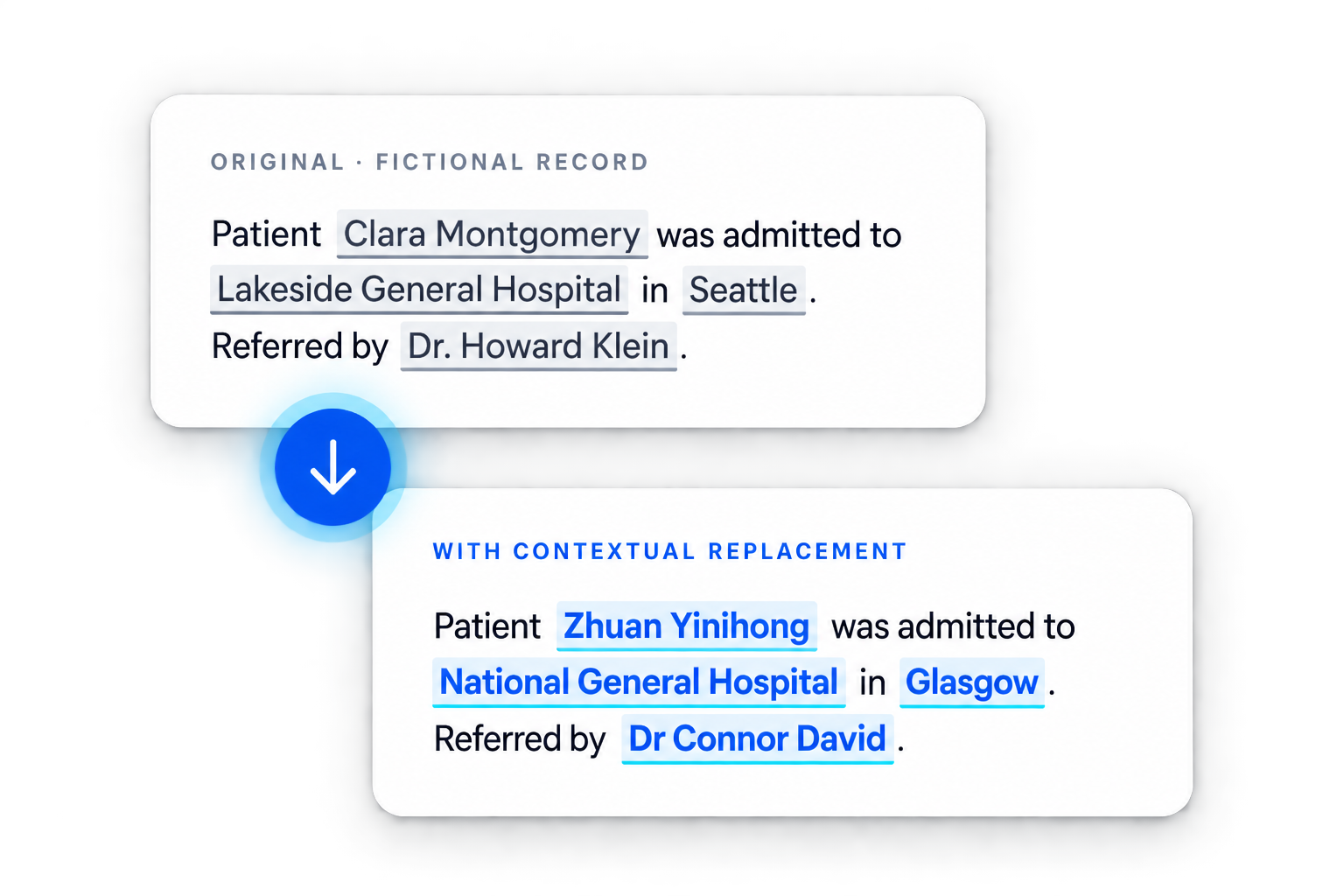
Redaction is the process of identifying and removing or obscuring sensitive information from a document before it is used, shared, or processed. In the context of LLM fine-tuning, redaction applied to training data is the most direct mechanism organizations have to prevent private information from being embedded into a model.
Historically, redacting PII from unstructured data was a labor-intensive, error-prone task. Human reviewers manually combing through emails, transcripts, and records are slow, inconsistent, and prone to fatigue. A reviewer who misses a single reference to a patient's name in a 200-page clinical document could compromise the privacy of an entire fine-tuning dataset.
AI-driven redaction has changed this substantially. Modern data de-identification solutions can automatically identify and obfuscate PII across large volumes of unstructured data, at a speed and consistency that manual review cannot match. Critically, the most capable systems are built to understand language in context, not just to pattern-match against a list of known entity types. This distinction matters because PII does not always appear in predictable forms. A document might reference a person by their role and an adjacent phone number rather than by name, and a system that only scans for "PERSON" entities will miss it entirely.
This is where Limina's approach stands apart. Built by a team of linguists, Limina's data de-identification platform is designed to understand language nuance and entity relationships within documents, rather than relying on pattern matching alone. That linguistic foundation means the platform can resolve co-references, understand contextual relationships between entities, and catch sensitive information that rules-based or purely statistical systems routinely miss. For organizations in regulated industries preparing datasets for fine-tuning, this level of precision is not a nice-to-have; it is a compliance requirement.
If your organization is working with sensitive data and considering a fine-tuning initiative, talk to Limina's team to understand how automated de-identification fits into your workflow.
What does an ethical fine-tuning framework look like in practice?
Ethical fine-tuning is not a single action but a structured process. The following framework, built around the integration of redaction throughout the pipeline, reflects what responsible AI development looks like across industries including insurance and financial services.
Identify data sources and PII considerations
The process begins with a thorough audit of the data that will be used for fine-tuning. This means identifying every source of training data, understanding what PII is likely to be present within each source, and mapping those considerations against the applicable regulatory requirements. For a healthcare organization, this will include HIPAA's Privacy Rule and its definitions of Protected Health Information (PHI). For a European financial institution, GDPR's requirements around personal data processing will apply. Getting this step right provides the foundation for everything that follows.
AI-assisted data discovery tools can accelerate this audit, surfacing PII categories and concentrations across large document sets faster than any manual approach could achieve.
Define goals and establish clear privacy measures
Once the data landscape is understood, organizations need to define precisely what they want the fine-tuned model to achieve and what privacy constraints must be maintained. Goals should be specific: not just "improve the model's performance in customer service" but "enable the model to accurately classify and route customer complaints in line with regulatory response timelines." Privacy measures should be equally specific, establishing acceptable limits on data usage, defining the standard of redaction required, and specifying how the completeness of that redaction will be verified before training begins.
Execute redaction and fine-tuning together, not sequentially as afterthoughts
The execution phase is where most organizations either protect themselves or expose themselves to risk. AI-driven redaction should run across all training data before any fine-tuning begins. This is not a step that can be partially completed or approximated. The accuracy of the redaction process directly determines the privacy properties of the resulting model.
After redaction is complete and verified, fine-tuning can proceed within the bounds established in the planning phase. Throughout this process, the defined privacy measures should serve as guardrails, not aspirational guidelines.
Monitor continuously after deployment
Ethical fine-tuning does not end at model deployment. Post-deployment monitoring is essential to ensure that the model continues to operate within established ethical and privacy parameters as it encounters real-world data. AI monitoring tools can detect inadvertent PII exposures in model outputs and flag outputs that appear biased or anomalous. This ongoing vigilance supports iterative refinement and ensures sustained compliance as the model is used in production.
Integrating redaction into the fine-tuning process through this structured framework ensures that LLMs are not only proficient in their intended functions but also genuinely protective of personal data and compliant with applicable law.
How does this apply across regulated industries?
The stakes of getting fine-tuning right vary by industry, but they are uniformly high in regulated sectors.
In healthcare, fine-tuned models are being used to process clinical documentation, support diagnostic workflows, and assist with patient communication. The training data for these applications is almost invariably rich with PHI, and the consequences of a breach are both regulatory and deeply personal. Healthcare organizations considering fine-tuning should treat de-identification as a foundational step, not an afterthought. Limina works with healthcare providers and health systems to ensure that data pipelines into AI systems are clean before training begins.
In pharma and life sciences, the volume of unstructured data involved in clinical trials, regulatory submissions, and research documentation is substantial. Fine-tuning models on this data without removing PII relating to trial participants is both an ethical and a regulatory failure. Limina's linguist-built platform is designed to handle the complex language of clinical documents, identifying sensitive references that simpler tools miss.
In financial services and insurance, customer data is the lifeblood of operational AI. Fraud detection, underwriting support, customer communication, and claims processing all benefit from fine-tuned models, but all of these use cases also involve personally sensitive financial information. The regulatory environment, spanning GDPR, CCPA, and sector-specific requirements, demands that this data be handled with precision.
If you are building or scaling AI capabilities in a regulated industry, connect with Limina to learn how context-aware de-identification supports compliant fine-tuning at scale.