
Fine-Tuning LLMs Safely: How to Redact PII Before Training
Fine-tuning LLMs on proprietary data can dramatically improve model performance, but it also introduces serious privacy risks when that data contains PII. This article explores why generative AI amplifies those risks compared to earlier machine learning techniques, what real-world leaks have already occurred, and how redacting sensitive information before training protects your organization without sacrificing model quality.


Large Language Models have moved from research curiosity to enterprise infrastructure faster than most organizations anticipated. Teams across healthcare, financial services, pharma, and insurance are no longer asking whether to use LLMs, but how to make them work for their specific domain. For many, the answer is fine-tuning: taking a powerful general-purpose model and training it further on proprietary data so it can answer domain-specific questions with precision.
The appeal is straightforward. A generic LLM will give you a plausible answer. A fine-tuned one will give you the right answer, grounded in the knowledge your organization has accumulated. But that proprietary knowledge frequently includes something far more sensitive: the personal data of patients, clients, employees, and customers. When that data is fed into a fine-tuning pipeline without adequate preparation, the consequences can extend well beyond a technical incident into regulatory liability and reputational damage.
This article examines why fine-tuning LLMs creates unique privacy risks compared to earlier machine learning approaches, what happens when those risks are not managed, and how PII redaction before training resolves the problem without meaningful loss of model performance.
What is fine-tuning, and why do organizations use it?
Fine-tuning involves adapting a pre-trained LLM to a specific domain or task by continuing its training on a curated, specialized dataset. The base model already understands language at a sophisticated level; fine-tuning gives it specialized knowledge on top of that foundation, enhancing its utility and accuracy in a particular context.
This matters enormously in regulated industries. Consider an organization in healthcare trying to build a tool that helps clinicians summarize patient notes or navigate clinical guidelines. A general LLM might produce a response that sounds medically plausible but does not reflect the organization's specific protocols, formulary, or patient population. After fine-tuning on the right dataset, that same model can produce outputs aligned with institutional knowledge. The same logic applies in financial services, where models fine-tuned on regulatory documents, internal policy, or historical case data can support compliance teams, underwriters, and advisors far more reliably than any off-the-shelf solution.
For traditional ML applications like sentiment analysis, intent classification, or document routing, fine-tuning has similarly emerged as the approach that closes the gap between generic model performance and the precision organizations actually need.

To illustrate the difference concretely: consider an open dataset from NVIDIA that contains detailed specifications about various graphics processing units. When a developer queries an un-fine-tuned LLM about a specific GPU attribute, the model will often produce a response that sounds reasonable but does not accurately reflect the dataset. This is a textbook model hallucination. The fine-tuned version, trained on the same NVIDIA dataset, returns a precise, accurate answer grounded in the actual specifications. The performance gap between the two is not marginal; it is the difference between a tool that is merely conversational and one that is operationally useful.

Why does fine-tuning create more privacy risk than earlier ML techniques?
This is where the conversation gets harder. Fine-tuning is powerful precisely because the model learns the content of its training data so thoroughly. In earlier ML techniques, the model was typically trained to identify patterns or classify inputs; the underlying training examples were not something the model could reproduce. Generative AI changes the equation entirely.
When an LLM is fine-tuned on data containing personally identifiable information, it does not simply learn the domain expertise embedded in that data. It also learns the personal information contained within it: names, locations, dates, contact details, financial records, clinical notes. And because LLMs generate outputs by drawing on everything they have learned, that personal information can surface in responses to entirely unrelated queries.
This is not a theoretical risk. ScatterLab, a Korean AI company, trained a chatbot on the personal conversations of its users. The result was a model that inadvertently exposed private data from those conversations in its responses, a breach that attracted regulatory attention and significant public scrutiny. The root cause was predictable in retrospect: the training data had not been adequately sanitized before it was used to fine-tune the model.
The Samsung incident offers a similar lesson from the enterprise context. Employees using an AI coding assistant inadvertently submitted confidential source code and internal meeting notes as prompts, which were then ingested into the model's training data. The confidential details of the organization's projects were not redacted from the dataset, and the result was a leak that not only breached privacy but also risked the organization's competitive advantage. The domino effect that can follow from a single oversight in data sanitization is not easy to contain once it begins.
When organizations in pharma and life sciences or insurance consider fine-tuning LLMs on clinical trial data, claims records, or policyholder files, the stakes are even higher. The data categories involved often carry specific regulatory protections under HIPAA, GDPR, and sector-specific frameworks, and the penalties for inappropriate disclosure are substantial.
If your organization is preparing to fine-tune a model on sensitive data and wants to understand the privacy risks before you begin, speak with Limina's team about your use case.
How does PII end up in fine-tuning datasets in the first place?
The honest answer is that it ends up there because most real-world data that is rich enough to be useful for fine-tuning is also rich enough to contain personal information. Organizations do not typically build their most valuable datasets with AI training pipelines in mind; they build them to support operations. Clinical records capture patient context because that context is clinically relevant. Customer service transcripts capture caller details because agents need them to resolve issues. Financial documents capture account information because that information drives the transaction.
When data teams go looking for material to fine-tune a model, the most accessible and highest-quality sources are invariably those operational datasets. They are comprehensive, domain-specific, and immediately relevant. They are also full of PII.
The challenge is compounded by the unstructured nature of most valuable enterprise data. PII does not appear only in labeled fields that can be filtered with a simple rule. It appears in the body of a clinical note, embedded in a paragraph of a legal filing, scattered across the transcript of a call center conversation. Pattern-matching tools that look for recognizable formats like phone numbers or email addresses will catch some of it, but they will miss the contextual references, the co-referential mentions, and the implicit identifiers that make sensitive information sensitive in the first place.
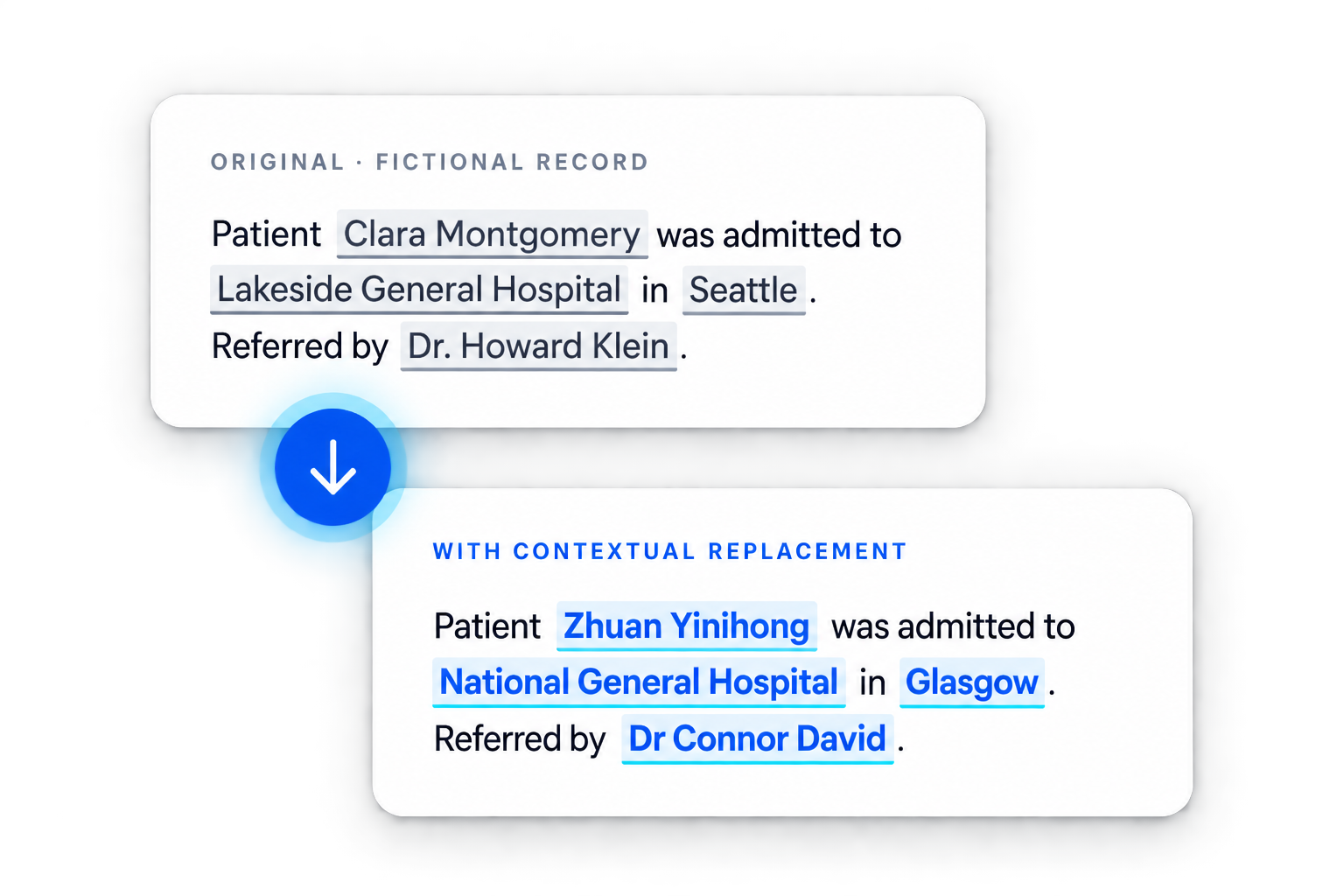
This is precisely the kind of challenge that Limina's AI-powered data de-identification solution is designed to address. Built by linguists rather than pattern-matching engineers, Limina understands language contextually. It recognizes not just that "John Smith" is a name, but that "the patient," "he," and "the referring physician's contact" all refer to the same individual within a document, and redacts them accordingly.
What does the redaction process look like in practice?
The core workflow is straightforward, though the sophistication required to execute it correctly is substantial. Before any training data enters a fine-tuning pipeline, it passes through Limina's de-identification layer. Limina detects and redacts over 50 entity types across more than 50 languages, covering the full range of PII, PHI, and PCI categories relevant to regulated industries.

What distinguishes this process from simple find-and-replace or regex-based filtering is the linguistic intelligence underlying it. Limina was built by a team of linguists who understand how personal information is encoded in natural language, not just how it appears as a formatted data point. That means the system handles co-reference resolution (understanding that multiple references in a document point to the same individual), entity relationships (recognizing when a professional title, department name, or organizational role constitutes an identifier in context), and language nuance across jurisdictions and document types.

The result is training data that retains the domain expertise organizations need to produce a high-performing model, while removing the personal information that creates privacy liability. The model learns the terminology, the reasoning patterns, the clinical or financial logic embedded in the data; it simply does not learn whose records those were.
Research examining this approach has confirmed that models fine-tuned on redacted data perform comparably to those trained on unredacted data across a range of domain-specific tasks. The concern that redaction will degrade model quality, while understandable, has not been borne out in practice when the redaction process is accurate and contextually aware.
Contact Limina to see how de-identification fits into your AI training pipeline before your next fine-tuning project begins.
Are there alternatives to fine-tuning that avoid these risks?
Fine-tuning is not the only path to a domain-capable LLM, and it is worth acknowledging the alternatives, even if the privacy principle underlying all of them remains the same.
Retrieval-Augmented Generation, or RAG, is a widely adopted approach that combines a standard LLM's generative capabilities with a real-time retrieval system. Rather than encoding domain knowledge into the model's weights through training, RAG retrieves relevant documents from a knowledge base at query time and includes them in the prompt context. The model then generates a response informed by those retrieved documents without needing to have been trained on them. For organizations in contact centers, where knowledge bases change frequently and training cycles are impractical, RAG often makes more operational sense than fine-tuning.
However, the data privacy obligation does not disappear with RAG. The retrieval corpus still contains sensitive information, and that information is still being processed by the model at inference time. If the knowledge base includes customer records, clinical notes, or financial documents, the same question applies: has the sensitive content been handled appropriately?
The critical principle, regardless of the method employed, is that every approach to enhancing LLM performance requires some interaction with data, and that data must be managed with genuine regard for privacy. Fine-tuning is the approach that tends to create the most durable privacy risk, because the model's exposure to PII is not limited to a single inference event but is encoded across its weights. That is why pre-training redaction matters most in a fine-tuning context, and why addressing it is a prerequisite rather than an afterthought.



Frequently Asked Questions
What is fine-tuning an LLM?
Fine-tuning is the process of taking a pre-trained large language model and continuing to train it on a smaller, domain-specific dataset. The goal is to adapt the model's outputs to a particular task or area of expertise without training from scratch. The base model retains its general language understanding while gaining specialized knowledge from the fine-tuning dataset.
Why is fine-tuning a privacy risk?
Unlike earlier machine learning techniques that learned patterns without memorizing training examples, generative LLMs can reproduce content from their training data in their outputs. When fine-tuning datasets contain personally identifiable information, that PII can surface in model responses to unrelated queries, creating the potential for data exposure and regulatory liability.
What types of PII are typically found in fine-tuning datasets?
Enterprise fine-tuning datasets commonly contain names, contact information, dates, locations, account numbers, clinical identifiers, case references, and conversational content from customer interactions. In regulated industries, datasets may also include protected health information (PHI), financial records, and other categories with specific legal protections.
Can PII redaction affect model performance?
When redaction is performed by a contextually aware system rather than a simple pattern-matcher, research has shown that model performance on domain-specific tasks is not meaningfully degraded. The model retains the domain expertise embedded in the data while losing only the personal identifiers that create privacy risk.
How is Limina's approach to PII redaction different?
Limina's de-identification solution was built by linguists, which means it understands language in context rather than relying on format-based pattern matching. It resolves co-references, understands entity relationships within documents, and detects implicit identifiers that rule-based tools routinely miss. This makes it significantly more accurate on the unstructured text that typically makes up enterprise fine-tuning datasets.
Does the same privacy obligation apply to RAG pipelines?
Yes. While RAG does not encode training data into model weights in the same way as fine-tuning, the retrieval corpus still contains sensitive information that is processed at inference time. Organizations should apply the same data hygiene standards to their RAG knowledge bases as they would to any fine-tuning dataset.
What industries face the greatest risk from improperly sanitized fine-tuning data?
Healthcare, pharma and life sciences, financial services, insurance, and contact centers are among the highest-risk sectors. These industries hold large volumes of sensitive personal data, operate under strict regulatory frameworks, and are also among the most active adopters of domain-specific LLMs, making the intersection of fine-tuning and privacy risk particularly acute.