The Real Cost of a Healthcare Data Breach and What It Means for Privacy Compliance
Healthcare data breaches now cost an average of $7.42 million per incident, according to IBM's 2025 Cost of a Data Breach Report — down from $9.77 million in 2024, but still the most expensive sector for breaches by a wide margin. This article breaks down why health records are prime targets, what noncompliance actually costs, and what organizations can do to reduce their exposure before a breach happens.


Healthcare data breaches are not a niche concern. They areone of the most financially damaging, operationally disruptive, andreputationally destructive events that any organization in the sector canexperience. And they are becoming more common, more expensive, and moresophisticated every year.
According to IBM’s 2025 Cost of a Data Breach Report, the average cost of a healthcaredata breach reached USD 9.77million in 2024, before falling to USD 7.42 million in 2025. Healthcarehas remained the most expensive sector for data breaches for over a decade. Atthe same time, theHIPAA Journal's December 2023 Healthcare Data Breach Report confirmed thatthe number of breaches recorded in the industry has more than doubled since2017.
These numbers are not abstractions. They represent hospitalsunable to process prescriptions, patients whose most sensitive personalinformation has been sold on the dark web, and healthcare organizations facinginvestigations, fines, and the long tail of legal liability that follows asignificant breach. Understanding where these costs come from, why health datais uniquely valuable to bad actors, and what compliance failures actually costis essential for any organization that handles protected health information.
What Makes Healthcare the Most Expensive Industry forData Breaches?
The healthcare sector sits at the intersection of twopowerful vulnerabilities: the critical, life-or-death nature of its operations,and the extraordinary value of the data it holds. This combination makeshealthcare organizations attractive targets and explains why breach costs inthis sector consistently outpace every other industry.
Why Ransomware Attackers Target Hospitals
When a ransomware group locks down a financial servicesfirm, the target can often route around the disruption for days whilenegotiating or restoring systems. When a ransomware group hits a hospital, thecalculus is entirely different. Delayed access to patient records, prescriptionsystems, or insurance billing infrastructure can directly affect patientoutcomes. Attackers understand this leverage and exploit it deliberately.
In December 2022, the ransomware group LockBit, one of themost prolific Ransomware-as-a-Service operations ever documented byCISA, made headlines for an unusual reason: itapologized to SickKids Hospital in Toronto after an affiliate violated itsown internal rules by attacking a pediatric healthcare provider. The apologywas not altruism. It was damage control for a criminal enterprise thatrecognized it had crossed a line that might attract unwanted enforcementattention.
But the apology told a more important story: even ransomwareoperators recognize how dangerous and destabilizing healthcare attacks are.That recognition has not stopped attacks from escalating.
In November 2023, aLockBit-affiliated threat actor made a calculated decision during an attackon a US healthcare provider: rather than encrypting systems and disruptingcare, they stated that they had deliberately chosen to steal data instead ofencrypting it to avoid interfering with patient care. The message was clear:the data itself was the leverage. They claimed to have exfiltrated over 10million files.
The Change Healthcare Attack: A Case Study in SystemicFragility
Then came February 2024, and what is widely regarded as themost damaging ransomware attack ever to hit the US healthcare sector: thebreach of Change Healthcare, a subsidiary of UnitedHealth Group and the largestclearinghouse for insurance billing and payments in the United States.Thousands of healthcare providers depend on Change Healthcare's systems toobtain insurance approvals for prescribed services, including medications, andto receive payment for those services.
The attackers did not need to disable care deliverydirectly. By taking down Change Healthcare's infrastructure, they forcedhealthcare providers across the country toscramble for funds to keep their operations running while waiting forpayment systems to come back online. The breach exposed just how fragile theinterconnected infrastructure of the US healthcare system truly is.
The HHS Office for Civil Rights, the agency responsible forenforcing HIPAA's security, privacy, and breach notification rules, launched aninvestigation into whether Change Healthcare had maintained HIPAAcompliance and whether Protected Health Information had been compromised.
Why Is Health Data So Valuable on the Black Market?
Understanding the financial motivation behind healthcareattacks requires understanding the market value of health data. It is notsimply that health records contain useful information. It is that healthrecords are among the most monetizable assets a criminal can obtain.
Accordingto reporting by CNBC, a single medical record sells for approximately USD60 on the dark web. By comparison, a Social Security number fetches around USD15, and a stolen credit card number brings in roughly USD 3. The price gapreflects a fundamental difference in utility.
TheHIPAA Journal explains that health records have a significantly longerlifespan than financial credentials. A credit card number can be cancelledwithin hours of a theft being detected. A medical record, however, contains astable constellation of personal identifiers that cannot be changed: dates ofbirth, addresses, insurance details, diagnosis history, and prescriptionrecords. This information enables a wide range of criminal activity, includingimpersonation to obtain prescription drugs, tax fraud, phishing attacks, extortion,and blackmail. The misuse is also far harder for victims to detect, often goingunnoticed for months or years.
For healthcareorganizations andpharmaceutical and life sciences companies that handle patient records atscale, this means the data they are managing is not just sensitive from acompliance standpoint. It is actively being targeted because of its marketvalue, and the cost of a breach reflects both the direct financial damage andthe downstream liability that follows.
If your organization processes Protected Health Informationand is looking for a proactive way to reduce that exposure, talk to Limina's team abouthealthcare-grade de-identification solutions.
What Does Noncompliance Actually Cost?
Financial penalties are not the only cost of noncompliance,but they are among the most quantifiable. According to the 2025 IBM Report, noncompliancewith data protection regulations drives up the total cost of a data breach inheavily regulated industries by 23 percent, or approximately USD 1.03 million,compared to industries with few or no regulatory requirements. IBM ranksnoncompliance as the third most impactful cost amplifier overall, behindsecurity skill shortages and system complexity.
The two regulatory frameworks most relevant to the UShealthcare sector are HIPAA and the GDPR, which applies to any organizationhandling data from EU residents, including clinical trial data, patient recordsfrom European providers, or data processed through international researchpartnerships.
Both frameworks impose strict and time-sensitive breachnotification requirements. Under HIPAA, breaches affecting 500 or moreindividuals must be reported without unreasonable delay and no later than 60days following discovery. The GDPR is considerably more demanding: it requiresnotification to the relevant supervisory authority without undue delay and,where feasible, within 72 hours of becoming aware of the breach.
This is where the gap between regulatory requirement andoperational reality becomes significant. According to the 2025 IBM Report, the averagetime to contain a data breach resulting from stolen or compromised credentialswas 73 days in 2023. Under GDPR, that means organizations breached throughcredential compromise would almost certainly miss the 72-hour notificationwindow. Under HIPAA, a 73-day containment timeline still falls within the60-day reporting requirement in some interpretations, but only barely, andunder conditions of extreme pressure.
The practical consequence is that organizations that lackthe tools to rapidly identify, locate, and document the personal data affectedby a breach are not just slower to respond. They are at significantly higherrisk of regulatory fines, enforcement actions, and the reputational damage thatfollows delayed or incomplete breach disclosures.
What Are the Most Effective Strategies for Reducing DataBreach Costs?
The 2025 IBMCost of a Data Breach Report identifies several strategies thatconsistently reduce breach-related costs. Three of the most impactful arebuilding security into every stage of software development and deployment,modernizing data protection across hybrid cloud environments, and usingsecurity AI and automation to increase speed and accuracy of detection andresponse. The report also identifies knowing your attack surface and havingpracticed incident response plans as key drivers of cost reduction.
These are not abstract recommendations. They translate intoconcrete operational decisions about how data is collected, stored, processed,and protected across the systems that healthcare organizations rely on everyday.
How De-identification Reduces Your Attack Surface
One of the most direct ways to reduce breach risk andcompliance exposure is to minimize the volume of personal data in circulationacross your systems. This principle, known as data minimization, is encoded inboth HIPAA and the GDPR, and it is rooted in straightforward logic: data thathas been de-identified or redacted cannot be stolen in a way that createsregulatory liability.
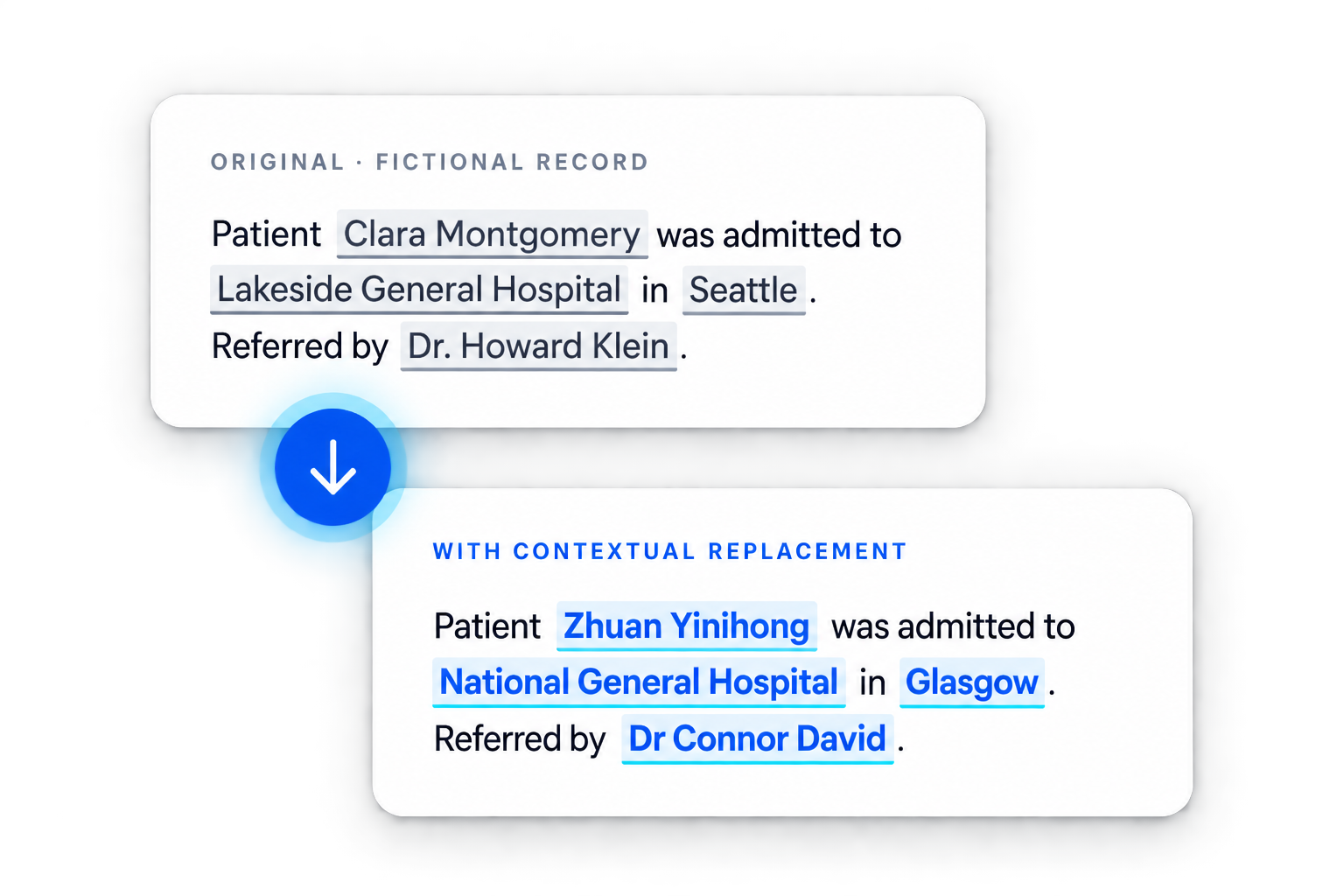
Limina'sdata de-identification platform is designed specifically for this purpose.It redacts and replaces personally identifiable information and ProtectedHealth Information in unstructured datasets with high accuracy, processing over70,000 words per second across 52 languages and more than 50 entity types.Unlike pattern-matching tools that rely on rule-based detection, Limina'ssolution is built by linguists, which means it understands the contextual andrelational nuances of language in clinical documentation, research records, andpatient communications. It knows, for example, that a name appearing in aclinical note may carry a different risk profile than the same name in aninsurance form, and it handles both appropriately.
For organizations developing software or AI models that drawon large healthcare datasets, this capability is foundational. Best practice,and increasingly regulatory expectation, requires that only the minimum amountof personal data necessary to achieve a development goal be included intraining or testing datasets. De-identifying those datasets before usesubstantially reduces exposure in the event of a breach and strengthens theorganization's compliance posture from the outset.
Healthcare technology teams, compliance officers, and contact centershandling sensitive patient interactions all face the same core challenge: thedata required to operate effectively is also the data that creates the mostrisk. Reducing that risk without reducing operational capability is preciselywhat de-identification is designed to accomplish.
How De-identification Supports Faster Incident Response
Knowing where your sensitive data lives is not just asecurity best practice. It is a prerequisite for effective breach response.When a breach occurs, the clock starts immediately. Regulatory deadlines aremeasured in hours and days, not weeks, and the ability to produce an accurateaccount of what data was affected, where it was located, and what it containedis often what separates organizations that navigate a breach effectively fromthose that compound their problems with late or incomplete disclosures.
Limina's platform can generate precise reports identifyingthe location and type of personal data across affected systems. Fororganizations managing large volumes of unstructured data, including clinicalnotes, call transcripts, emails, and documents, this capability is particularlyvaluable. It transforms what would otherwise be a weeks-long manual reviewprocess into something that can be completed far more quickly, helpingorganizations meet tight regulatory reporting windows and reducing the internalcost of breach response.
This matters not just for HIPAA compliance but for thebroader obligation to notify affected individuals and demonstrateaccountability to regulators. The organizations that handle breach responsemost effectively are those that have already built the infrastructure to know,at any given moment, what personal data they hold and where it is.
If your organization is working to build that infrastructureand reduce its breach exposure,connect with Limina to explore what healthcare-specific de-identification cando for your compliance program.
The Bigger Picture: Compliance as Risk Management
There is a tendency in compliance discussions to frameregulatory requirements as obligations to be met rather than risk managementtools to be leveraged. The data from IBM's annual breach reports consistentlychallenges that framing. The organizations that fare best when breaches occurare those that have treated compliance not as a checklist but as a frameworkfor identifying where their most valuable data lives, who has access to it, andwhat happens when that access is compromised.
For financialservices organizations and insurance providersthat also handle health-adjacent data, the same logic applies. The convergenceof healthcare, financial, and personal data in modern enterprise environmentsmeans that the boundaries between regulated and unregulated data areincreasingly blurred, and the cost of getting that wrong is rising every year.
The declinein average breach costs from USD 9.77 million in 2024 to USD 7.42 million in2025 is not a signal that the threat is receding. Attackers are becomingmore sophisticated. Attack surfaces are expanding as healthcare organizationsadopt cloud infrastructure, remote care platforms, and AI-driven clinicaltools. The regulatory landscape is tightening. And the value of health data onthe black market is not diminishing.
The organizations that will manage this environment mosteffectively are those that treat data minimization, de-identification, andbreach readiness not as compliance expenses but as strategic investments inoperational resilience.