
Healthcare and Medical Data: The Ultimate PII Detection Challenge
Healthcare records contain some of the most sensitive and structurally complex personal information in existence. This article examines why medical data is the ultimate stress test for PII detection systems, breaks down benchmark performance across major providers, and explains how Limina's purpose-built approach handles free-form clinical notes, PHI entity coverage, and HIPAA compliance where general-purpose tools fall short.


Medical records are not just sensitive. They are structurally and linguistically complex in ways that break most automated PII detection tools. A single patient encounter note can contain a person's name, a family member's name, a referring physician, a diagnosis, a medication dosage, a lab value, and a casual offhand comment from a nurse -- all in a single unstructured paragraph. Getting that right requires more than a pattern-matching engine. It requires a system that understands language.
This article explores why healthcare data represents the definitive test for any PII or PHI detection solution, what the benchmark data shows about how different systems perform, and why the gaps between solutions are not just a matter of accuracy scores -- they are a matter of patient privacy and regulatory exposure.
Why is medical data the hardest PII detection challenge?
Most industries deal with a relatively predictable set of personal identifiers: names, email addresses, phone numbers, government IDs. Healthcare data contains all of those and then layers on an entirely separate category of sensitive information -- protected health information (PHI) -- that requires its own detection logic.
The entity types that must be identified and redacted in healthcare settings include Blood Type, Dosage, Injury, Medical Condition, Medical Process, Medical Statistics, and Medication, in addition to the full complement of standard PII such as names, dates, addresses, and account numbers. Each of these entity types appears in different linguistic contexts, uses domain-specific vocabulary, and can be expressed in shorthand, abbreviation, or plain conversational language depending on who wrote the note.
Regulatory complexity compounds the technical challenge. Healthcare organizations operating in the United States must comply with the Health Insurance Portability and Accountability Act (HIPAA). Organizations handling data from European patients must comply with GDPR, which explicitly covers sensitive health data. Many jurisdictions layer additional requirements on top of these: California's CPRA, Quebec's Law 25, and Japan's APPI all treat medical information as a special category of sensitive data with heightened obligations. A de-identification solution that works for one regulatory context may not satisfy another, and organizations operating across borders need coverage that accounts for all of them.
If your organization is working with clinical datasets, research records, or patient communications and needs to meet these obligations, Limina's healthcare data de-identification solution is purpose-built to address exactly this complexity.
The entity coverage gap: what most solutions miss
One of the most consequential differences between PII detection solutions is not accuracy on the entities they support -- it is which entities they support at all.
Limina identifies and redacts all of the medical and clinical entity types described in major privacy regulations in a single API call. The competitive picture looks considerably different for general-purpose solutions.
Azure's PII detection and Microsoft Presidio do not support any medical entity types. If an organization uses either of these tools to de-identify healthcare data, every blood type, every diagnosis, every medication reference, and every injury description will pass through unredacted. The tools simply have no awareness that these are sensitive fields.
Google supports a single broad MEDICAL_TERM entity type that collapses conditions, injuries, procedures, and statistics into one undifferentiated bucket. This provides some coverage, but it lacks the granularity that healthcare compliance workflows require when organizations need to track which types of clinical information were present in a dataset.
AWS takes a two-service approach: standard PII is handled by Amazon Comprehend, while PHI detection requires a separate call to AWS Comprehend Medical. This architecture creates a meaningful practical problem. An organization that wants to redact both a patient's name and their diagnosis from the same document must make two separate API calls for the same text, which doubles the computational cost and increases the complexity of the processing pipeline. Even with this additional service call, AWS Comprehend Medical does not detect Blood Type, Injury, or medical Statistics -- all of which are covered by Limina.
How do different solutions perform on real medical notes data?
The performance benchmarks detailed in The Specialization Gap: Purpose-Built vs. General Market PII Detection Solutions quantify these differences using the methodology established in How to Properly Benchmark PII Detection Solutions. The medical notes results show stark performance differences across providers.
Competitive commercial approaches consistently miss between 15% and 33% of sensitive information when evaluated against medical data. At first glance, an 85% detection rate might sound adequate. In healthcare, it is not. A system that misses one in six sensitive data points is not a de-identification tool -- it is a liability. When the missed entities include patient names, medical conditions, or family member references embedded in clinical notes, the consequences for both patients and covered entities can be severe.
Limina's performance on the same medical notes dataset reflects the architectural difference: a solution designed with healthcare as a first-class use case, not an afterthought applied to a general-purpose model. The gap is not incremental -- it reflects the difference between a system trained on the linguistic patterns of clinical language and one that was not.
These results represent a comparison completed in October 2024. Organizations evaluating solutions should request current benchmark data as part of their vendor assessment process.
The free-form text problem in patient records and EMRs
The benchmark numbers tell part of the story. The qualitative challenge of free-form clinical text tells the rest.
Electronic medical records (EMRs) and patient record systems are not uniformly structured databases. They contain structured fields for things like dates of service and diagnostic codes, but they also contain open-text fields where clinicians write in natural language. These fields go by names like "attending notes," "nursing observations," "discharge summary," and "care plan." Their content is unconstrained, written under time pressure, often abbreviated, and routinely includes personal references that would not appear in a structured field.
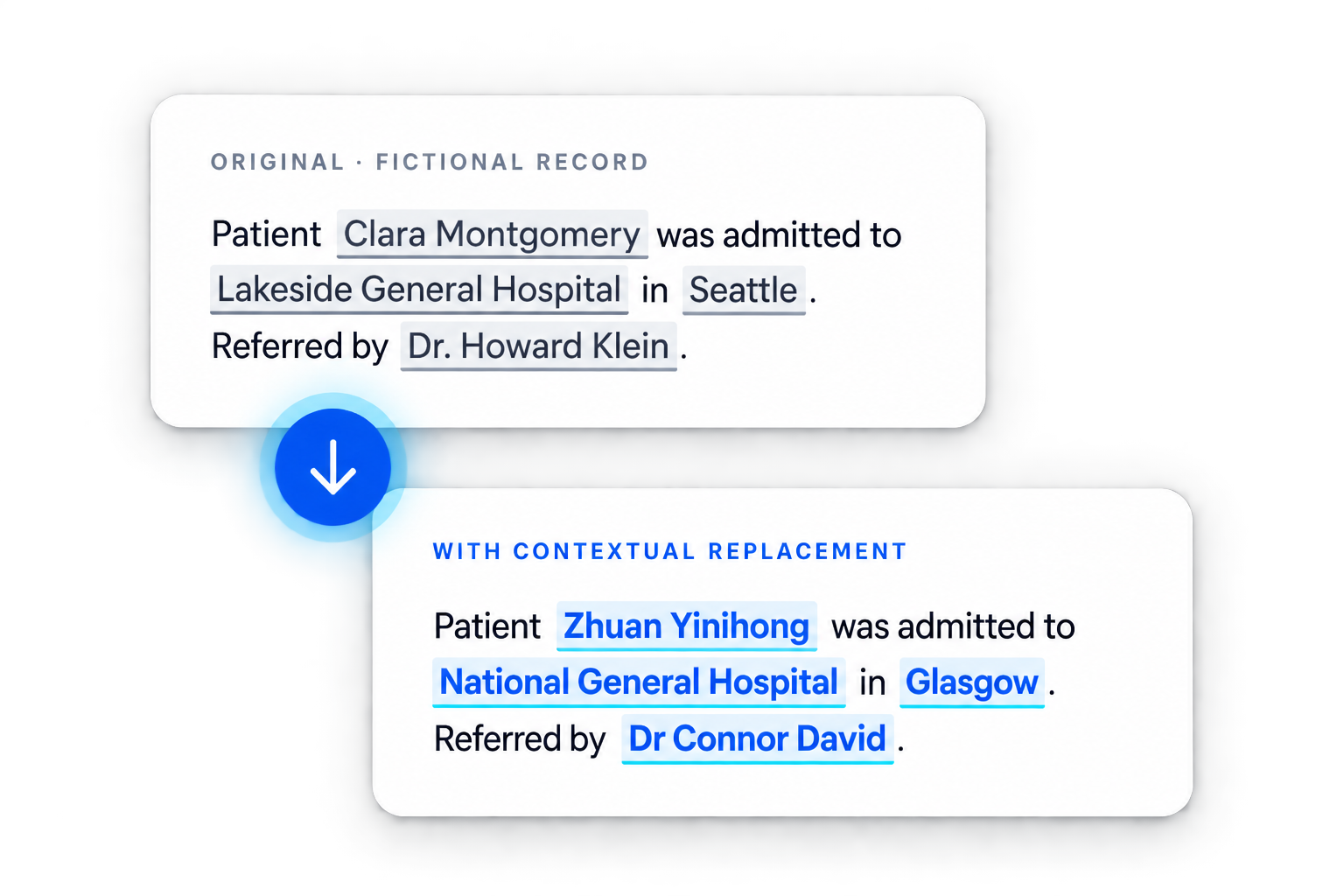
A note that reads "Mr. Johnson had a fall last night" contains PII. The name is not in a designated name field. It appears mid-sentence in a free-form observation. A pattern-matching system that looks for names in name fields will not find it. A string-search approach that looks for names extracted from other parts of the patient record might find it -- if the spelling matches exactly, if no nickname was used, and if no other patient or family member shares a similar name.
In practice, string-search de-identification of free-form fields fails regularly due to typos in the notes, use of nicknames or informal names, references to family members whose names do not appear in the patient record, and mentions of third parties such as caregivers or witnesses. Each of these failure modes results in a real name surviving the de-identification process -- and potentially appearing in a downstream dataset, research output, or third-party system.
Limina handles this class of problem through contextual language understanding. Because the system is built by linguists and trained on the linguistic structures of medical text, it recognizes that "Mr. Johnson" in a clinical note is a person reference even when it appears in an unpredictable position in an unstructured field. The same applies to references to family members, physicians, and other named individuals who appear in notes but whose names are not in any structured field of the record.
This capability matters beyond HIPAA. GDPR and other international frameworks treat indirect identifiers -- information that could, in combination with other data, identify an individual -- as personal data subject to protection. A family member's name mentioned in a clinical note is exactly the kind of indirect identifier that a linguistically-aware system will catch and a pattern matcher will not.
HIPAA compliance and the expert determination standard
Organizations seeking HIPAA compliance through de-identification typically pursue one of two recognized methods: the Safe Harbor method, which requires removal of a specific list of 18 identifier types, or the Expert Determination method, which requires a qualified expert to assess that the risk of re-identifying any individual in the dataset is very small.
Expert determination is a more rigorous and often more defensible path for research-grade datasets. It involves statistical analysis of a representative sample of the de-identified data to verify that re-identification risk falls below a predetermined threshold. For expert determination to succeed, the underlying de-identification must be thorough enough that the residual risk is genuinely low. A system that misses 15% to 33% of sensitive entities will not produce data that passes a rigorous expert determination review.
Limina supports this workflow directly. By accurately de-identifying healthcare datasets at the entity level -- including the medical-specific entity types that other solutions miss -- Limina produces output that is meaningfully more suitable for expert determination review. A Senior Software Development Manager at Providence Health has spoken to the practical value of this capability in their own data workflows.
Organizations in the pharmaceutical and life sciences sector face similar requirements when working with clinical trial data, patient-reported outcomes, and post-market surveillance records. Limina's pharma and life sciences solution is designed for exactly these workflows, where both regulatory compliance and data utility must be maintained simultaneously.
If your organization is preparing healthcare datasets for secondary use, research sharing, or AI training and needs a solution that can meet expert determination standards, get in touch with the Limina team to discuss your specific requirements.
Why specialized AI outperforms general-purpose solutions in healthcare settings
The pattern across all of these comparisons -- entity coverage, benchmark accuracy, free-form text handling, and HIPAA compliance support -- points to a single underlying conclusion: general-purpose PII detection solutions are not built for healthcare, and it shows.
This is not a criticism of what those solutions do well. Azure, AWS, and Google have each built capable tools for identifying standard PII in business text. The problem is that healthcare data is not business text. It has a different vocabulary, a different structure, different regulatory requirements, and different failure modes. A solution that performs adequately on customer service records or financial documents may perform dangerously inadequately on clinical notes.
Limina's approach to this problem starts with language. The platform is built by linguists, which means the entity recognition models are grounded in an understanding of how medical language actually works -- how clinicians abbreviate, how names and relationships appear in context, how medical terminology intersects with conversational register in a nursing note at the end of a long shift. That linguistic foundation is what makes accurate detection possible across the full range of entity types that healthcare data contains.
This same foundation extends to other industries that handle sensitive, domain-specific language. Financial services organizations, insurance carriers, and contact centers all deal with text that combines standard PII with industry-specific sensitive information that general-purpose tools were not designed to recognize.
The healthcare benchmarks represent the most challenging version of this problem. When a de-identification solution performs well on medical notes data, it demonstrates a level of linguistic and domain sophistication that translates across every other sensitive data context.
What does accurate healthcare de-identification actually require?
To summarize what the evidence shows, accurate de-identification of medical data requires four things working together.
First, comprehensive entity coverage that includes the full range of PHI types -- not just the standard PII identifiers, but blood types, dosages, injuries, medical conditions, procedures, statistics, and medications. Missing any of these categories means allowing sensitive clinical information to pass through unredacted.
Second, free-form text understanding that can locate personally identifying information in unstructured clinical notes, not just in designated structured fields. This requires a contextual language model, not a pattern matcher or string search.
Third, a single, unified processing pipeline that handles both PII and PHI in one pass, without requiring multiple API calls or multiple vendors for the same document.
Fourth, output quality sufficient to support rigorous compliance workflows, including expert determination under HIPAA and equivalent standards under GDPR and other international frameworks.
Limina's data de-identification platform is designed to meet all four of these requirements. If your organization is working with healthcare data and needs to get this right, contact Limina to learn how the platform performs against your specific data and compliance requirements.



Frequently Asked Questions
What makes medical data more difficult to de-identify than other types of data?
Medical data combines the full range of standard personally identifiable information with an additional layer of protected health information specific to clinical contexts, including diagnoses, medications, dosages, injuries, blood types, and medical statistics. It also contains extensive free-form text in clinical notes and EMR fields, where personal references appear in unpredictable positions within natural language sentences rather than structured fields. This combination of entity complexity and unstructured text makes medical data uniquely challenging for automated de-identification systems.
What is PHI and how does it differ from PII?
PII (personally identifiable information) is a broad category covering any data that can identify an individual, such as names, addresses, phone numbers, and government IDs. PHI (protected health information) is a subset of PII defined under HIPAA that specifically relates to health status, healthcare provision, or payment for healthcare, and that is created, received, or maintained by a covered entity. PHI includes not only standard identifiers but also clinical information such as diagnoses and treatment records when they are linked to an individual. All PHI is PII, but not all PII is PHI.
Why do general-purpose PII detection tools underperform on healthcare data?
General-purpose tools are typically trained and evaluated on business text, customer records, and standard document types. They are designed to detect a defined set of common identifiers and do not include the medical-specific entity types -- such as blood types, dosages, and medical conditions -- that healthcare data requires. They also lack the domain-specific language models needed to locate personal references in the unstructured clinical notes that make up a significant portion of medical records.
Does AWS Comprehend Medical cover all PHI entity types?
No. Even when using the separate AWS Comprehend Medical service for PHI detection, AWS does not detect Blood Type, Injury, or medical Statistics. These entity types are covered by Limina in a single API call alongside standard PII, without requiring a separate service or additional processing steps.
How does Limina support HIPAA expert determination?
HIPAA's expert determination method requires a qualified expert to assess that the risk of re-identifying any individual in a de-identified dataset is very small. Limina supports this process by producing de-identified output with comprehensive entity coverage, including the medical-specific entity types that other solutions miss. This reduces residual re-identification risk to a level more suitable for expert review, and is one reason organizations like Providence Health have integrated Limina into their data workflows.
Which regulations govern medical data privacy beyond HIPAA?
In the United States, HIPAA is the primary federal standard for healthcare data privacy. Internationally, GDPR explicitly classifies health data as a special category of sensitive personal data requiring heightened protection. Additional frameworks with specific provisions for medical information include California's CPRA, Quebec's Law 25, and Japan's APPI. Organizations handling patient data across multiple jurisdictions need a de-identification solution that addresses the entity types required under each of these frameworks.
Can Limina handle free-form text in EMRs and clinical notes?
Yes. One of the most common failure points for string-search and pattern-matching de-identification approaches is the unstructured text fields found in patient records and electronic medical records. Because Limina is built by linguists and uses contextual language understanding, it can locate personal references -- including names, family member mentions, and references to third parties -- in free-form clinical notes, even when those references do not match any structured field in the record and regardless of spelling variations, nicknames, or informal language.