
How Limina Helps Organizations Achieve Compliance Under China's Personal Information Protection Law (PIPL)
China's PIPL sets some of the strictest data privacy standards in the world and applies to organizations far beyond China's borders. This guide breaks down PIPL's key compliance requirements and explains how Limina's context-aware de-identification technology helps organizations meet them.


China's Personal Information Protection Law (PIPL), which came into force on November 1, 2021, represents one of the most comprehensive personal data protection regimes in the world. It sets out stringent requirements for the handling, processing, and protection of personal information — requirements that apply not only to organizations operating within China, but in many cases to organizations operating entirely outside it.
For compliance, legal, and data governance teams working through what PIPL demands, the sheer scope of obligations can be daunting. Limiting data collection, ensuring data security, managing sensitive information, responding to data breaches, and conducting protection impact assessments are all obligations that require systematic, scalable approaches. Limina's advanced machine-learning technology is designed to address these requirements efficiently and accurately, giving organizations a practical path to compliance.
Does PIPL apply to organizations outside of China?
This is one of the first questions organizations ask when encountering PIPL, and the answer is: often, yes. Article 3 of PIPL clarifies that the law applies to the processing of personal information of individuals located within China's borders, even when that processing takes place outside of China, under the following circumstances: where the purpose is to provide products or services to natural persons inside the borders; where the processing involves analyzing or assessing the activities of natural persons inside the borders; or where other circumstances are provided for by law or administrative regulation.
In practical terms, this means that any multinational organization, technology platform, or service provider that engages with users or customers in China needs to take PIPL seriously, regardless of where its data infrastructure is located.
Accurate identification and management of personal information
Under PIPL, the definition of personal information is broad: it covers any data related to identified or identifiable individuals, with anonymized information explicitly excluded from the definition (Article 4). The law defines anonymization as the process by which personal information is handled to make it impossible to distinguish a specific natural person and impossible to restore.
This framing aligns closely with the concept of personal data found in other global privacy frameworks such as the GDPR, though PIPL's anonymization standard is notably more demanding. Where the GDPR adds a reasonableness threshold to its re-identification assessment, PIPL sets a higher bar, requiring that linkage to an individual be rendered genuinely impossible.
Limina's machine-learning models are trained to recognize more than 50 different types of personal data entities across 53 languages, including the sensitive information categories defined in Article 28 of PIPL, such as biometric data, health information, and financial data. This broad detection capability ensures that organizations can accurately identify and manage the personal information present in their data, whether that data is structured, semi-structured, or unstructured.
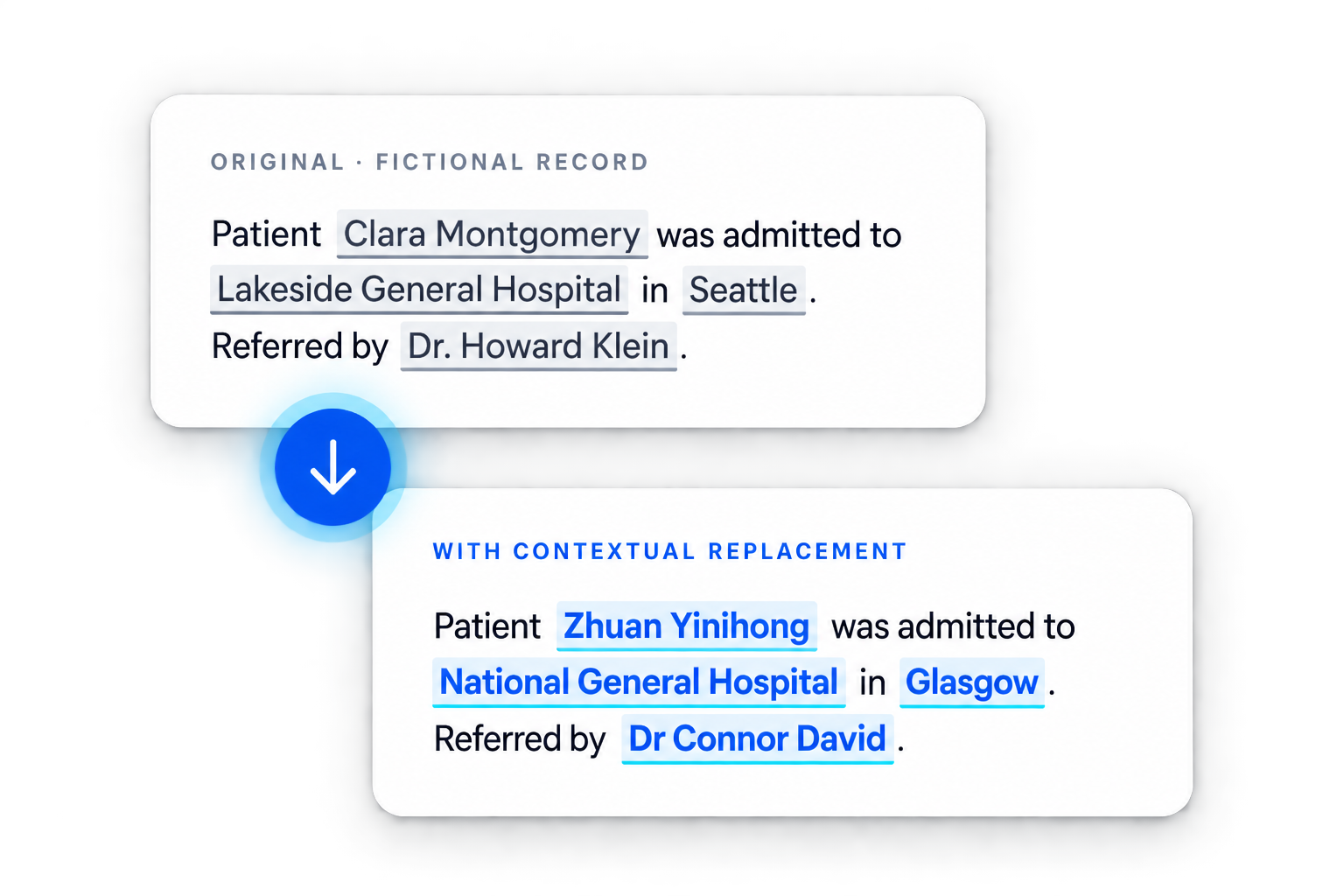
Crucially, Limina is built by linguists, which means its models go beyond simple pattern matching to understand the contextual relationships between entities within a document. A name that appears in a clinical note carries different context than a name in a financial record, and Limina's approach accounts for those nuances. For regulated industries like healthcare and financial services, this level of precision is essential when operating under privacy laws that offer little tolerance for misidentification.
By enabling precise identification of personal information within datasets, Limina supports PIPL's data minimization principle (Article 6), which requires that data collection and processing be limited to the minimum necessary to achieve specific purposes and prohibits the collection of excessive personal information. With Limina, organizations can systematically assess whether they are collecting only what they need, and identify where data can be minimized or removed entirely.
If your organization handles personal data subject to PIPL and you are unsure where to start, get in touch with Limina's team for a practical assessment of your compliance posture.
How does PIPL handle data retention and third-party data handling?
PIPL mandates that personal information be retained only for the shortest period necessary to achieve the processing purpose (Article 19). Limina's technology assists organizations in managing data retention policies by identifying and categorizing personal information, making it easier to implement retention schedules and ensure alignment with PIPL's requirements, including the requirement under Article 51 to implement categorized management of personal information.
On the question of data retention, it is worth noting that while PIPL does not state it explicitly, anonymization can be treated as equivalent to data disposition. If personal information is anonymized to the standard required by the law, it falls outside PIPL's scope, removing ongoing retention obligations from that data.
When organizations need to entrust third parties with the handling of personal information (Article 21), Limina helps ensure that the data shared does not exceed the scope agreed upon in the relevant contract. This is critical for avoiding unauthorized processing or retention by third parties. Notably, PIPL explicitly states that third-party data recipients are not permitted to retain the personal information they have received. Anonymizing the data before transfer, supported by Limina's data de-identification capabilities, can provide a practical means of meeting this requirement.
Handling sensitive personal information under PIPL
Sensitive personal information under PIPL carries a higher compliance burden. Article 28 requires that such information be processed only when absolutely necessary, and Article 29 requires separate consent for its processing. Categories covered include biometric data, medical and health information, financial account information, location tracking data, and personal information relating to minors under the age of 14.
Limina's models detect and categorize these sensitive data types, enabling organizations to apply stricter controls at the point of processing and to maintain auditable records of where sensitive information exists within their data estate. This is particularly important in sectors like pharma and life sciences, healthcare, and financial services, where sensitive personal information is routinely processed at scale and where regulatory penalties for non-compliance are most severe.
Facilitating incident response and data breach management
In the event of a data breach, PIPL requires prompt action and notification to the relevant authorities and affected individuals (Article 57). A key element of this obligation is identifying the categories of personal information involved in the breach, as these categories determine what must be disclosed and to whom.
Limina's solution can rapidly identify the types of personal information implicated in a breach, helping organizations assess the severity of the incident and determine whether their notification obligations are triggered. By ensuring that the correct and complete picture of affected data categories is surfaced quickly, Limina supports effective breach management and reduces the risk of under-reporting or delayed disclosure.
For organizations in contact centers and insurance, where large volumes of personal information are captured through calls, chat logs, and policy records, the ability to quickly scope a breach across unstructured data formats is especially valuable.
Supporting PIPL's de-identification and anonymization requirements
PIPL draws a clear distinction between de-identification and anonymization (Article 73), with different legal implications for each.
De-identification, under PIPL, refers to the processing of personal information so that individuals cannot be identified without access to additional information. This is treated as a security measure under Article 51, which requires information handlers to adopt it as appropriate given the purpose of processing, the sensitivity of the information, and the security risks involved.
Anonymization, by contrast, excludes the information from PIPL's application altogether, because it renders identification impossible and irreversible. For organizations seeking to leverage data for secondary purposes such as analytics, model training, or research, achieving true anonymization offers the most favorable outcome from a regulatory standpoint.
Limina's data de-identification platform supports both processes. For de-identification, it identifies and removes direct identifiers with high accuracy, meeting the standards PIPL sets for this security measure. For anonymization, it provides the foundational and most critical step: comprehensive identification and removal of personal identifiers. Given that PIPL's anonymization standard requires that identification be rendered genuinely impossible, accuracy at this stage is non-negotiable. Automating this step with Limina saves considerable time and effort, though organizations should consult a privacy expert to assess residual re-identification risk and determine whether additional measures are needed to satisfy PIPL's demanding anonymization threshold.
Conducting Personal Information Protection Impact Assessments
PIPL requires organizations to conduct Personal Information Protection Impact Assessments (PIPIAs) in certain high-risk scenarios, including the handling of sensitive personal information, automated decision-making, entrusting personal information to third parties, and transferring data abroad (Articles 55 and 56).
A PIPIA requires a thorough understanding of what personal information is being processed, where it resides, how it is used, and what risks that processing poses to individuals. Limina's detailed reports on the types and locations of personal information within datasets provide a solid foundation for these assessments, enabling compliance and legal teams to surface and analyze the relevant risks systematically rather than relying on manual review.
For organizations preparing to transfer data across borders under PIPL, this capability is particularly valuable. Cross-border data transfers are subject to especially stringent controls, and regulators will expect evidence of a rigorous assessment process.
Ready to see how Limina can support your organization's PIPL compliance program? Talk to an expert today and learn how our platform fits into your data governance workflow.



Frequently Asked Questions
What is China's Personal Information Protection Law (PIPL)?
China's Personal Information Protection Law (PIPL) is a comprehensive data privacy statute that came into force on November 1, 2021. It establishes rules for the collection, processing, storage, use, transmission, and deletion of personal information. PIPL is widely considered one of the most rigorous personal data protection regimes in the world, comparable in scope to the European Union's GDPR, and it applies both to organizations operating within China and, in many circumstances, to those processing the personal information of individuals located in China from outside its borders.
Who does PIPL apply to?
PIPL applies to any organization or individual that processes the personal information of people located within China's borders. Article 3 explicitly extends the law's reach beyond China's territory to cover processing that occurs outside of China when the purpose is to provide products or services to individuals in China, or to analyze the behavior of individuals in China. This extraterritorial application means that multinational corporations, technology companies, and any service provider with a user base in China must assess their compliance obligations under PIPL.
What counts as sensitive personal information under PIPL?
PIPL Article 28 defines sensitive personal information as information that, once leaked or illegally used, may easily cause harm to the dignity of natural persons or cause harm to personal safety or property. Categories include biometric data, religious beliefs, designated status, medical health information, financial accounts, and location tracking, as well as any personal information relating to minors under the age of 14. Sensitive personal information may only be processed when there is a specific purpose and sufficient necessity, and it requires separate, explicit consent from the data subject.
What is the difference between de-identification and anonymization under PIPL?
PIPL Article 73 defines both terms and treats them differently from a legal standpoint. De-identification refers to the processing of personal information such that the data subject cannot be identified without the use of additional information; de-identified data is still considered personal information under PIPL and remains subject to the law. Anonymization refers to the processing of personal information such that the data subject cannot be distinguished at all and the data cannot be restored; anonymized data falls outside the scope of PIPL entirely. Achieving anonymization under PIPL is therefore more demanding and more consequential than de-identification.
How can Limina help with PIPL compliance?
Limina helps organizations meet several core PIPL obligations. Its machine-learning models, built by linguists for context-aware detection, accurately identify more than 50 types of personal data entities across 53 languages, supporting data minimization, sensitive data management, and retention policy enforcement. Limina's de-identification platform automates the identification and removal of personal identifiers, supporting both the de-identification security measures required by Article 51 and the preliminary steps toward anonymization. Limina's reporting capabilities also provide the data inventory foundation needed for Personal Information Protection Impact Assessments. Organizations in healthcare, pharma and life sciences, financial services, insurance, and contact centers can particularly benefit from Limina's ability to process unstructured data formats at scale.
What are the penalties for non-compliance with PIPL?
PIPL establishes significant penalties for violations. Depending on the nature and severity of the breach, penalties can include orders to correct violations, warnings, confiscation of illegal gains, fines of up to 50 million Chinese yuan or up to 5% of an organization's annual turnover from the previous year, as well as suspension or termination of business operations. In serious cases, individuals responsible for the violations may also face personal fines and be barred from holding senior management roles. These figures make PIPL one of the highest-stakes data privacy regimes globally, reinforcing the importance of proactive compliance investment.