
Navigating the New Frontier of Data Privacy: Protecting Confidential Company Information in the Age of AI
As employees turn to AI tools for everyday tasks, confidential company information is at risk of being shared with third-party systems. This article explores the growing threat of unintentional data exposure through AI, what qualifies as confidential company information, and how organizations can protect sensitive data without sacrificing productivity.


Artificial intelligence and large language models (LLMs) are transforming the way we work, and the boundaries of data privacy are being tested like never before. While most organizations have robust measures in place to secure their proprietary algorithms and internal data repositories, there is a growing challenge that cannot be overlooked: the uncontrolled sharing of Confidential Company Information (CCI) by employees interacting with third-party AI systems.
This is not a theoretical risk. It is happening every day, in virtually every industry, as workers reach for AI-powered tools to help them write faster, analyze data, and streamline workflows. The convenience is undeniable. But so is the exposure.
What is confidential company information, and why does it matter in an AI context?
Confidential Company Information refers to any data or knowledge that an organization considers proprietary, sensitive, or restricted. This encompasses a wide range of material: internal financial forecasts, strategic plans, client names and contact details, partnership agreements, unreleased product specifications, legal correspondence, and HR records, among much else. The common thread is that this information has business value precisely because it is not public, and its exposure could cause competitive, legal, or reputational harm.
When employees work with traditional tools, such as email clients, internal documents, or secure databases, CCI typically stays within the organization's controlled environment. But third-party AI platforms are a different story. When a user pastes a block of text into an LLM interface to request a summary or rewrite, that text may be processed, stored, or used to train future models by the external platform. The employee's intent is to work more efficiently. The unintended consequence may be the exposure of information the organization never agreed to share.
Why are employees inadvertently sharing sensitive data with AI tools?
The honest answer is that most employees are not thinking about data privacy when they reach for an AI assistant. They are thinking about the email they need to finish, the report they need to polish, or the presentation they need to refine. AI tools feel like productivity tools, not data transfer mechanisms, so the natural caution people apply to, say, forwarding a confidential document via personal email often does not carry over.
At Limina, we have been closely observing this emerging risk across regulated industries. A few scenarios illustrate how easily it can happen:
A sales professional drafting a high-stakes proposal for a prospective client might paste internal notes about deal terms, pricing history, and account strategy directly into an LLM to help structure the language. The AI produces a polished draft, but the sensitive context was transmitted to an external system in the process.
A financial analyst seeking help with trend analysis might share confidential revenue projections or unpublished earnings data to give the model enough context to generate useful output.
A marketing professional working on a product launch might input unreleased product details into an AI content tool to generate campaign copy, inadvertently exposing go-to-market strategy.
A project manager refining a client presentation might upload slides containing client logos, partnership terms, or non-public project milestones.
In each case, the employee is acting in good faith to be productive. The risk arises not from negligence or malice, but from the gap between how employees experience AI tools and how those tools actually handle the data they receive.
What types of confidential information are most at risk?
Not all sensitive data looks the same. Some of it is obviously structured, such as a social security number or a financial account balance. But much of the confidential information employees share with AI systems is embedded in natural language and less easy to recognize at a glance.
CCI that frequently appears in AI prompts includes client names and contact information, internal pricing and deal terms, strategic plans and roadmaps, personnel information, merger and acquisition discussions, legal advice and correspondence, clinical trial data in pharmaceutical and life sciences contexts, and patient information in healthcare settings. For organizations in regulated industries, these categories may also overlap with data types protected under privacy law, creating compliance exposure on top of competitive risk.
The challenge is compounded by the fact that LLMs are designed to extract signal from context. The richer and more specific the information a user provides, the better the output. This creates a natural incentive to share more, not less, which works directly against data protection objectives.
How Limina's data de-identification platform addresses the challenge
Limina was built to address exactly this kind of risk. Our data de-identification platform intercepts and redacts confidential company information before it leaves your organization's controlled environment, enabling employees to benefit from AI tools without inadvertently exposing sensitive data.
What sets Limina apart is the technology underneath the platform. Limina was built by linguists, which means it is context-aware in a way that pattern-matching systems are not. It understands language nuances and the relationships between entities within a document, not just surface-level text patterns. This matters enormously when it comes to CCI, because confidential information is rarely labeled as such. A client name embedded in a sales note, a revenue figure woven into a narrative paragraph, or a strategic initiative described in conversational language are all things a purely pattern-based system might miss, but that Limina is built to detect.
The core capabilities of Limina's platform include real-time monitoring and redaction, where the engine integrates with workflows and communication tools to scan data before it is transmitted to any third-party system. Sensitive information is redacted at the point of transfer, so the employee's workflow continues without interruption. Beyond text, Limina's advanced detection also covers a wide array of sensitive data types embedded in documents, including images such as client logos or signatures that might appear in a presentation or report.
Organizations can also customize what constitutes CCI within their specific context. Every industry and every company has its own data protection requirements, and the platform's configurable sensitivity settings allow organizations to define the categories and thresholds that matter most to them. This is especially relevant for industries like healthcare, pharma and life sciences, financial services, insurance, and contact centers, where regulatory obligations impose specific requirements around what data can be shared and with whom.
If your organization is ready to take a proactive approach to AI-related data exposure, talk to one of our experts to see how Limina can be configured for your environment.
How does real-time CCI redaction work in practice?
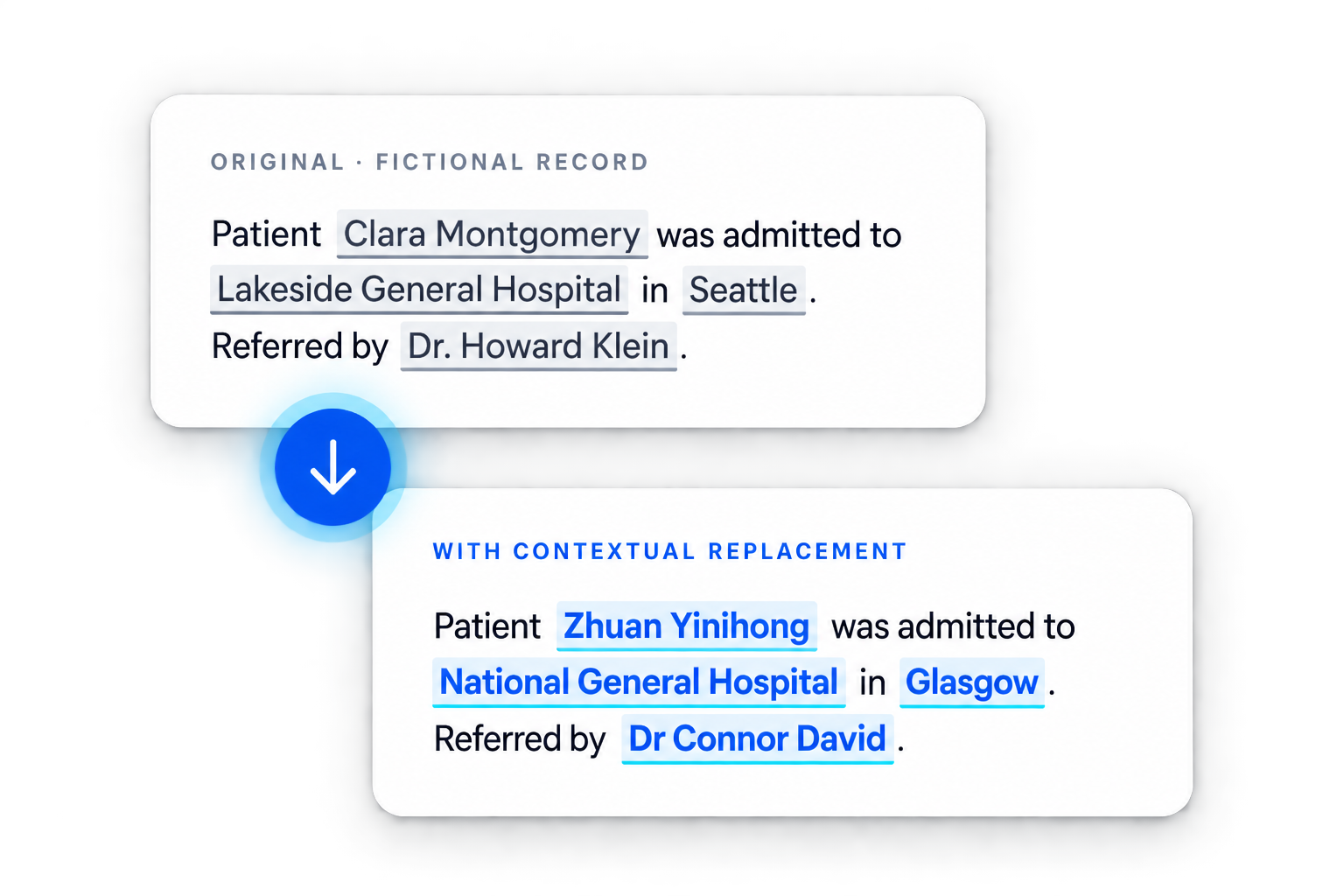
The practical experience of using Limina's platform is designed to be unobtrusive. The goal is to protect the organization without adding friction for the employee. When a user drafts a prompt for an AI tool that contains CCI, the platform identifies and redacts that information before the content is transmitted externally. Placeholder tokens or anonymized substitutions are used in place of the sensitive data, allowing the AI to still process a meaningful and contextually coherent request, while the confidential details remain inside the organization's environment.
This approach balances two objectives that are often seen as being in tension: productivity and security. Employees can continue to use the AI tools that help them work faster and smarter. The organization retains control over its most sensitive information. Neither objective has to be sacrificed for the other.
Why compliance with internal data policies is a business priority, not just an IT concern
Organizations tend to think of data compliance as a regulatory obligation, something managed by legal or security teams in response to external requirements like HIPAA, GDPR, or CCPA. But the risk of unintentional CCI exposure through AI tools is primarily an internal policy issue, and one that requires buy-in across the business.
When employees share confidential company information with third-party AI platforms, they may not be violating any external regulation. But they may be violating the organization's own data handling policies, contractual obligations to clients, or non-disclosure agreements with partners. The consequences can include loss of competitive advantage, damaged client relationships, breach of contract claims, and reputational harm.
Proactively implementing a solution like Limina signals to clients and partners that the organization takes data responsibility seriously, not just as a matter of regulatory compliance, but as a matter of professional integrity. In industries where trust is foundational to the business relationship, that signal matters.
For organizations in financial services or insurance, where client confidentiality is both a legal requirement and a competitive differentiator, the ability to demonstrate that AI-assisted workflows do not compromise sensitive data is increasingly a business-critical capability.
Balancing AI productivity with organizational data security
It would be counterproductive to respond to the risks of AI-assisted work by restricting access to AI tools entirely. The productivity benefits are too significant, and organizations that forgo them will find themselves at a disadvantage relative to competitors who have found ways to use AI responsibly.
The more effective approach is to build guardrails that allow employees to use AI tools freely, within clearly defined boundaries. This requires a combination of policy, education, and technology. Employees need to understand what CCI is and why sharing it with external systems creates risk. But awareness alone is insufficient, because the same cognitive shortcuts that lead people to share sensitive information in the first place will continue to operate under time pressure. Technology that operates at the point of data transfer, detecting and redacting CCI before it leaves the organization, is the only reliable mechanism for closing the gap between policy intent and employee behavior.
Limina's platform is designed to do exactly that, and to do it in a way that educates users about potential risks without hindering the workflows they depend on. Over time, this supports the development of a broader culture of security awareness, where protecting CCI becomes a natural part of how employees think about working with AI tools.
To see how Limina can be integrated into your organization's AI workflows, get in touch with our team.



Frequently Asked Questions
What is confidential company information (CCI)?
Confidential Company Information is any data or knowledge that an organization designates as proprietary, sensitive, or restricted from external disclosure. This typically includes financial data, strategic plans, client information, personnel records, legal correspondence, and any other material whose exposure could create competitive, legal, or reputational harm for the organization.
How does confidential company information end up in AI tools?
Employees share CCI with AI tools when they paste text, upload documents, or describe situations in ways that include sensitive organizational details. This typically happens not out of negligence but because employees are focused on the task at hand, not on the data handling practices of the AI platform they are using.
Can AI tools use the information employees input for model training?
This depends on the specific platform and its data use policies. Many AI providers process and may retain user input for purposes including model improvement, though policies vary and are subject to change. Organizations that rely on employees to self-select what is appropriate to share with AI platforms are taking on substantial and largely unmanaged risk.
How does Limina detect confidential company information in AI prompts?
Limina's platform uses context-aware natural language processing developed by linguists, which means it understands the meaning and relationships within text, not just surface-level patterns. This allows it to identify confidential information that might be embedded in conversational language, narrative paragraphs, or document structures, rather than relying solely on identifiable patterns like account numbers or structured data fields.
Which industries are most at risk from CCI exposure through AI tools?
Any industry that handles sensitive client or business information faces risk, but regulated industries face compounded exposure because of the overlap between CCI and regulated data types. Healthcare organizations, pharmaceutical and life sciences companies, financial services firms, insurers, and contact centers all deal routinely with data that is both organizationally sensitive and subject to legal protection. Unintentional AI-related disclosure can therefore create both internal policy violations and external regulatory liability.
Can Limina be customized to reflect our organization's specific definition of confidential information?
Yes. Limina's platform includes configurable sensitivity settings that allow organizations to define what constitutes CCI in their specific context. This means the redaction logic can be tailored to the categories, terminology, and risk thresholds that are most relevant to your industry and internal data policies.
Does using Limina slow down employee workflows?
Limina is designed to operate unobtrusively, intercepting and redacting sensitive data at the point of transfer without requiring employees to change how they work. The goal is to protect the organization while preserving the productivity benefits that make AI tools valuable in the first place.