Unlocking New Levels of Accuracy in Privacy-Preserving AI with Co-Reference Resolution
When AI systems fail to recognize that "Robert Johnson," "Bob Johnson," and "R. Johnson" all refer to the same person, the results are fragmented summaries, missed insights, and unreliable outputs. Co-reference resolution solves this -- and Limina has built it directly into its privacy-first data de-identification layer.


One of the most persistent challenges in deploying AI across regulated industries is not just what the AI knows -- it is how well the AI understands the data it is processing. Even the most capable language models can produce fragmented, unreliable outputs when the underlying data contains varied references to the same entity. A patient's name spelled differently across clinical notes. A company referred to by its full legal name in one document and its ticker symbol in another. A research subject identified by first name in one section and by a pronoun in the next.
This is the problem that co-reference resolution is designed to solve. And for organizations operating in environments where data privacy is non-negotiable, solving it without exposing sensitive information adds another layer of complexity entirely.
At Limina, we have built co-reference resolution directly into our privacy layer, enabling AI systems to produce more accurate, coherent outputs -- while ensuring that personal data is de-identified before it ever reaches a language model.
What Is Co-Reference Resolution in Natural Language Processing?
Co-reference resolution is the computational task of identifying when two or more expressions in a text refer to the same entity. In natural language, people and organizations are rarely referred to in the same way twice. A single document might introduce someone as "Dr. Elizabeth Warren," refer to her later as "Dr. Warren," "she," or simply "the physician." Without a mechanism that links these expressions to the same underlying entity, an AI system processes them as separate, unrelated references.
In natural language processing (NLP), this fragmentation has measurable consequences. Summarization models produce incomplete or contradictory summaries. Reasoning chains break down because the model cannot associate an action with the person who performed it. Data linking across records fails because the same individual appears as multiple distinct entries.
Co-reference resolution bridges this gap. By resolving all expressions that refer to the same entity -- whether they are full names, shortened names, aliases, abbreviations, or pronouns -- it gives AI systems the connected, coherent view of the data they need to perform accurately.
Why Does Entity Name Variation Create Problems for AI Systems?
The diversity of naming conventions in real-world data is far greater than most AI systems are built to handle by default. Consider a few scenarios that arise routinely in enterprise data:
A pharmaceutical company's adverse event database may refer to a clinical investigator as "Dr. Michael Chen," "M. Chen, MD," "Michael Chen," and "Dr. Chen" across different data entry fields and time periods. A hospital's EHR system may contain notes from multiple providers who each refer to a patient by a different combination of name, patient ID, and pronoun. A financial institution's compliance records may reference an organization as "Goldman Sachs," "GS," "Goldman," and "the firm" within the same audit trail.
Without co-reference resolution, each of these variations is treated as a distinct data point. The result is noise -- and in regulated industries, noise in AI outputs is not just an inconvenience. It creates compliance risk, undermines the reliability of AI-assisted decision-making, and erodes trust in the systems organizations are investing in.
How Does Limina's Co-Reference Resolution Work?
Limina introduced co-reference resolution as part of its 4.0alpha release, integrating it into the same privacy layer that powers its data de-identification platform. The feature is designed to work seamlessly within existing AI workflows, without requiring organizations to build or maintain separate entity resolution pipelines.
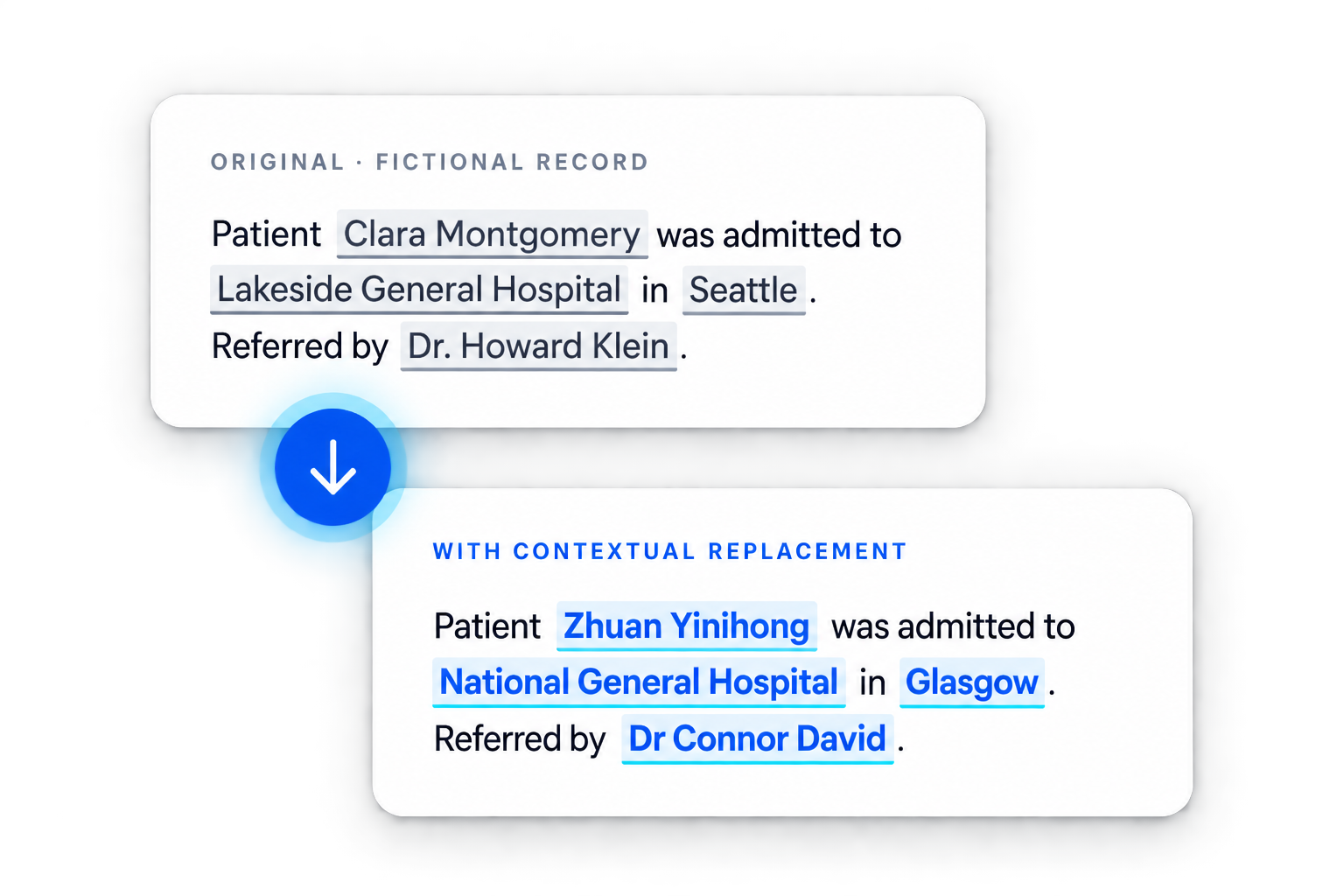
The process works by first detecting all named entities and their referential expressions within a document or data input -- full names, shortened names, titles, aliases, organizational abbreviations, and pronouns. It then links these expressions to the same underlying entity before the data is passed to any downstream AI system. This means that when a language model receives the data, it receives a coherent, consistent representation of each entity, rather than a fragmented collection of disconnected references.
Because this resolution happens within Limina's privacy layer, the process is fully integrated with de-identification. Personal data is detected, linked through co-reference resolution, and then redacted or pseudonymized before it is ever sent to an external AI system. Once the AI has completed its task, data can be securely re-identified within your own environment. At no point does sensitive information leave your control.
This architecture reflects a foundational principle at Limina: privacy should not be an afterthought applied after AI processing. It should be built into the pipeline from the start.
It is also worth noting what makes Limina's approach different at a technical level. Unlike tools that rely solely on pattern matching or regular expression-based entity detection, Limina's de-identification solution is built by linguists. This means it is context-aware -- capable of understanding language nuance, entity relationships within documents, and the semantic role a given expression plays in a sentence. That linguistic foundation is precisely what makes co-reference resolution possible at the level of accuracy enterprise use cases demand.
If your organization is working with large volumes of unstructured data in a privacy-sensitive environment, speak with Limina's team about building co-reference resolution into your AI pipeline.
What Are the Real-World Benefits of Co-Reference Resolution for AI Workflows?
The practical impact of co-reference resolution becomes clearest when you consider the workflows that depend on AI-generated outputs being accurate and complete.
Summarization becomes more reliable. When an AI model is tasked with summarizing a lengthy clinical report, legal document, or earnings call transcript, it needs to associate every reference to a given entity with the same underlying person or organization. Without co-reference resolution, a summary might accurately describe what "Dr. Chen" said in one section while failing to connect it to the findings attributed to "the lead investigator" in another. With co-reference resolution, the model receives a unified view, and the summary reflects it.
Data linking improves across records. Organizations in healthcare, financial services, and insurance frequently need to link information about the same individual or entity across multiple systems, documents, or time periods. Co-reference resolution ensures that name variations do not create false distinctions, improving the integrity of AI-driven record matching and analysis.
Reasoning chains stay intact. AI-assisted research, compliance review, and due diligence tasks rely on the model being able to follow a thread of information across a document. When the model cannot connect "she" to the named individual introduced three paragraphs earlier, reasoning breaks down. Co-reference resolution preserves the logical continuity that these tasks require.
Manual data preparation workload decreases. Teams that work with large volumes of unstructured text often spend significant time cleaning and standardizing entity references before that data can be used effectively. Co-reference resolution automates a meaningful portion of this work, allowing analysts and data scientists to focus on higher-value tasks.
Where Is Co-Reference Resolution Most Impactful?
The value of co-reference resolution scales with the complexity and sensitivity of the data environment. Several industries are positioned to benefit most immediately.
In healthcare and clinical settings, patient records, clinical trial documentation, and physician notes all contain dense, varied references to the same individuals. AI systems used for clinical summarization, patient journey analysis, or research support need the kind of entity coherence that co-reference resolution provides -- and they need it delivered in a way that keeps protected health information (PHI) out of external systems.
In pharma and life sciences, the stakes are similarly high. Pharmacovigilance workflows, regulatory submissions, and medical literature review all involve large volumes of unstructured text where accurate entity tracking is essential. A missed connection between two references to the same adverse event reporter or clinical site can have real downstream consequences.
In financial services, compliance and risk teams use AI to review transaction records, communications, and audit trails. These documents frequently reference individuals and entities using a mix of full names, abbreviations, job titles, and pronouns. Co-reference resolution helps ensure that AI-assisted reviews are complete and that relevant references are not overlooked because of naming inconsistencies.
In insurance, claims processing and fraud detection systems analyze documents where the same claimant, provider, or policy may be referenced in multiple ways. Accurate entity linking reduces false negatives and improves the reliability of AI-driven assessments.
And in contact centers, where AI is increasingly used to analyze call transcripts and agent notes, co-reference resolution ensures that a customer referenced by name, customer ID, and pronoun within the same transcript is recognized as a single entity -- producing more accurate sentiment analysis, issue categorization, and quality assurance outputs.
Privacy-First AI: Accuracy and Compliance Are Not Trade-Offs
A common concern among organizations exploring AI at scale is that improving AI accuracy requires sending more data -- and more sensitive data -- to external systems. Co-reference resolution, as implemented by Limina, is a direct refutation of that assumption.
By resolving entity references within the privacy layer before data is passed to any AI model, Limina enables organizations to improve the coherence and accuracy of their AI outputs without ever exposing personal or sensitive information to third-party systems. The de-identification step and the co-reference resolution step are integrated, not sequential. This means that the entities are linked and then redacted in a single, coordinated process -- eliminating the window of exposure that a two-step approach would create.
For organizations subject to HIPAA, GDPR, or other data privacy regulations, this matters enormously. Compliance is not a constraint that limits what AI can do. It is a design requirement that Limina has built its entire platform around.
The Foundation Beneath Better AI Outputs
Co-reference resolution is not a surface-level improvement. It addresses something fundamental about how AI systems understand language: the ability to recognize that different expressions can refer to the same thing. When that ability is missing, even the most powerful language models produce outputs that are only as reliable as the fragmented data they received. When it is present -- and when it is integrated into a privacy-preserving pipeline -- the quality of AI-driven work improves across every task that depends on coherent, connected understanding of entities.
Limina built co-reference resolution into its platform because accurate AI and private AI should not be two different things. They are the same goal, pursued through the same architecture.