Healthcare data breaches cost more than any other industry. According to the IBM Cost of a Data Breach Report 2025, the average healthcare breach cost reached $9.77 million in 2024 before dropping to $7.42 million in 2025—still the highest of any sector, and for the 14th consecutive year. The decline is partly attributed to the 2024 figure being inflated by the Change Healthcare ransomware attack, the largest healthcare breach on record. Electronic health records sit at the center of that risk because they hold every identifier needed to commit identity theft, insurance fraud, and worse.
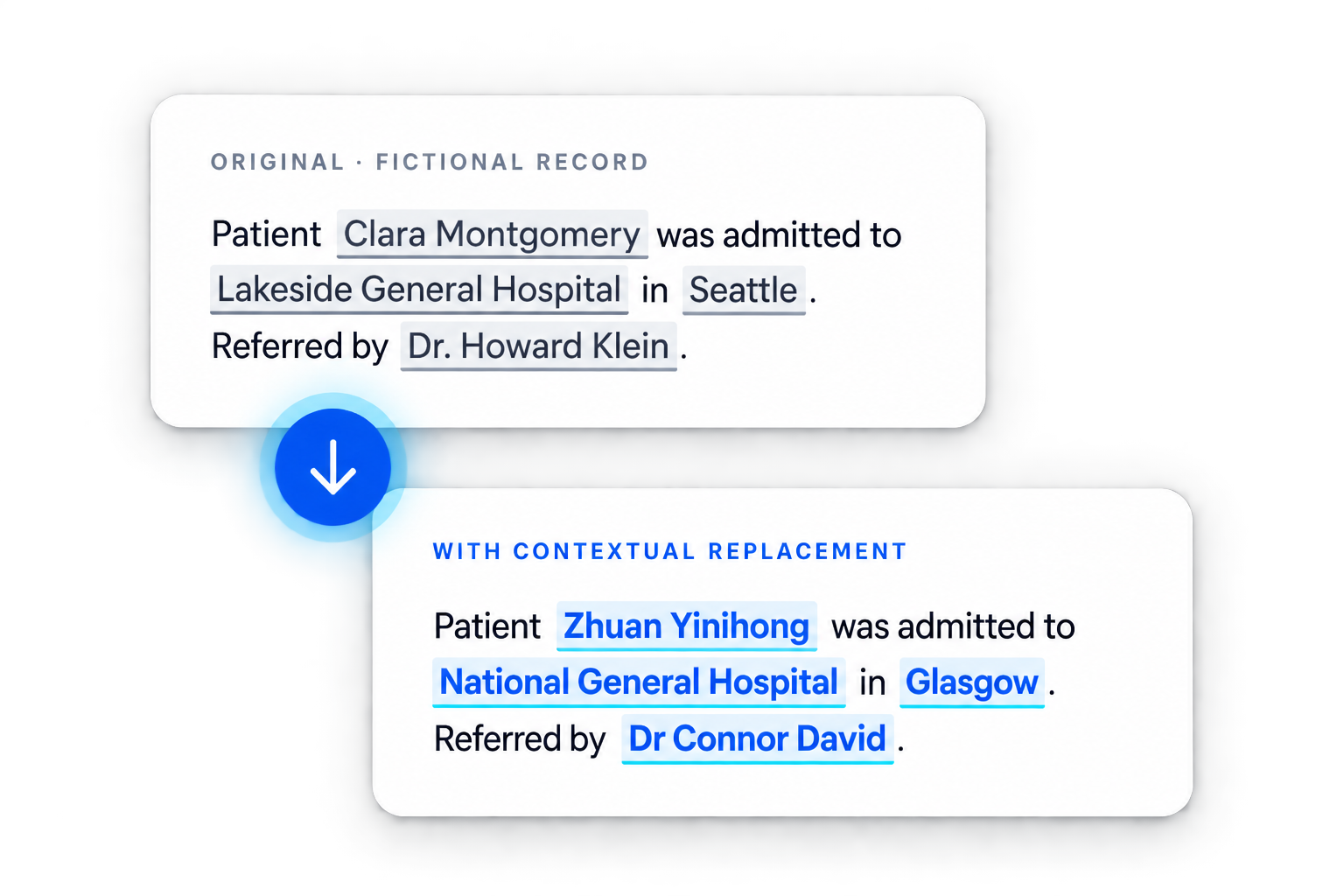
EHR de-identification is how modern healthcare organizations unlock the clinical value of sensitive data without triggering the full weight of HIPAA. Done correctly, de-identified data is no longer protected health information (PHI) and the HIPAA Privacy Rule no longer applies—transforming what organizations can do with that data for research, analytics, AI training, and operational improvement, without patient authorization.
Why EHR De-identification Matters Now
For most of HIPAA's history, de-identification was treated as a research workflow—slow, expensive and reserved for specific projects. That has changed. Three converging pressures have moved EHR de-identification from a back-office concern to a board-level priority.
1. The Data Demand Has Exploded
AI model training, real-world evidence research, population health analytics and quality improvement all depend on access to large volumes of clinical data. This is especially acute for organizations in pharma and life sciences, where clinical data is foundational to product development and evidence generation. PHI cannot be used freely for any of those purposes without patient authorization or a business associate agreement. Properly de-identified data can.
2. Regulators Are Paying Closer Attention
The HHS Office for Civil Rights has expanded its risk-analysis enforcement initiative and continues to issue civil monetary penalties for HIPAA violations. According to HHS enforcement data, penalties now reach as high as $2,190,294 per identical violation per calendar year (2026 inflation adjustment). The regulator is no longer passive: covered entities and business associates face active audits, and the penalty structure incentivizes proactive compliance.
3. Breach Surface Area Keeps Growing
The fewer systems that hold raw, identified PHI, the smaller your breach surface. De-identification is one of the few HIPAA-recognized ways to shrink that surface without losing analytical value. For insurance companies managing high-value claims data, this risk reduction translates directly to lower breach costs and reduced regulatory exposure.
What HIPAA Actually Requires for De-identification
The HIPAA de-identification standard is codified in 45 CFR § 164.514. The rule is short and worth reading directly. Health information is not individually identifiable if it does not identify an individual and the covered entity has no reasonable basis to believe the remaining information can be used to identify an individual.
To meet that standard, you must use one of two methods set out in the regulation:
| Method |
Definition |
Best For |
| Safe Harbor |
Remove all 18 specified identifiers and confirm no actual knowledge that remaining data could identify anyone |
Deterministic workflows, compliance audits, data publication, simpler use cases |
| Expert Determination |
Retain more data; a qualified statistical expert documents that re-identification risk is "very small" |
Precision analytics, AI training pipelines, temporal research, fine-grained patient cohorts |
Both methods, properly applied, produce data that is no longer PHI. Once that bar is met, the Privacy, Security and Breach Notification Rules no longer apply to that data set. You can share it, use it for research, train models on it, or publish it without patient authorization.
The Two HIPAA De-identification Methods
Safe Harbor: The Rule-Based Path
Safe Harbor is the more commonly used method because it is deterministic. Remove every item on the fixed list of 18 identifiers, confirm you have no actual knowledge that remaining data could identify someone, and document what you did.
The advantage: Safe Harbor is auditable, repeatable and requires no statistical expertise. Most general-purpose privacy tools and many EHR vendors map their workflows to it. The compliance pathway is clear and demonstrable to auditors.
The trade-off: Stripping all dates except year, all geography below state level, and all ages over 89 removes granularity that researchers and AI teams often need. A clinical study that depends on the day of admission cannot use a Safe Harbor data set as-is.
Expert Determination: The Risk-Based Path
Expert Determination flips the logic. Instead of removing a fixed list, you retain more data and have a qualified expert assess whether the risk of re-identification is "very small"—the specific threshold set by 45 CFR § 164.514(b)(1).
The advantage: Full dates, more detailed geography, and other quasi-identifiers can remain in the data set when the use case justifies it. This is the method of choice for serious analytics, clinical research, and AI training pipelines that need temporal precision or fine-grained cohorts.
The trade-off: Expert Determination requires a documented analysis from a qualified expert, ongoing risk monitoring, and a stronger compliance program overall. The bar for demonstrating compliance is higher—but so is the value extracted from the data.
Choosing Between Them
Stop choosing between compliance and data utility.
See how Limina's healthcare-specific de-identification platform helps you meet Safe Harbor or Expert Determination standards while preserving the clinical detail your teams actually need.
Schedule a Demo
Choose Safe Harbor if your primary need is speed, simplicity, and auditability. It works well for data publication, anonymized analytics, and use cases where granular dates and geography are non-essential. Choose Expert Determination if you need temporal precision, detailed patient cohorts, or are building AI training pipelines where data fidelity directly affects model performance.
The 18 Safe Harbor Identifiers
Under 45 CFR § 164.514(b)(2)(i), you must remove every category below for the patient and the patient's relatives, employers, and household members:
| Identifier Category |
Examples & Notes |
| Names |
First name, last name, any combination that could identify the individual |
| Geographic subdivisions smaller than state |
Street address, city, county, precinct, ZIP code (except first 3 digits if the area has population > 20,000) |
| Date elements |
Birth, admission, discharge, death dates (year only is permitted); all ages over 89 must be aggregated as '90 or older' |
| Telephone numbers |
Any phone number format, including mobile |
| Fax numbers |
Any fax number format |
| Email addresses |
Personal or work email addresses |
| Social Security numbers |
Full or partial SSN |
| Medical record numbers |
Patient MRN, chart number, hospital identifier |
| Health plan beneficiary numbers |
Insurance member ID |
| Account numbers |
Billing or hospital account numbers |
| Certificate and license numbers |
Medical license, state driver's license, professional certifications |
| Vehicle identifiers and serial numbers |
License plate numbers, VIN |
| Device identifiers and serial numbers |
Implant serial numbers, medical device IDs |
| Web URLs |
Personal websites, patient portal links |
| IP addresses |
Any internet protocol address format |
| Biometric identifiers |
Fingerprints, voice prints, retinal scans, facial geometry |
| Full-face photographs and comparable images |
Patient photos or images from which identity could be determined |
| Any other unique identifying number, characteristic, or code |
Any element not listed above that could reasonably identify the individual |
HIPAA Versus GDPR for EHR Data
If you handle EHR data from European patients, HIPAA is not enough. The General Data Protection Regulation (GDPR) treats health data as a special category with stricter rules. Understanding the difference is critical for any organization managing cross-border clinical data.
The most important difference: HIPAA's Safe Harbor is not recognized as anonymization under GDPR. According to GDPR Recital 26, anonymous data falls outside the regulation's scope—but the standard for anonymity is higher than HIPAA's. GDPR requires that the data subject no longer be identifiable by any means reasonably likely to be used, accounting for all objective factors including available technology and future developments.
In practice, you typically need to apply Expert Determination–level analysis to reach true anonymity under GDPR. Organizations in financial services and contact centers handling EU resident data face the same elevated bar, even outside of healthcare contexts. For a deeper breakdown of HIPAA vs GDPR compliance requirements, the differences have significant implications for any global data strategy.
Manual Review, Cloud APIs, and Specialized De-identification
Most organizations start with manual review. It does not scale. A typical EHR holds millions of clinical notes, and human review introduces inconsistency and unacceptable cost at volume.
General-purpose cloud PII tools cover the basics—names, emails, phone numbers—but research has consistently shown that real-world clinical text contains identifier patterns these tools miss. Domain-specific de-identification systems built for healthcare data perform meaningfully better on EHR text.
Why Healthcare De-identification Is Different
Clinical notes contain patterns that generic tools are not trained to recognize: patient initials embedded in narrative text, abbreviated medical record numbers, family names in medical histories, dates in multiple formats, and location references scattered throughout unstructured prose. Specialized systems handle these patterns because they are trained on clinical data, not general PII.
What to Evaluate in Any De-identification Tool
- Recall on real clinical text, not synthetic benchmarks—can it find actual identifiers in real EHR data?
- Handling of free text and audio—does it work on narrative notes, transcribed conversations, and unstructured voice data?
- Deployment that respects data sovereignty—can it run in-VPC, on-premise, or in your cloud environment?
- Audit trail outputs—does it produce confidence scores and documentation to support Safe Harbor or Expert Determination compliance reporting?
Key Takeaways
- EHR de-identification is a HIPAA-recognized mechanism for unlocking clinical data for analytics, research, and AI training without the full compliance burden of managing PHI.
- Two methods are available: Safe Harbor (rule-based, deterministic) and Expert Determination (risk-based, higher data utility). Choose based on your data needs and governance capacity.
- Properly de-identified data is no longer PHI. HIPAA's Privacy, Security, and Breach Notification Rules cease to apply.
- Healthcare-specific de-identification tools substantially outperform generic PII tools on clinical text due to the complexity and variability of medical language.
- If you handle European patient data, GDPR anonymization standards exceed HIPAA de-identification. Safe Harbor alone is not sufficient.
- De-identification is optional under HIPAA but highly recommended for any organization seeking to extract maximum analytical value from clinical data while managing regulatory risk.
Ready to Unlock Your EHR Data?
De-identification is the foundation for compliant analytics, research, and AI training on sensitive healthcare data. Whether you need Safe Harbor for simplicity or Expert Determination for maximum data utility, getting it right requires the right tools and the right expertise.
Limina's data de-identification platform helps regulated enterprises in healthcare, pharma, financial services and insurance de-identify sensitive data at scale—maintaining compliance while preserving the analytical value your teams need.
Schedule a Demo → Explore Data De-identification →