The True Cost of a Data Breach: By Region, Industry, and What You Can Do About It
Data breaches cost organizations an average of $4.35 million per incident. Learn what drives that number up -- and what brings it down.


Data breaches rarely leave the news cycle for long. Whether it is a hospital system exposing patient records, a financial institution losing control of account data, or a retailer suffering a payment card compromise, the headlines are relentless -- and so are the bills. But beyond the dramatic press coverage, what does a data breach actually cost a business? And more importantly, what determines whether that cost is manageable or catastrophic?
This article examines the tangible financial impact of data breaches: the average overall cost, how costs differ across regions and industries, what drives them up, and what organizations can do to meaningfully reduce their exposure before an incident occurs.
What Is the Average Cost of a Data Breach?
According to the 2022 Cost of a Data Breach Report conducted by the Ponemon Institute and sponsored by IBM Security -- a study covering 550 organizations across 17 countries and 17 industries -- the average cost of a data breach in 2022 reached $4.35 million USD. That figure represents the highest average in the 17-year history of the report at the time of publication, and it marked a 2.6 percent increase over the prior year.
It is worth pausing on what "cost" means in this context. The Ponemon/IBM framework accounts for four major cost categories: detection and escalation, notification, post-breach response, and lost business. Lost business -- which includes customer churn, reputational damage, and the cost of acquiring new customers to replace those who leave -- is consistently one of the largest contributors to total breach costs. This is not a line item that appears on an invoice. It accumulates over months and years, quietly eroding the organization's competitive position.
How Do Data Breach Costs Vary by Region?
Geography matters considerably when it comes to breach costs. The United States leads all regions covered by the 2022 report with an average breach cost of $9.44 million -- more than double the global average. The Middle East ranks second at $7.46 million, and Canada places third at $5.64 million. These figures reflect a combination of factors: the density of highly regulated industries, the scale of enforcement activity, and the litigiousness of the legal environment.
Organizations operating across multiple jurisdictions face compounded exposure. A breach affecting customers in both the United States and the European Union, for example, triggers reporting obligations under HIPAA or state-level laws on one side and the GDPR on the other -- each with its own timelines, documentation requirements, and penalty structures.
Which Industries Pay the Most for Data Breaches?
Healthcare consistently ranks as the most expensive industry for data breach costs, followed closely by financial services. Pharmaceuticals and technology round out the top four. The 2022 report found healthcare breach costs averaging well above the cross-industry mean, a trend that has held for over a decade.
This is not a coincidence. Healthcare organizations handle some of the most sensitive personal information in existence: diagnoses, treatment histories, prescription records, mental health data, and insurance details. The sensitivity of this data increases the likelihood of identity theft and insurance fraud when it is exposed, which in turn drives up regulatory penalties, litigation costs, and remediation expenses. Pharma and life sciences organizations face similar dynamics, particularly those conducting clinical trials where patient-level data must be protected under both data privacy frameworks and research ethics standards.
Financial services firms and insurance companies operate under equally demanding compliance regimes. Payment Card Industry Data Security Standards (PCI DSS) and a patchwork of state and federal financial privacy laws create a compliance burden that amplifies breach costs the moment a control failure occurs.
What Does a Data Breach Cost Per Record?
While aggregate costs tell part of the story, the cost-per-record figure offers a more granular picture of financial exposure -- and it helps organizations understand the relationship between data volume and risk.
In 2022, the cost per compromised record hit a seven-year high of $164 USD, according to the Ponemon/IBM report. Breaches in the study ranged from 2,200 to 102,000 records, which means even a mid-sized incident involving 10,000 records carries an estimated direct cost of $1.64 million. That number does not include the long-tail regulatory and legal costs that can continue accruing for years afterward.
The 2020 Cost of a Data Breach Report provided additional granularity by distinguishing between records that contained personally identifiable information (PII) and those that did not. Breaches involving PII were both the most frequent type and the most expensive, averaging $150 per record -- compared to $146 per record for non-PII data. When a malicious actor was responsible for the breach, that figure climbed to $175 per record for PII-containing records.
By contrast, anonymized data that was involved in a breach -- which occurred in 24 percent of incidents tracked in the 2020 report -- cost an average of $143 per record, or $171 per record in a malicious attack. The difference is meaningful: de-identified data is simply worth less to an attacker, which lowers both the probability of targeted theft and the regulatory consequences when exposure does occur.
For this reason, the question of whether data is adequately de-identified before it enters a system is not just a compliance question. It is a direct financial risk management decision.
Why Compliance Failure Is One of the Most Expensive Cost Factors
Healthcare and financial services are the two most heavily regulated industries in most jurisdictions, and that regulatory weight is directly visible in breach costs. The 2022 Ponemon/IBM report found that in these industries, 24 percent of breach costs accrue more than two years after the breach itself -- compared to only 8 percent in industries with lighter regulatory oversight. This "long-tail" effect reflects the pace of regulatory investigations, enforcement proceedings, and civil litigation, all of which take time to resolve and generate costs long after the immediate incident has been contained.
The financial consequences of compliance failure can be severe. Under the European General Data Protection Regulation (GDPR), organizations that fail to notify the supervisory authority of a personal data breach within the required timeframe can face administrative fines of up to 10 million EUR or two percent of global annual turnover -- whichever is greater. The notification obligation under Article 33 requires reporting "without undue delay and, where feasible, not later than 72 hours after having become aware" of a breach.
HIPAA imposes analogous obligations. Under Sections 164.404 and 164.408, covered entities and their business associates must notify affected individuals and the Department of Health and Human Services. Fines under the HITECH Act range from $100 per violation (capped at $25,000 annually for the same type of violation) to $50,000 per violation, capped at $1.5 million annually. The culpability of the organization -- whether it acted with willful neglect, for example -- directly determines where within that range the penalty lands.
When comparing organizations with high compliance failure costs against those with low compliance failure costs, the difference is stark: $5.57 million versus $2.26 million, a gap of 50.9 percent. Overall, compliance failure ranks as the third most expensive contributing factor to breach costs, exceeded only by security system complexity and cloud migration complexity.
The conclusion is straightforward: organizations that invest in compliance infrastructure before a breach occurs protect themselves not just from fines, but from the entire chain of downstream costs that compliance failures trigger.
What Mitigates the Cost of a Data Breach?
The 2022 Ponemon/IBM report identified several factors that meaningfully reduce the total cost of a data breach when implemented before an incident occurs. Among the most impactful are the formation of an incident response team, deployment of an AI security platform, and DevSecOps practices that integrate security controls throughout the software development lifecycle.
How Does Risk Quantification Reduce Breach Costs?
One of the more compelling findings in the report is the financial return of risk quantification. On average, organizations that employed risk quantification techniques saved $2.1 million compared to those that did not.
Risk quantification is a structured methodology for determining both the potential financial impact of each cyber threat and the probability of its occurrence. A widely used international framework for this purpose is the Factor Analysis of Information Risk (FAIR), which provides a model for translating technical security risks into financial terms that executive leadership and boards can act on.
Effective risk quantification begins with a clear picture of what data the organization holds. Without that foundation, it is impossible to assign meaningful values to threatened assets -- and therefore impossible to prioritize investments in their protection. This means knowing not just what data exists, but where it lives, what regulatory classification it falls under, and what the business and legal consequences of its exposure would be.
Data that has been de-identified or anonymized carries materially lower risk. An attacker who gains access to a dataset stripped of personal identifiers has less to monetize, less leverage for extortion, and less ability to commit the follow-on fraud that amplifies breach costs. Equally important, the regulatory obligations triggered by a breach depend in part on whether the exposed data constitutes "personal data" under applicable law. De-identified data, in many frameworks, falls outside or at the margins of those obligations.
How Can Limina Help Reduce the Cost of a Data Breach?
If the evidence above points toward a consistent conclusion, it is this: organizations that know what data they hold, have reduced the sensitivity of that data where possible, and have built systems to respond quickly when a breach occurs will always fare better than those that have not. Limina's data de-identification platform is built to support each of these imperatives directly.
What sets Limina apart is that its de-identification solution is built by linguists -- not pattern matchers. This means the platform understands language context and entity relationships within documents, enabling it to accurately identify and redact personal information that pattern-based tools routinely miss or misclassify. It covers 50+ entity types, operates across 52+ languages, and processes text at 70,000 words per second, with accuracy exceeding 99.5%.
Faster, More Accurate Breach Reporting
When a breach occurs, speed matters. The GDPR's 72-hour notification window and HIPAA's 60-day reporting requirement create real pressure on organizations that are simultaneously managing incident response, communications, and legal review. In practice, breaches caused by stolen or compromised credentials take between 61 and 84 days on average to contain -- meaning even the 60-day HIPAA window can feel uncomfortably tight.
Limina enables organizations to generate precise reports identifying the location and type of PII within affected datasets. This accelerates the initial assessment that any breach notification requires: what data was exposed, whose data it was, and what regulatory obligations flow from that exposure. The difference between a report that takes hours to produce and one that takes days can be the difference between a manageable regulatory interaction and a significant fine.
Identifying and Classifying Data Before a Breach Occurs
Risk quantification requires knowing what data the organization holds. Limina's platform can scan, identify, and classify the personal information across an organization's data systems -- enabling the kind of comprehensive data inventory that informs both risk quantification models and regulatory compliance programs.
Organizations operating in contact center environments, for example, handle enormous volumes of unstructured data: call transcripts, chat logs, email threads, and case notes, all of which may contain PII, PHI, or payment card data embedded in natural language. Without automated identification and classification, this data is effectively invisible to risk management -- and invisible data cannot be protected.
Reducing the Value of Data at Risk
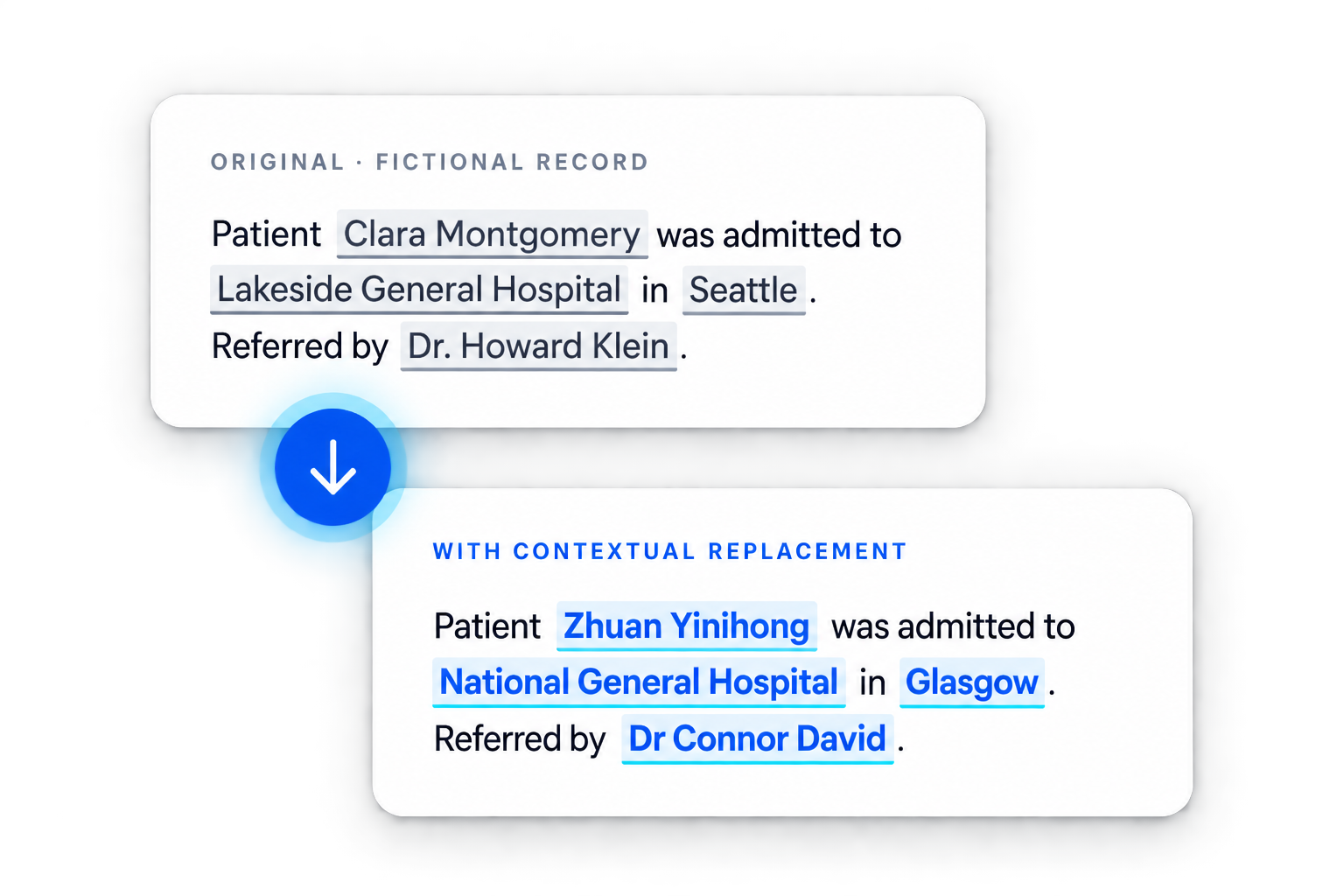
The most financially effective approach to data breach risk is reducing the value of the data an attacker could access in the first place. Limina redacts and replaces personally identifiable information across structured and unstructured data, making the resulting datasets far less useful to malicious actors while preserving their analytical value to the organization.
This is not simply a theoretical benefit. The cost-per-record differential documented in the 2020 Ponemon/IBM report -- $150 per PII record versus $143 per anonymized record, and $175 versus $171 in a malicious attack -- reflects a real and quantifiable reduction in exposure when data is de-identified before a breach occurs. At scale, across tens or hundreds of thousands of records, that differential compounds into significant savings.
If your organization handles sensitive data in healthcare, financial services, pharma, insurance, or contact center operations, now is the time to assess your exposure. Talk to a Limina expert to understand how de-identification can reduce your risk profile before a breach forces the conversation.
The Bottom Line: Data Breaches Are Expensive, But They Don't Have to Be Catastrophic
There is no version of this story where data breaches become rare events. The frequency is increasing, the costs are rising, and the regulatory environment is tightening. The 2022 report documented a 2.6 percent increase in breach frequency over the prior year, and there is no structural reason to expect that trend to reverse.
What organizations can control is their preparedness. The evidence is clear: companies that have implemented incident response teams, AI-powered security infrastructure, and systematic risk quantification practices absorb breach costs that are materially lower than those of organizations that have not. The gap between "prepared" and "unprepared" is measured in millions of dollars -- and in some cases, in the organization's ability to continue operating at all.
De-identification is not a silver bullet. But it is one of the highest-return investments an organization can make in its data risk posture. It reduces the value of data to attackers. It limits regulatory exposure when breaches occur. It supports the kind of data inventory and classification that underpins meaningful risk quantification. And it does all of this without compromising the utility of the data for the business purposes that make it worth collecting in the first place.
Get in touch with Limina to learn how context-aware de-identification can become a foundational part of your data security strategy.