The Future of Health Data: How New Tech is Changing the Game
New technologies like ambient listening, wearables, and telemedicine are generating more patient data than ever before. Here is what that means for healthcare organizations and why turning that data into secure, actionable insights is now a strategic imperative.


The way healthcare organizations collect and use critical patient data is changing fast. From smartwatches to AI-powered clinical documentation, new technologies are transforming how health information flows, creating new opportunities for continuous monitoring, early intervention, and improved clinical outcomes. But with so many tools entering the space simultaneously, it can be difficult to separate the technologies that are genuinely reshaping care from the ones that are still finding their footing.
This article breaks down some of the most impactful new ways healthcare organizations are collecting health data and explores how they are beginning to leverage it, along with the significant challenge that sits at the center of it all.
How Is Health Data Collection Changing in Healthcare?
The short answer is: fundamentally. For most of modern medicine, health data collection was episodic. A patient came in for an appointment, a provider recorded observations and measurements, and that record became the basis for clinical decisions. The data was structured, standardized, and relatively easy to manage, but it was also limited to snapshots in time, often taken weeks or months apart.
Today, health data is being generated continuously, across a growing number of channels and devices, much of it outside the clinical setting entirely. This shift is not incremental. It represents a different model of care, one built on real-time, longitudinal data that can surface patterns and risks long before a patient ever walks through a clinic door.
Ambient Listening: Less Typing, More Care
Clinicians did not sign up to be scribes. Yet for years, the burden of documentation has consumed enormous amounts of their time and attention, pulling focus away from the patients in front of them. Ambient listening technology is stepping in to solve that.
Ambient listening "listens" to patient visits and automatically creates accurate summaries, generates billing and diagnostic codes, and drafts orders for labs, prescriptions, and follow-up appointments. The technology is designed specifically for healthcare environments, trained to understand medical terminology and clinical context. It goes beyond simple audio recording: it interprets the content and meaning of the dialogue, turning a natural conversation between a patient and provider into structured, actionable documentation.
The result is meaningful. Clinicians get more face time with patients and less time at the keyboard.
According to a survey led by the Medical Group Management Association (MGMA), 42% of medical group leaders are already using some form of ambient AI solution. However, the majority of those are using it simply for visit transcription or speech recognition, while only 29% use it for clinical note generation and 21% have deployed a full AI documentation assistant. At the same time, the vast majority of respondents, 80%, say they are very likely or somewhat likely to implement or update an ambient AI solution in the next 12 months.
This is not about replacing doctors. It is about giving them back the time and the focus they need to deliver better care. As Bob Murry, PhD, MD, FAAFP, chief medical officer at NextGen Healthcare, put it for MGMA: it saves time and mental energy, allowing providers to concentrate on the patient and the conversation.
Wearables and Smart Devices: Turning Daily Habits Into Health Insights
What used to live only in a clinic now lives on your wrist, or even in your toilet. From consumer wearables to smart home systems, a wave of accessible technologies is quietly reshaping how health data is collected, understood, and used.
Wearable sensors like smartwatches and fitness trackers have gone mainstream. Over a third of U.S. adults now use them, with 43% wearing them daily. These devices continuously gather real-time data including heart rate, sleep patterns, and activity levels. For patients managing chronic conditions like diabetes or heart disease, this creates a stream of digital biomarkers, quantifiable insights into their day-to-day health that simply did not exist in a traditional care model.
Rather than relying on isolated readings from a ten-minute doctor visit, providers can now access a richer, continuous view of how a patient is actually functioning outside of the clinical setting. This kind of data does not replace medical expertise or the clinical exam; it adds meaningful context to it. In many cases, it also encourages patients to seek care earlier than they otherwise would. And according to the same research, nearly 80% of wearable users say they are willing to share that data with their healthcare providers to help drive better outcomes.
Are Smart Home Devices the Next Frontier for Health Monitoring?
Health tracking is no longer limited to what you wear. Smart home devices are entering the picture, often collecting useful health signals without the user having to do anything at all.
Researchers at the University of Waterloo used data from ecobee smart thermostats, combined with AI algorithms from the UbiLab Public Health Surveillance Platform, to successfully monitor sleep, physical activity, and sedentary behavior in participants. The results were comparable to those from traditional, resource-intensive surveys conducted by public health agencies, suggesting that passive data collected from everyday home devices can serve as a meaningful proxy for clinical-grade behavioral health information.
The innovation does not stop there. Smart toilets capable of analyzing urine and stool offer non-invasive ways to monitor hydration, nutrition, and gut health, while radar technologies originally developed for defense applications are now being adapted to track vital signs without wires or physical contact.
These passive systems mark a significant shift toward home-based monitoring, where health data is collected naturally from the environment rather than through deliberate clinical intervention. The benefits extend beyond patient convenience. This type of data collection can be more cost-efficient, more scalable, and significantly faster in translating observations into clinical action, enabling more personalized care plans and more effective long-term progress tracking.
Taken together, these innovations point to a clear directional shift: health data collection is moving closer to the patient and farther from the clinic. Whether the signal comes from a wrist, a thermostat, or a bathroom fixture, the goal is the same: equipping providers with high-quality, real-world data that supports more proactive and personalized care.
Virtual Visits, Real Impact: How Is Telemedicine Changing Health Data?
Healthcare is no longer limited to in-person visits. Patients now interact with their providers through screens, sensors, and digital touchpoints, whether it is a telemedicine appointment, a chatbot, an online intake form, or a patient portal message.
Telehealth saw explosive 766% growth at the start of the COVID-19 pandemic. And it has not retreated. By early 2025, 83% of healthcare providers still support its use, and 82% of patients say they prefer a hybrid model that combines in-person and virtual care.
The reasons are practical: virtual visits save time, reduce logistical stress, and make it meaningfully easier to manage chronic conditions from home. For patients, the ability to check lab results, message a care team, or request a prescription refill from a single platform reduces friction and improves the likelihood of follow-through. For providers, the digital trail left by these interactions contains valuable patient-reported data that, when used effectively, can enhance care quality and inform clinical decisions.
Used well, this data becomes a powerful tool: fueling personalized care, continuous monitoring, and shared decision-making that meets patients where they actually are.
If you are looking to build compliant, AI-ready workflows around the health data your organization already collects, talk to the Limina team about how our de-identification solutions support healthcare organizations at every stage of that process.
The Challenge: What Happens When Health Data Becomes Unstructured?
Here is the problem at the center of all this innovation. Over 70% of physicians say they are drowning in data without the tools or standards to manage it. All of the powerful, patient-centered data generated by wearables, ambient listening, telemedicine, and smart home systems does not arrive neatly packaged in a standardized format. It arrives as text, audio, images, and unstructured sensor feeds. It is messy, inconsistent, and difficult to process at scale.
Unstructured data now makes up an estimated 80% of all health data. It lives in clinical notes, scanned documents, patient portal messages, imaging reports, chatbot transcripts, and the growing volume of content flowing in from new digital health sources. That data is rich with clinical insight, but it is locked behind layers of complexity that most traditional data tools were never designed to handle.
Why Is Unstructured Health Data So Difficult to Use Safely?
The challenge is not just technical; it is also regulatory. Healthcare organizations operating under HIPAA, and increasingly under GDPR and emerging state-level privacy frameworks, are responsible for protecting the personal health information embedded within that unstructured content. The problem is that unstructured data is especially difficult to de-identify reliably. Sensitive information does not always appear in predictable patterns. Names, dates, diagnoses, and relationships between entities can appear anywhere in a document, in any form, and context determines what counts as identifying information.
Most traditional approaches to this problem either strip away too much context in an effort to reduce risk, making the data less analytically useful, or fail to catch sensitive information that appears in non-standard forms. Neither outcome serves the organizations trying to unlock the value of their data while remaining compliant.
What Does Effective Health Data De-identification Look Like?
To make unstructured health data genuinely usable, organizations need to accomplish three things. First, they need to discover what sensitive content is embedded across their data, spanning text, audio, images, and structured records. Second, they need to configure de-identification that is intelligent enough to preserve the clinical context that makes the data valuable, not just remove obvious identifiers. Third, they need to transform that content into structured, AI-ready formats without losing the signal that matters.
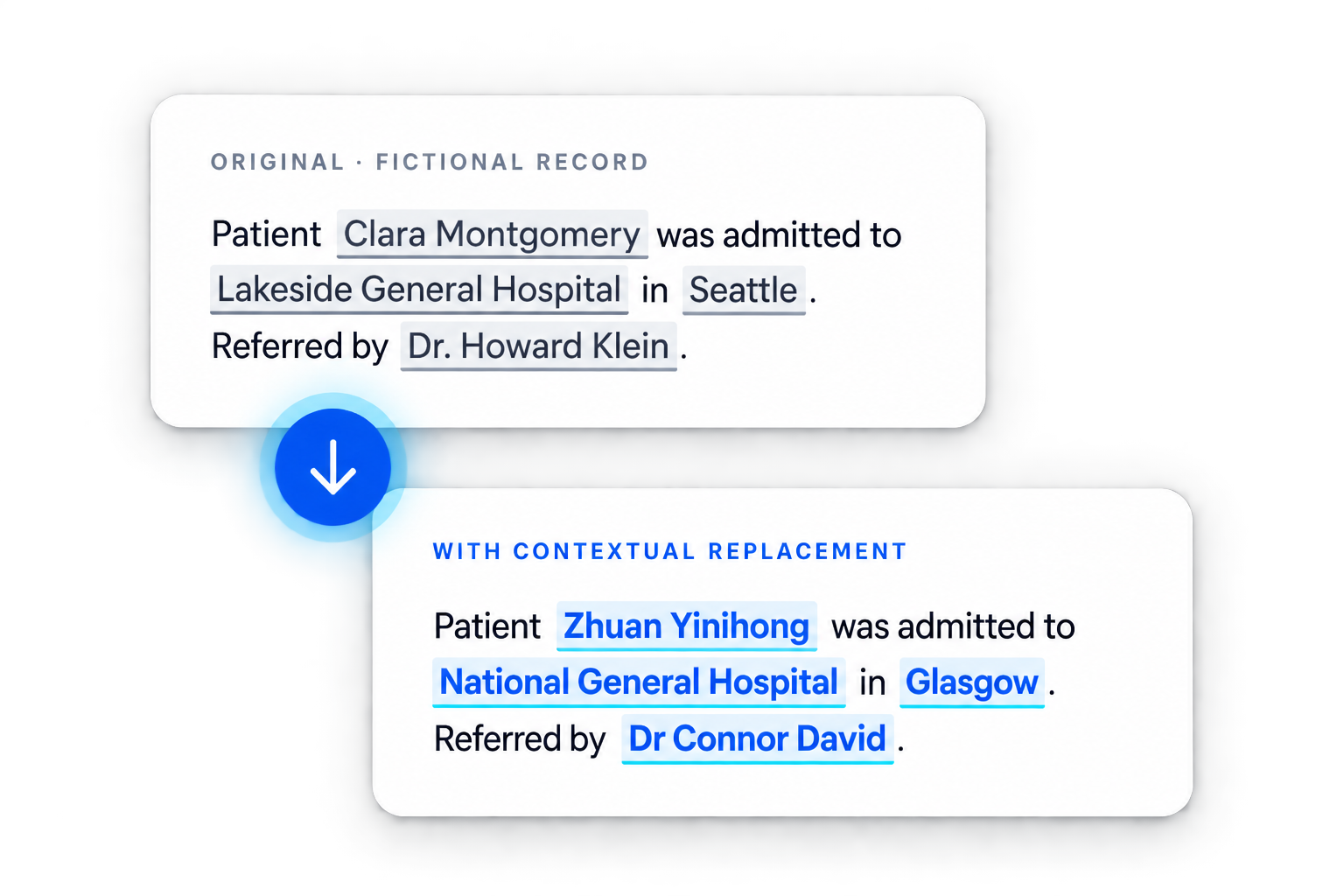
This is where the linguistic architecture of a solution makes a significant difference. Limina's data de-identification platform is built by linguists, which means it is context-aware in a way that purely pattern-matching approaches are not. It understands language nuances and entity relationships within documents, recognizing that the same word or phrase may be sensitive in one context and entirely benign in another. That distinction is critical when the goal is to preserve clinical utility while fully protecting patient privacy.
For organizations in healthcare and pharma and life sciences, this matters enormously. Clinical notes, trial documentation, patient histories, and research data all contain the kind of nuanced, context-dependent information that requires a linguistically grounded approach to de-identify accurately. The same holds true for organizations in financial services, insurance, and contact centers, where sensitive personal data arrives in similarly unstructured, conversational forms.
Why Does Data De-identification Matter Now?
The organizations that will lead the next chapter of healthcare are not simply the ones that collect the most data. They are the ones that can activate it. Making sense of unstructured health data is not just a compliance exercise; it is a strategic capability. Without it, healthcare systems risk missing earlier diagnoses, more effective treatment plans, and the research breakthroughs that come from being able to analyze large, diverse, real-world datasets at scale.
That is why more organizations are investing in data de-identification: AI-powered solutions designed specifically to extract value from unstructured health data without compromising security or patient trust. The future of healthcare is digital, and it is also increasingly unstructured. The organizations that figure out how to safely unlock that data will be the ones that define what care looks like over the next decade.
If your organization is ready to take that step, get in touch with the Limina team to learn how context-aware de-identification can help you move from data collection to data activation, compliantly and at scale.