Why is linguistics essential when dealing with healthcare data?
Healthcare data is messy, ambiguous, and deeply human. That's why de-identifying it correctly requires more than pattern-matching AI. It requires linguistics. Learn why Limina's linguistics-first approach produces more accurate, context-aware results for healthcare organizations working with sensitive unstructured data.

Clinical notes. Imaging reports. Lab results. Transcripts from patient conversations. This data is full of critical insights, but none of it fits neatly into rows and columns. It's unstructured, it's sensitive, it's messy, and according to Health Tech Magazine, it's growing by 137 terabytes a day.
When it comes to activating the value of that unstructured health data, a one-size-fits-all model simply doesn't work. You need systems that understand context, nuance, and ambiguity. You need more than algorithms. You need linguists.
At Limina, our linguistics-first approach means our technology is designed not just to read language but to understand it. Our data team includes experts in semantics, pragmatics, sociolinguistics, morphology, and syntax. These are people who have spent their careers decoding how humans actually use language, including all the ways meaning can shift based on context, structure, or dialect.
Healthcare data, in particular, has its own dialect. It's packed with shorthand, acronyms, telegraphic sentence structures, and specialized jargon. To unlock the value trapped inside it, and to de-identify it accurately, you first have to understand it.
What Makes Healthcare Data Different from Other Unstructured Data?
Most unstructured text follows relatively predictable patterns. Healthcare data does not. A physician's progress note might read like a series of fragmented observations. A discharge summary might compress weeks of care into a few terse paragraphs. A transcribed patient interview might be interrupted, unclear, or peppered with colloquialisms that no algorithm has ever encountered.
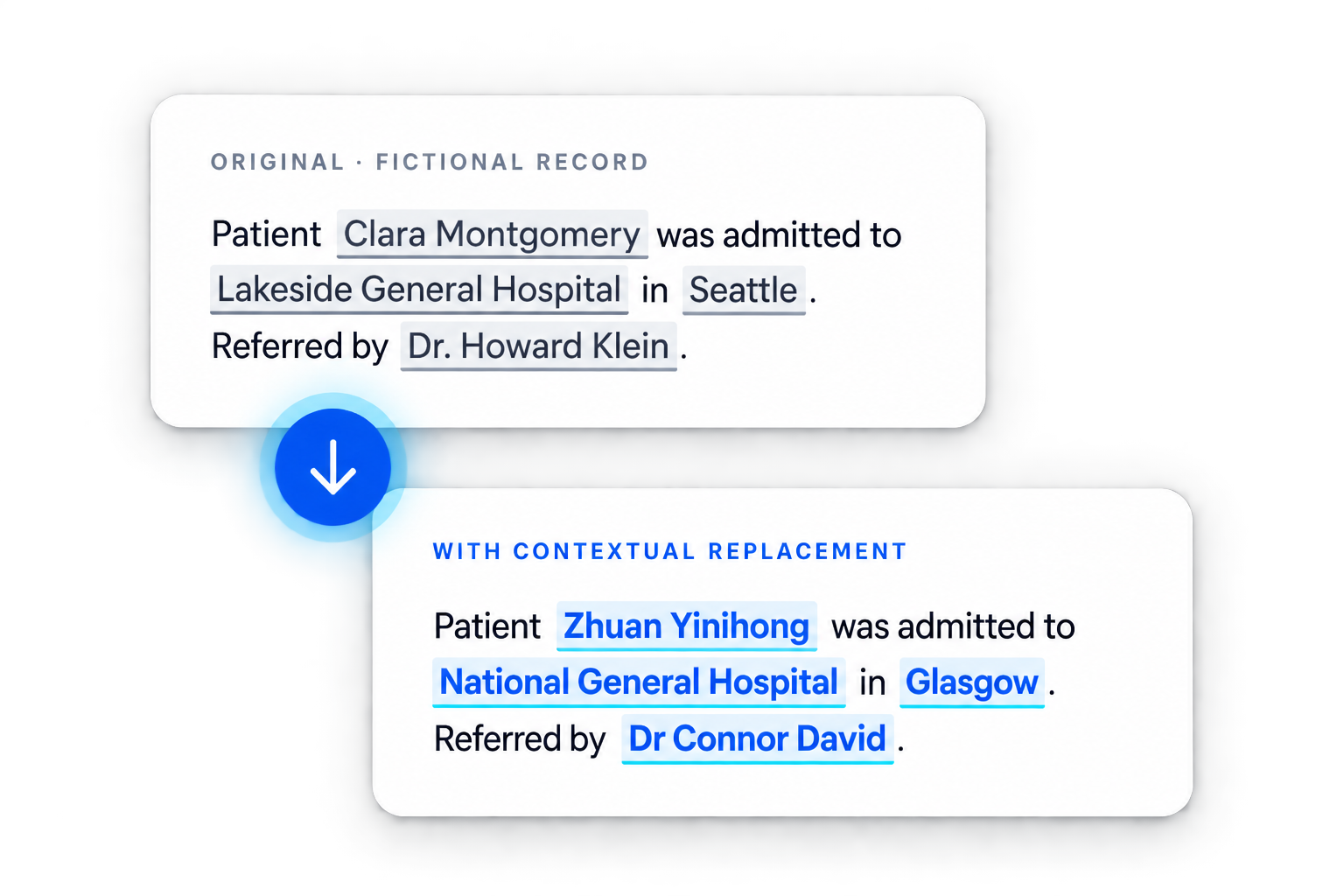
This is what makes healthcare data de-identification so technically demanding. It's not enough to scan for names, dates, and phone numbers in isolation. Protected Health Information (PHI) in clinical text is embedded in language that is contextual, relational, and often deliberately abbreviated. A system that doesn't understand that context will miss things. It will also over-redact, stripping out clinically meaningful information alongside the sensitive identifiers.
The stakes are significant. Errors in de-identification can expose healthcare organizations to HIPAA liability, compromise data quality for research, and erode patient trust. This is why the linguistics behind Limina's data de-identification platform are not an afterthought. They are the foundation.
Why Does Linguistics Matter in AI Training?
There's a meaningful difference between AI that is trained on language data and AI that is built with linguistic insight shaping every step of its development.
Most AI models are built by feeding large volumes of data into powerful algorithms to extract statistical patterns. That approach works reasonably well for many general-purpose tasks. But when the domain is healthcare and the data is unstructured clinical text, pattern-matching is not enough. The data is filled with nuance, ambiguity, and variation. It's not just about what is said. It's about how and why.
At Limina, our language experts are involved at every stage of model development, not just during initial training. They help select the right real-world examples to teach the AI, including common misspellings, informal abbreviations, and the kind of telegraphic shorthand that clinicians use under time pressure. They define and refine how information is labelled, ensuring the model correctly distinguishes whether a term refers to a condition, a treatment, a drug, or a process. They conduct detailed error analysis to understand not just what the model gets wrong, but why, and how to correct it systematically.
This continuous human oversight is what separates a linguistically grounded approach from a purely data-driven one. Limina's linguists don't just annotate text. They understand why certain errors occur and how to prevent them, whether the issue is a missed coreference, a misclassified entity, or a subtle shift in meaning caused by context.
How Does Linguistic Ambiguity Affect Healthcare Data De-identification?
The challenge of ambiguity is best understood through examples, and healthcare data is full of them.
Take the word "Graves." In a clinical note, it could refer to Graves' disease, a common thyroid condition. It could also be a patient's surname, or a physician's last name that should be retained in the record. A purely pattern-based model has no reliable way to know which it is without understanding the surrounding context.
"Pain" is another example. In most clinical situations it describes a symptom. But it can also appear as a family name. "Raynaud," "Crohn," and "Hodgkin" are all surnames that have become medical eponyms, making it impossible to distinguish their meaning without contextual awareness. And "R/o PE" means "rule out pulmonary embolism," not a sequence of random characters. A system that treats it as random characters has already failed.
This is the ambiguity that Limina's linguistic approach is built to navigate. Where conventional models encounter edge cases and fail, a linguistically trained system understands intent, structure, and the relationships between entities in the text.
The specific challenges our team has engineered solutions for include overlapping terms, where the same word functions as a symptom, condition, or person's name depending on placement and phrasing; clinical shorthand and jargon, where abbreviated terminology carries dense clinical meaning; messy transcripts from real doctor-patient conversations where speech is fragmented, interrupted, or contextually unclear; inconsistent date formats, where "03/07/22" may mean March 7th or July 3rd depending on geography; and identifying the correct referent for a name, determining whether it belongs to the patient and should be redacted, or to a clinician who should be retained.
None of these challenges are solvable with keyword matching or brute-force data volume. They require systems that understand how language works. That means they require linguists.
What Does Limina's Linguistics Team Actually Do?
Limina's linguists perform work that extends well beyond annotation. They curate high-quality, representative training datasets that reflect the full range of real-world clinical language. They design annotation guidelines rooted in linguistic theory, ensuring consistency and accuracy across labeling at scale. They conduct meticulous error analysis to refine model performance and identify systematic gaps. They research, develop, and test new capabilities like coreference resolution, which tracks when different words or phrases in a document refer to the same entity, and relation extraction, which maps the relationships between entities in complex clinical text.
Coreference resolution is particularly important in healthcare. A patient might be referred to as "Mr. Johnson," "the patient," "he," and "the 68-year-old male" all within the same clinical note. A de-identification system that misses any of these references will leave PHI in the document. Limina's linguistically grounded approach is built to track these references across the full span of a document, not just within individual sentences.
This combination of linguistic expertise and applied AI research is what allows Limina to deliver de-identification accuracy above 99.5% across more than 50 entity types and 52 languages. It's not the result of a larger dataset alone. It's the result of a smarter, more principled approach to teaching AI how language actually works.
If your organization works with sensitive clinical text and wants to understand what precision de-identification looks like in practice, speak with Limina's team to see it firsthand.
What Are the Real-World Benefits of Linguistics-First De-identification in Healthcare?
The practical implications of getting de-identification right are significant. Healthcare organizations are sitting on enormous volumes of unstructured data that could power faster diagnoses, smarter clinical trials, more personalized care, and real-world evidence generation. Most of that potential goes unrealized because the data is too sensitive to use and too complex to process accurately.
Linguistics-first de-identification changes that equation. It enables healthcare and pharma and life sciences organizations to extract meaning from physician notes with the clinical context intact, connect scattered patient data across trial populations, capture nuance and context in patient-reported outcomes that would otherwise be lost, and organize data from wearables, chatbots, and other emerging sources into AI-ready formats.
When linguistic precision is paired with AI's scale, the result is a system that doesn't just process data. It makes data usable. That distinction matters enormously for organizations that depend on secondary use of health data for research, product development, or care improvement.
Healthcare isn't the only domain where this applies. Limina's linguistic infrastructure also powers de-identification for financial services organizations, insurance providers, and contact centers where unstructured text carries significant sensitivity and regulatory risk. But the complexity of clinical language makes healthcare the domain where the difference between a linguistic approach and a purely computational one is most consequential.
Why Can't General-Purpose AI Models Handle Healthcare De-identification?
This is a question that comes up often, particularly as large language models have become more capable and more widely adopted.
General-purpose AI models are trained on broad internet data. They are reasonably good at understanding common language patterns. But healthcare de-identification requires domain-specific accuracy that general models cannot reliably provide. Clinical abbreviations, eponyms, specialty jargon, and fragmented documentation styles fall outside the distribution of general training data. When a general model encounters them, it makes mistakes, and in healthcare, mistakes carry real consequences.
There's also the question of what general models are optimized for. A model trained to generate fluent responses is not the same as a model trained to identify and classify sensitive entities in clinical text with high precision and recall. These are fundamentally different tasks that require fundamentally different training approaches.
Limina's approach was built specifically for the complexity of real-world sensitive data. It wasn't adapted from a general model. It was designed from the ground up with linguistic expertise embedded at every level.
Linguistics Is Not a Feature. It's the Foundation.
The healthcare industry is at a turning point. The volume of unstructured clinical data continues to grow, regulatory requirements around data privacy are tightening, and the potential value of secondary data use has never been higher. Capturing that value without compromising patient privacy requires tools that are genuinely equipped for the task.
At Limina, we believe you cannot transform health data without deeply understanding language. That's why our team of linguists does more than annotate. They engineer the intelligence behind our platform, ensuring that the AI we build reflects how real people use language in real clinical environments, with all the ambiguity, variation, and human complexity that entails.
AI is only as good as the people who shape it. And when the goal is to find meaning within complex, sensitive healthcare data, linguists are not just helpful. They are essential.
If your organization is ready to move from raw clinical data to AI-ready, privacy-compliant assets, get in touch with the Limina team to learn how we can help.